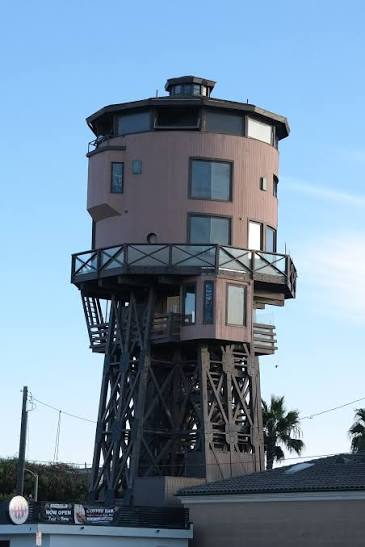
A California landmark that spent decades quietly supplying water to steam locomotives is back on the market, and the asking price says a lot about what a good origin story is worth in coastal real estate. The Seal Beach water tower turned four-bedroom house is listed at $5.5 million, more than a million dollars above what it sold for just a few years ago.
From railroad infrastructure to residence
The tower at 1 Anderson Street was built in 1892 to hold water for steam trains running the coastal route between San Diego and Santa Barbara, according to the property’s history as documented on Wikipedia’s entry on the structure. It sat unused for the better part of a century before a local math professor named George Armstrong took on the strange task of converting it into a livable home in 1985, dismantling the tower, building a three-floor structure inside its footprint, and raising the whole thing back up. The result stands 87 feet tall and is framed largely in redwood and fir.
What used to be industrial plumbing is now four bedrooms and four bathrooms spread across roughly 2,828 square feet, per CBS Los Angeles’s coverage of an earlier listing. The layout climbs through a spiral staircase to a rotunda level, with an elevator running alongside it for anyone who’d rather skip the stairs. CBS’s reporting also notes a fountain feature built into the entry foyer, a detail that’s stuck around through multiple sales as one of the house’s signature quirks, along with a pirate-themed bedroom with a large porthole window that nods to the property’s nautical setting along Pacific Coast Highway.
A view worth paying for
The wraparound deck delivers sweeping, unobstructed views up and down the Orange County coastline, and a second-floor Jacuzzi area was built specifically to take advantage of them. It’s the kind of vantage point you can’t manufacture on a standard lot, since the tower’s original height requirement for gravity-fed water pressure is exactly what now makes it valuable for an entirely different reason.
According to Surfer’s report from July 2025, the home last changed hands in 2022 for $4.5 million and was used primarily as a short-term rental afterward, generating income from vacationers drawn to the novelty as much as the ocean access. Listing agent John Simcoe is marketing the relisted property at $5.5 million, a jump of roughly $1 million from that 2022 sale price and about $550,000 above where the home was priced when it last hit headlines in 2021.
Why converted landmarks keep commanding a premium
Water towers, silos, and old fire lookouts occasionally turn up as unconventional home conversions, but few pull off the transition as completely as this one. Part of the appeal is scarcity: there’s exactly one historic water tower home in Seal Beach, and buyers shopping in this price range are often looking for something they can’t replicate by building new. A custom home with comparable square footage and views along the same stretch of coast would likely cost more to build from scratch than the tower is currently asking, once land and construction costs in coastal Orange County are factored in.
The other part is maintenance reality that doesn’t show up in listing photos. A structure built for holding water, not living space, requires ongoing attention to waterproofing, structural reinforcement, and code compliance that a typical single-family home never has to think about. Whoever buys it next is purchasing not just a house with a great view, but stewardship of a piece of railroad-era infrastructure that happens to double as a home.
What its sales history says about the market
Tracking the price across three transactions tells its own story about how Seal Beach’s coastal market has moved. The home asked $4.95 million in 2021, sold for $4.5 million the following year once negotiations settled, and is now testing whether buyers will pay a premium once again after several years of short-term rental income proved the property could pay for itself between owners. That pattern, list high, sell for less, then relist higher once the market catches up, isn’t unusual for one-of-a-kind properties that don’t have direct comparables sitting a few blocks away.
Local real estate watchers have pointed to the tower’s built-in marketing advantage: a house with this kind of backstory generates attention that a conventional listing never could, regardless of price point. Photos of the spiral staircase and rotunda level circulate well beyond typical real estate audiences, which tends to widen the pool of curious buyers even if most of them were never going to make an offer. Given how quickly interest tends to build around genuinely unique listings like this one, it likely won’t sit on the market long enough for the next relisting to feel like a surprise.
Leave a Reply