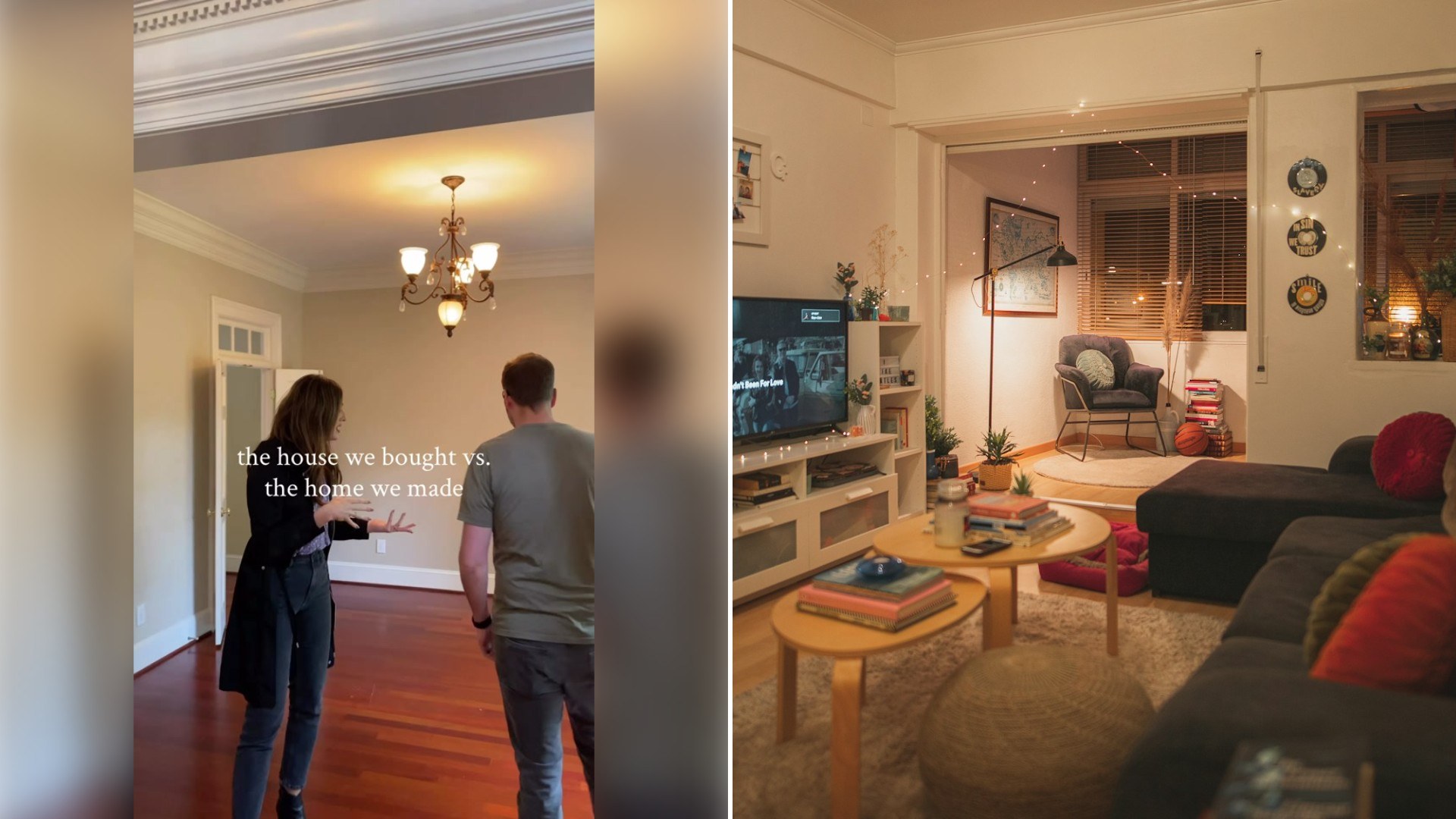
A well-known renovation couple shows a transition from a plain, empty room in the house as purchased to the same room fully renovated and styled, framing it with the line “the house we bought vs. the home we made” to show how homes evolve slowly into a reflection of the people living there. The video works less like a highlight reel and more like a short, honest documentary, the kind that earns its ending by actually showing the unglamorous steps that led there.
What distinguishes this clip from a typical before-and-after is the five-year gap the caption openly names, treating the transformation not as a single renovation project but as the slow accumulation of an entire half-decade of choices, repairs, and small decisions layered one on top of another.
@chrislovesjuliaHomes aren’t transformed over night. They evolve. And slowly become more and more a reflection of you. 5 years calling this house our home 🤎
As @chrislovesjulia shows it, the appeal isn’t really about the size of the number or the scale of the transformation on its own, it’s about the willingness to document the process honestly, warts and all, instead of only posting the polished result once everything was already finished.
The choice of “Everybody Loves Somebody” by Dean Martin as the soundtrack does specific work here that a trending pop song couldn’t replicate. A warm, nostalgic standard signals permanence and sentiment rather than novelty, reinforcing the caption’s own argument that this transformation is about accumulated time and feeling rather than a quick, trend-chasing redesign.
Five years is long enough that the couple’s own tastes, budget, and priorities almost certainly shifted multiple times over the course of the renovation, which is part of why the caption frames the house as something that “evolved” rather than something that was simply finished. A kitchen remodeled in year one reflects a different version of the homeowners than a primary bedroom finished in year four, even within the same overall project, and that internal shift is part of what the word “evolve” is doing in the caption.
Established renovation couples with an existing following face a specific challenge that a first-time renovator doesn’t: an audience that has already seen dozens of their transformations expects each new reveal to feel distinct rather than repetitive. Framing this particular room around a five-year emotional arc, rather than purely around the physical work, gives longtime followers a reason to engage beyond simply admiring another finished space, and it turns what could have been one more routine reveal into something that reads as a genuine milestone in the account’s own ongoing story.
The empty, unstyled starting point shown here carries its own kind of honesty that a lot of renovation content skips past. A plain room with no furniture or decor has nothing to hide behind, no clever styling trick to distract from the bones of the space, which makes the contrast with the finished room that much more legible to a viewer scrolling quickly, even one who has never set foot in the house in person.
Comment sections under long-arc renovation content like this one tend to gather a specific kind of response: not just reactions to the finished room, but reflections on how a viewer’s own home has changed over a comparable stretch of years, turning what started as a renovation reveal into something closer to a shared meditation on how long-term homeownership actually feels from the inside.
For anyone newer to a renovation project of their own, there’s a quiet reassurance built into a caption that explicitly says homes aren’t transformed overnight. It pushes back against the compressed, sped-up version of renovation that most short-form content shows, reminding viewers that the realistic timeline for a home to feel genuinely finished is measured in years rather than weekends.
There’s also a subtler point embedded in the phrase “a reflection of you” that separates this kind of content from a purely aesthetic renovation reveal. A room can be beautifully redone without ever feeling personal, chosen from a catalog rather than built around how a specific family actually lives, and the caption’s emphasis on reflection suggests the couple sees the distinction between a styled room and a lived-in one as the real measure of success.
For an established renovation account, revisiting the earliest, roughest version of a space years later also serves a practical archival purpose beyond sentiment. It gives new followers who only discovered the account recently a condensed entry point into the couple’s full journey, letting someone who’s never seen the original empty room understand, in a single clip, just how far the space and the people living in it have actually come.
The five-year timestamp also does something subtle to how viewers judge the pace of their own home projects. A renovation account that normally shows polished, sequential updates can inadvertently make viewers feel behind on their own slower projects, and naming the real elapsed time here pushes back against that distortion, giving an honest sense of scale to a process that usually gets compressed into a tidy highlight reel.
Whatever room this couple tackles next, the five-year framing here has already reset the baseline for what a “transformation” clip can mean, less a single dramatic reveal and more a running record of a home slowly catching up to the people who actually live in it.
Leave a Reply