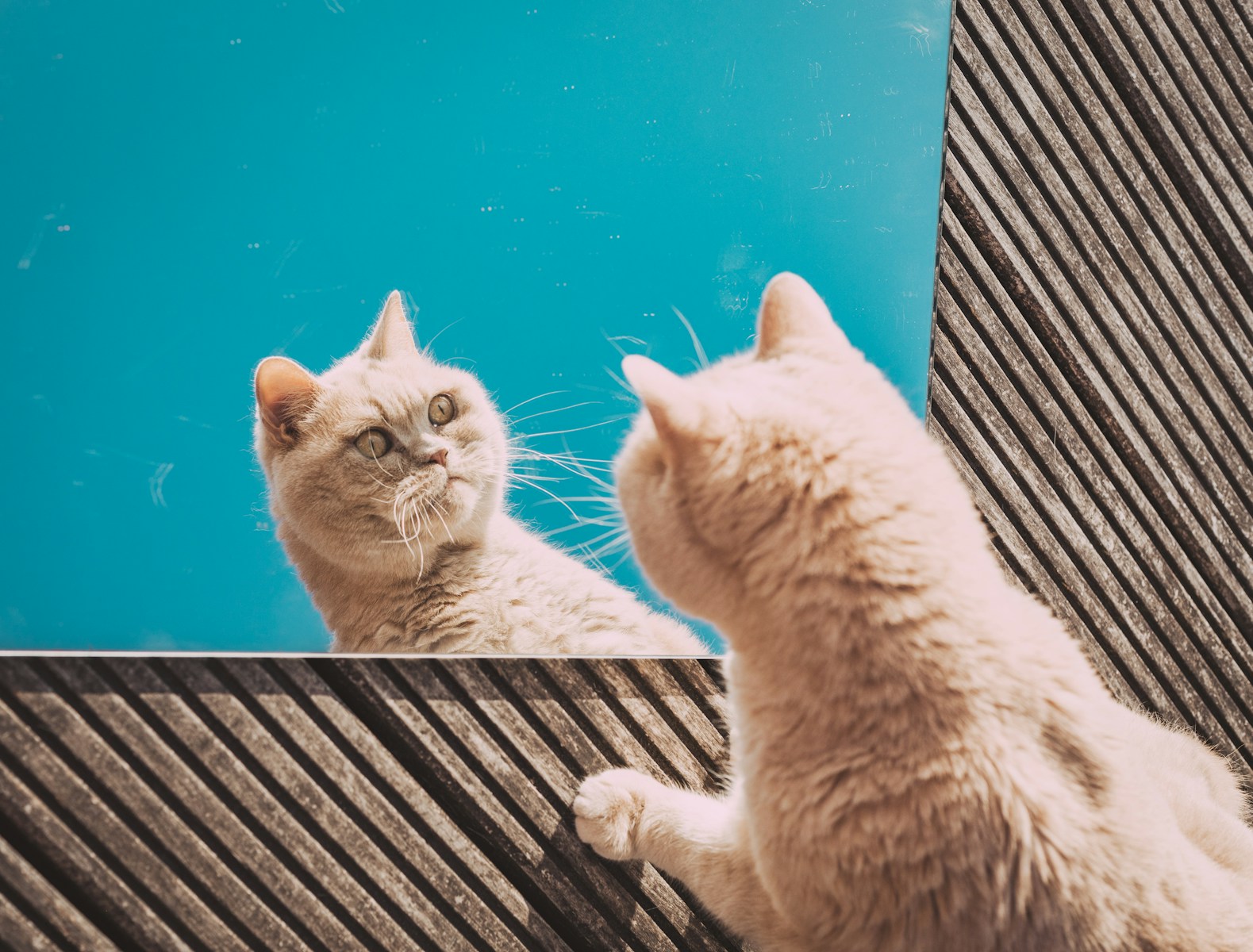
A cat that keeps launching itself at a hallway mirror is not being dramatic for social media, it is acting out a very real confusion between instinct and perception. When a veterinarian finally explains what is happening, the story turns from slapstick to a lesson in how feline brains process threats, territory and even their own reflection. Understanding that gap is the key to protecting both the glass and the animal behind the behavior.
Instead of a quirky one-off, repeated mirror attacks usually signal a predictable mix of hunting drive, social stress and sensory overload. Once owners see the pattern, they can swap frustration for practical steps that lower tension, redirect energy and make the mirror just another harmless object in the room.
The Viral Mirror Attack That Sparked Questions
In the typical viral clip, a young indoor cat spots movement in a full-length mirror, arches its back and then charges, paws splayed, at what it reads as an intruder. The scene is comic, but the body language is textbook: dilated pupils, puffed tail and rapid tail flicks that signal a cat on high alert rather than a pet playing for laughs. To the animal, the hallway has just been invaded by a silent stranger that copies every move, which is exactly how a territorial species is wired to interpret a lifelike reflection.
Owners often describe the pattern as escalating, with the cat returning to the mirror again and again, hissing, swatting and sometimes even urinating nearby as if to mark the area. That cycle reflects how strongly a healthy adult cat prioritizes territory and social hierarchy, especially in confined indoor spaces where every doorway and corridor matters. What looks like a slapstick routine is, in behavioral terms, a serious attempt to defend home turf from what the animal believes is a rival.
What The Vet Saw That Owners Missed
When the cat in that scenario finally lands in the exam room, the veterinarian is not just checking for scratches on the nose or cracked claws. The first task is to read the emotional state behind the mirror lunges, from the stiffness of the spine to the way the cat scans the room for exits. Many clinicians now frame the behavior as a stress response layered on top of normal curiosity, a sign that the animal is struggling to reconcile what it sees with what it smells and hears.
One veterinary professional, Maja, who is described as enthusiastic about volunteer work and neutering projects for stray animals in Greece, has emphasized that figuring out why a cat is fixated on a mirror largely depends on the individual animal’s temperament and environment. In her view, some cats will try to play with the “other” feline, while others will attempt to flee or fight the other feline that appears in the glass, a pattern she links to broader social and territorial dynamics in multi-cat homes and crowded shelters where she works in Greece. That clinical lens shifts the story from a quirky habit to a signpost of how secure or threatened the cat feels in its daily life.
Why Cats Do Not Recognize Themselves
At the heart of the mirror drama is a simple neurological fact: most domestic cats do not recognize their own reflection as “me.” When they see a moving image that looks like a cat, their brain files it under “other animal,” not under self, which is why the reflection can trigger stalking, play bows or outright aggression. Researchers and behaviorists have long noted that cats fail classic self-recognition tests, such as ignoring a mark on their fur that is only visible in the mirror, a pattern that aligns them with many other mammals that rely more on scent than on sight to identify individuals.
One behavioral explainer puts it bluntly, stating that Cats Don Recognize Themselves when they look in a mirror, and that when they see their reflections, they interpret the image as another cat that may or may not pose a threat. Here, the mismatch between visual input and the absence of any confirming scent or sound keeps the animal in a loop of investigation and alarm. Until the cat has enough calm, repeated exposure to decide that the “stranger” never advances, never smells like anything and never makes a sound, the reflection remains a puzzle that can tip into conflict.
From Curiosity To Conflict: The Territorial Trigger
For many cats, the first encounter with a mirror is tentative, a cautious approach with ears forward and whiskers relaxed as they test whether the image will move independently. The shift from that curiosity to full-blown conflict usually happens when the cat reads the reflection’s posture as challenging, such as when it sees its own arched back or sideways stance and interprets it as a rival squaring up. Because the reflection copies every aggressive signal in perfect sync, the cat never receives the calming cues that would normally defuse a standoff with a real animal.
Veterinary behavior guidance notes that territorial instincts are especially strong in indoor cats that have limited control over their environment and few outlets for natural patrol routines. In that context, a mirror placed near a doorway or food station can feel like an invasion of core territory, prompting the cat to scratch, swat or even body-slam the glass in an attempt to drive the “intruder” away. Maja has pointed out that in some households, the same cat that tries to play with a reflection in one room will try to fight the other feline it sees in a different mirror, a sign that location and perceived ownership of space matter as much as the reflection itself, according to her behavioral explanations.
Scratching, Swatting And The Meaning Behind The Claws
Once a cat has decided that the mirror hides a rival, the claws come out, literally. Scratching at the glass is not random vandalism, it is a mix of scent marking, visual signaling and stress relief. Cats have scent glands in their paws, so every rake of the claws across a surface leaves both visible marks and chemical information, a way of saying “this spot is mine” to any other animal that might pass by. On a mirror, the scent sticks even if the scratches do not, which helps explain why some cats return to the same panel of glass day after day.
Veterinary behaviorists like Maja, who has extensive experience with stray and shelter animals, stress that scratching can also be a displacement behavior, a way for a cat to channel frustration when it cannot reach or control the perceived opponent behind the glass. She has described cases where a cat will first try to interact with the “other” feline, then escalate to attempts to flee or fight the other feline when the reflection fails to respond, a pattern that often leaves long streaks of claw marks on nearby walls and furniture as well as on the mirror itself, according to her case discussions. For owners, those claw marks are a visible record of an invisible social battle the cat believes it is fighting.
How Vets Like Maja Decode The Behavior
When a mirror-obsessed cat arrives at the clinic, professionals such as Maja do not treat the glass as the root problem, they treat it as a trigger that reveals deeper stressors. Her background in neutering projects for stray animals in Greece gives her a front-row view of how cats negotiate crowded territories, scarce resources and constant exposure to unfamiliar animals. That experience informs her approach in private homes, where the same instincts play out in smaller, more polished spaces that happen to include reflective surfaces.
She has explained that figuring out the answer to why a particular cat is scratching or attacking a mirror largely depends on a structured assessment of the animal’s daily routine, social contacts and health status. In some cases, the mirror fixation is one symptom in a broader pattern of anxiety that includes overgrooming, hiding or redirected aggression toward other pets. In others, it is a short-lived phase that fades once the cat has enough positive experiences in the room to decide that the “other” feline is irrelevant. By mapping those patterns, Maja can recommend targeted changes, from altering room layouts to adjusting play schedules, a process she has outlined in her guidance for owners who are trying to decode similar behaviors at home.
Why Some Cats Ignore Mirrors Completely
Not every cat stages a showdown with the hallway mirror. Many glance at their reflection once, sniff the frame and then lose interest forever, a contrast that can puzzle owners who expect a universal reaction. Behavior specialists point out that individual differences in confidence, socialization and sensory priorities all shape how a cat responds to a reflection. A well-socialized adult that has met many other animals and humans may be less likely to treat a silent, scentless image as a real threat, especially if the mirror is in a low-stakes area of the home.
There is also the question of learning. Some cats appear to go through a brief phase of batting at the glass or peering behind it, then gradually stop as they gather evidence that the “other” cat never moves independently, never smells like anything and never blocks access to food, water or resting spots. Behavioral explainers that note how When cats see their reflections they initially interpret them as other animals, also emphasize that many eventually decide the image does not pose a threat. For those individuals, the mirror becomes background scenery, no more interesting than a blank wall.
Practical Ways To Calm A Mirror-Fixated Cat
For owners living with a cat that still charges the glass, the priority is to lower arousal and restore a sense of safety. Vets often recommend starting with environmental tweaks, such as moving mirrors away from doorways, food bowls and litter boxes so they do not sit in the middle of key territorial routes. Covering a problem mirror temporarily with a sheet or repositioning it so it reflects neutral areas instead of the cat’s favorite resting spot can also reduce perceived intrusion.
At the same time, increasing structured play with wand toys, puzzle feeders and climbing structures gives the cat healthier outlets for its hunting and territorial drives. By scheduling interactive sessions before the times of day when the cat usually fixates on the mirror, owners can preempt some of the pent-up energy that fuels the attacks. If the behavior persists or escalates, a veterinary checkup is essential to rule out pain, vision changes or neurological issues that might make reflections more confusing or threatening, a step that professionals like Maja, who has extensive experience with stressed and stray animals, consistently highlight in their advice.
What The Mirror Attacks Really Mean About Your Cat
Once the glass is cleaned and the claws are trimmed, the deeper meaning of a cat’s mirror attacks comes into focus. The behavior is not a sign of vanity or stubbornness, it is a window into how the animal experiences its home as a living territory filled with potential allies and rivals. A cat that repeatedly confronts its reflection is broadcasting that it takes its role as guardian of that space seriously, and that it is willing to invest energy and risk in defending what it believes is its own.
For owners, the veterinarian’s explanation reframes the viral spectacle as a call to pay closer attention to stress, enrichment and social dynamics in the household. The mirror is only the stage; the real story is the cat’s attempt to make sense of a world where sight, scent and sound do not always line up. By responding with empathy, environmental changes and, when needed, professional guidance from experts like Maja, who brings insights from her work with stray populations in Greece to domestic cases, people can turn a running battle with a reflection into an opportunity to build trust and security for the animal that started it.
More from Willow and Hearth:
Leave a Reply