For months, a 55-year-old widow in upstate New York chose to sleep beside her husband’s grave rather than in a shelter bed, clinging to the last place that felt like home. Her vigil in a historic cemetery ended only when a campus police officer and a nearby college stepped in, offering not just a roof but a path back to stability.
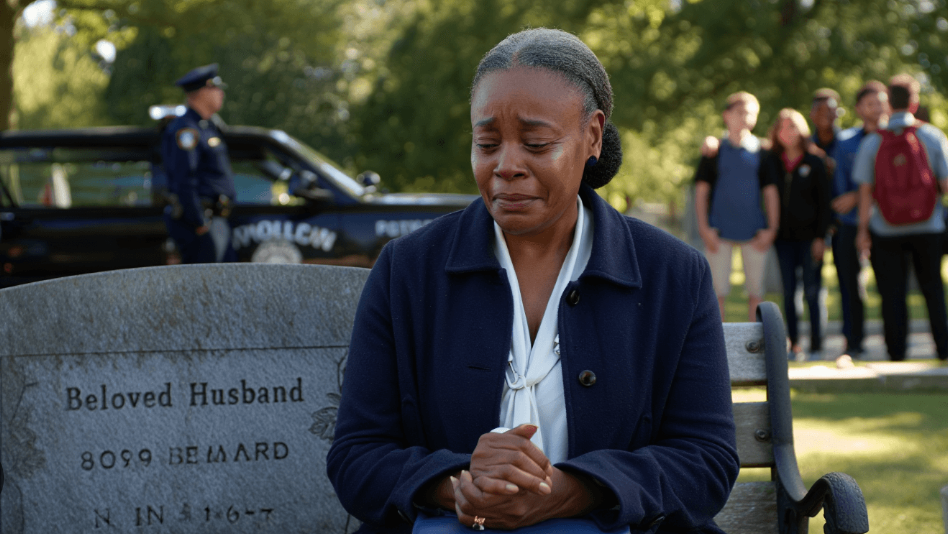
The story of how a local Jesuit institution opened a vacant house to her, and how one officer refused to walk away after a welfare check, exposes both the depth of one woman’s grief and the gaps in the safety net that left her there. It is also a rare, concrete example of what can happen when individuals and institutions decide that “simply the right thing to do” is not just a slogan but a plan.
The Cemetery That Became Home
The woman at the center of this story is Rhea Holmes, a 55-year-old widow who began sleeping in Syracuse’s Oakwood Cemetery after losing her housing. For months, she laid her blankets directly on the grave of her husband, Eddie Holmes, refusing to leave the spot where his name was carved in stone. The cemetery, a sprawling, tree-lined burial ground on a hill above the city, became the unlikely setting for her nightly routine, as she tried to stay warm, dry, and close to the man she had loved for almost two decades.
Holmes did not describe her presence there as a stunt or a protest, but as a last resort that felt emotionally inevitable. She had purchased the burial plot as part of the couple’s plans for the future, and when everything else fell away, she saw the grave as the one thing she still owned. In her telling, she “just stayed there,” returning night after night to the same patch of ground in Oakwood Cemetery because it felt safer than the streets and more meaningful than a cot in a crowded shelter.
A Marriage Cut Short and a Financial Freefall
The path that led Holmes to that hillside began years earlier with the death of her husband, Eddie Holmes, whose loss shattered both her emotional world and her finances. The couple had been together for almost 20 years, building a life in Syracuse that included a modest home and shared plans for retirement. When Eddie died unexpectedly, the shock left her reeling, and the income he had provided disappeared overnight, setting off a chain reaction that she struggled to stop.
According to accounts of how Rhea Holmes ended up in the cemetery, grief quickly bled into depression. Left with little money and little left to live for, she lost her job and then her home, unable to keep up with rent once Eddie’s support was gone. The downward spiral was not immediate, but once it took hold, she found herself making impossible choices about which bills to pay and which possessions to keep, until eventually there was nothing left to sell and nowhere left to go.
Choosing a Grave Over a Shelter
When the eviction finally came, Holmes faced a decision that many people in crisis confront: whether to enter the shelter system or try to survive on her own. She chose the cemetery, a choice that might seem unfathomable from the outside but made sense to her in the fog of grief. She had already invested what little she had in the burial plot, telling an interviewer that “this is what I purchased,” and she saw sleeping there as a way to stay connected to Eddie while avoiding the chaos she feared in shelters.
Holmes described how, after losing everything, she slipped into a deep depression that made it hard to navigate bureaucratic systems or advocate for herself. She was too overwhelmed to manage paperwork or appointments, and the idea of lining up for a bed among strangers felt intolerable. As one account put it, she was left with little and little will to keep going, so she gravitated to the one place that still felt like it belonged to her: the grave she had chosen for Eddie and, eventually, for herself.
Life Among the Headstones
Night after night, Holmes settled in among the headstones, arranging her belongings so she could sleep as close as possible to Eddie’s marker. She endured rain, wind, and freezing temperatures, relying on layers of clothing and makeshift bedding to get through the dark hours. The cemetery’s quiet paths and towering trees offered a measure of privacy, but they also underscored how isolated she had become, living among the dead while the rest of the city went about its business below.
Visitors and staff at Oakwood eventually noticed that the same woman was there at all hours, not just during the day when mourners typically come to pay respects. Some grew concerned as they realized she was not simply visiting but effectively living at the gravesite, and their unease led them to contact police. By the time officers arrived to check on her, Holmes had already spent months in that limbo, caught between her attachment to Eddie’s resting place and the reality that a cemetery is not meant to be anyone’s home.
The Officer Who Refused to Walk Away
When Syracuse police officer Pastorello responded to the call about a woman sleeping in the cemetery, he could have treated it as a routine trespassing or welfare check. Instead, he listened as Holmes explained why she was there and what she had lost, and he decided that simply moving her along was not an acceptable outcome. He later described his response as “simply the right thing to do,” a phrase that captured his belief that compassion sometimes requires going beyond the minimum required by policy.
Pastorello and a fellow officer took immediate, practical steps, pooling their own money to pay for a hotel room so Holmes would not have to spend another night outside. They understood that this was only a stopgap, but it bought time to look for a more stable solution. As one account of how a police officer helped her find a home noted, Pastorello and his colleague did not see Holmes as a problem to be removed but as a neighbor in crisis, and that shift in perspective changed everything that followed.
A Jesuit College Steps In
Recognizing that a few nights in a hotel would not solve Holmes’s homelessness, Pastorello began reaching out to contacts in the community, looking for anyone who might have a spare room or a vacant property. A friend ultimately connected Pastorello to Linda LeMura, the president of Le Moyne College, a Jesuit institution on a hill not far from the cemetery. When she heard about Holmes’s situation, Linda did not hesitate, offering temporary housing in a vacant home owned by the college near campus.
Within a day of that introduction, Holmes was offered a place to stay in the college-owned house, a quiet property that had been sitting empty while students were away. According to reporting on how she was helped, Within that short window, the trajectory of Holmes’s life shifted from sleeping on frozen ground to having a bed, a kitchen, and a front door she could lock. Le Moyne’s decision was framed as an extension of its Jesuit mission, a concrete expression of the idea that caring for vulnerable neighbors is part of the college’s identity, not an optional extra.
From Gravesite to Campus Housing
For Holmes, moving into the college-owned house was more than a change of address; it was a psychological jolt that reminded her she was still part of the living world. She went from arranging blankets on a grave to unpacking her few belongings in a real bedroom, with heat, running water, and a sense of privacy she had not felt in months. The house, located near the Jesuit campus, gave her a base from which to begin addressing the practical tasks she had been too overwhelmed to face, such as replacing documents, seeking medical care, and exploring longer term housing options.
Accounts of her story emphasize that the offer from Le Moyne College was not open-ended but was designed as a bridge, giving Holmes time to stabilize without the immediate pressure of rent. A friend had connected Pastorello to Linda LeMura, and the college president described the decision to house Holmes as something that was “in our DNA,” a reflection of the school’s values. For Holmes, that institutional generosity translated into something very tangible: a warm bed, a safe neighborhood, and the first real chance in a long time to imagine a future that did not end at the cemetery gate.
Grief, Race, and the Edges of the Safety Net
Holmes’s experience also highlights how grief and structural inequities can intersect to push someone to the margins. She is a Black New York woman who, after being evicted from her home, made a home at her late husband’s gravesite after losing everything, a detail that underscores how race and economic vulnerability often compound each other. Her story has been framed as that of a Black New York a Home at her Late Husband’s Gravesite After Losing Everything, a stark description that captures both the intimacy of her grief and the extremity of her circumstances.
Holmes herself has spoken about how depression sapped her ability to navigate systems that might have helped, leaving her too drained to fill out forms or advocate for services. The fact that she ended up in a cemetery rather than a shelter is not just a personal quirk but a sign that the existing safety net did not feel accessible or safe to her. In that sense, her months among the headstones are a case study in how people can fall through the cracks, even in a city with social services, until someone like Pastorello intervenes and reframes the situation as a shared responsibility rather than an individual failure.
A Local Story With Wider Resonance
Holmes’s rescue has resonated far beyond Syracuse because it combines elements that are both deeply personal and broadly familiar: a sudden death, a financial collapse, a woman in midlife who finds herself without a home. Coverage has emphasized that she is 55, a detail repeated in summaries that describe how a local college offered housing to a woman, 55, who was living in a cemetery after her husband’s unexpected death. One such account noted that Rhea Holmes, 55, said she never imagined she would end up sleeping outdoors, let alone in a graveyard, but that she felt she had no other choice.
Her story has been shared widely on social media and in national outlets, often framed as an example of how institutions can respond creatively when confronted with human suffering. One feature highlighted the phrase Local College Offered to a Woman Who Was Living in a Cemetery After Her Husband’s Unexpected Death, a formulation that captures both the desperation of her situation and the specificity of the response. The attention has turned Holmes into an unwitting symbol of both the fragility of middle age security and the possibility of community-driven solutions.
What Comes Next for Rhea Holmes
Holmes’s future is still unfolding, but the move into college-owned housing has given her a platform from which to rebuild. She has spoken about wanting to honor Eddie’s memory not by remaining at his graveside forever but by finding a way to live that reflects the love they shared. In one conversation, she recalled how the offer on their former home had finally been accepted and how, in the same breath, she learned that Eddie had died, a cruel convergence she summarized with the words, “The offer got accepted. And that same day your husband died. Yes.” As she put it, “So Rhea took the down payment and spent it on a cemetery plot,” a decision captured in a So Rhea clip that has circulated widely.
More from Willow and Hearth:
Leave a Reply