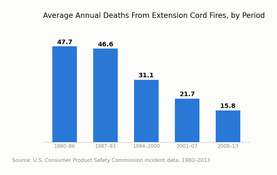
Extension cords are behind an estimated 3,300 home fires, roughly 50 deaths, and about 270 injuries every year, according to the U.S. Consumer Product Safety Commission’s own fact sheet on extension cord safety. The same document puts the total higher once you count non-fire incidents: nearly 4,000 people a year end up in the emergency room because of extension cords, mostly from tripping, with a startling share of pediatric burns from kids biting into a live plug. Zoom out and cords are one piece of a bigger electrical picture: the Electrical Safety Foundation International puts total home electrical fires at roughly 51,000 a year, causing about $1.3 billion in property damage. None of this is really about defective cords. CPSC’s own incident review found the annual death toll from extension cords has fallen for decades, from an average of nearly 48 deaths a year in the early 1980s to under 16 a year by 2013, a trend the agency links to tighter UL 817 safety standards rather than luck. The mistakes that still cause the remaining fires are strikingly repetitive, and every one of them is avoidable in about the time it takes to plug in a lamp.
Daisy-Chaining Cords and Power Strips
Plugging one extension cord into another, or feeding a power strip through a cord instead of straight into the wall, is the single fastest way to push a circuit past what any one piece of it was rated to carry. Every connection adds resistance, and resistance means heat building up somewhere you can’t see it. CPSC’s fact sheet is direct on this point: never link cords together and never plug a power strip into an extension cord. If a cord won’t reach, the fix is a longer cord rated for the load, not two shorter ones taped together.
Running Cords Under Rugs or Through Doorways
A cord’s insulation is designed to shed heat into open air. Bury it under a rug and that heat has nowhere to go, while foot traffic slowly works cracks into the jacket that you’ll never see coming. A cord pinched in a door or window frame fails the same way, just faster, since the metal edge does the damage a rug does more slowly. CPSC’s list of leading causes of extension cord fires names damaged insulation right alongside short circuits, overloading, and general misuse. The rule of thumb is boring but it works: keep cords visible, along a baseboard, never underneath anything you’d walk on.
Skipping the Wattage Math
A standard 16-gauge indoor extension cord on a typical 13-amp, 120-volt circuit tops out around 1,560 watts. A single space heater can eat well over half of that by itself, and most portable heaters are rated between 750 and 1,500 watts on their own. Add a couple of lamps and a phone charger and you’ve quietly loaded a cord meant for convenience past what it can handle without anyone flipping a breaker to warn you first. The math takes thirty seconds: add the wattage printed on the back of every device sharing that cord, and if the total gets close to what the cord’s label allows, unplug something or run a second circuit instead. It’s worth doing before you plug in the last thing on a cord, not after the plate on the wall starts feeling warm to the touch.
Using the Wrong Cord for the Job
Indoor and outdoor cords aren’t interchangeable, and it isn’t a marketing distinction. Outdoor-rated cords carry heavier insulation built to handle moisture, UV exposure, and temperature swings that an indoor cord’s jacket was never designed for, which matters most exactly when you need one outside for a pressure washer, string lights, or a pump. A cord degrades fastest right at the point it’s misused, which is exactly why CPSC’s guidance keeps circling back to matching the cord’s rating, gauge, and environment to the job rather than grabbing whatever’s closest in the garage. Coiling a cord too tightly while it’s in use adds another failure point most people never think about, since a tight coil traps heat the same way a rug does.
What connects all four habits is that none of them look dangerous in the moment. A power strip chained to an extension cord looks like problem-solving. A cord tucked under a rug looks tidy, not risky. The long decline in CPSC’s own fatality numbers suggests the danger was never really about the cord itself failing on its own; it’s about how invisible these small, compounding choices stay right up until an incident report turns one of them into a statistic. Buying a better cord helps, but reading the wattage label on the one you already own helps more.
Leave a Reply