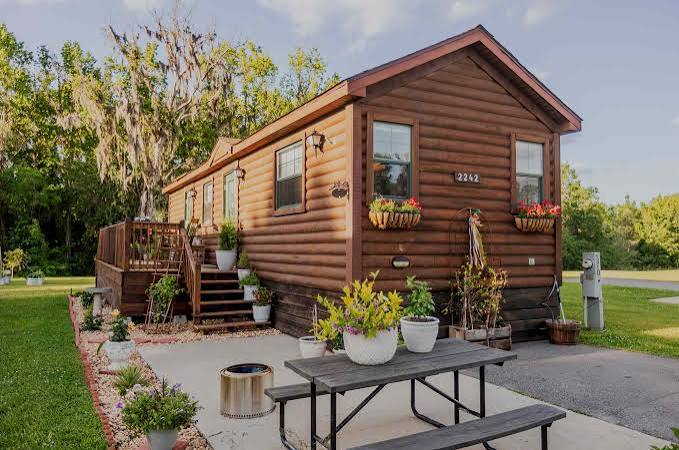
Grace and Jacob Kocher paid $53,375 for a 540-square-foot cabin that Disney World no longer wanted, and their room-by-room documentation of turning it into an actual home hasn’t stopped making the rounds online since. The cabin started life in 1998 as a guest unit at Disney’s Fort Wilderness Resort in Orlando, one of hundreds the company began phasing out and selling off to the public as it updated the property.
Buying a decommissioned piece of Disney World
Disney periodically retires cabins at Fort Wilderness as it renovates the resort, and rather than demolishing every unit, the company has sold a number of them to buyers willing to haul the structures off-site, according to reporting on the phenomenon from outlets including the Disney Food Blog, which has tracked the sales as they’ve popped up on resale sites and Facebook Marketplace. The Kochers found theirs listed there and bought it sight-unseen in large part on the strength of the story attached to it, then arranged to have it transported to land they owned. Cabins of this era were built log-cabin style with cedar trim and wood paneling, meaning what they were buying looked far more like a rustic guest cottage than a mobile home, even though moving it required the same kind of specialized transport.

Renovating in Florida heat, without air conditioning
The couple did the bulk of the renovation work themselves, tackling it during Florida’s summer without the benefit of air conditioning while the cabin’s systems were being reworked, with occasional help from family and friends, according to coverage of the project from AOL and Travel+Leisure. Rather than gutting the cabin and starting fresh, they kept as much of its original character intact as they could, preserving vintage furniture pieces and the rustic wood paneling while quietly upgrading the appliances, wiring, and plumbing to something built for full-time living rather than a week-long resort stay. That balance, old bones with modern guts, is a big part of why the renovation has resonated with people well beyond the usual Disney fan communities.
Public coverage of the Kochers’ project, including a separate write-up from CNBC published in late 2024, confirms the purchase price and the cabin’s 1998 construction date, and the couple has continued sharing updates on their renovation on social media as work has progressed. Since buying it, they’ve turned the 540-square-foot footprint into their full-time residence, a scale of downsizing that would be a significant adjustment for most households and made even more unusual by the cabin’s theme-park pedigree.
Why a $53,000 cabin keeps finding new audiences
Part of the draw is straightforward math: in a housing market where starter homes routinely run well into six figures, a renovated 540-square-foot home for roughly $53,000 plus renovation costs represents a genuinely different path into homeownership, even if it requires skills, land, and tolerance for a serious DIY project that most buyers don’t have. Tiny home searches and small-space renovation content have both grown steadily as a category, and a cabin with an actual Disney résumé sits at the exact intersection of both trends plus a story that’s easy to share in a single video clip.
The Kochers aren’t the only buyers who’ve picked up a retired Fort Wilderness cabin. Disney has sold off enough of them over the past couple of years that a small secondary market has developed among people specifically hunting for one, with wildly different outcomes depending on how far a buyer had to transport their unit and how much structural work it needed once it arrived. Some have ended up as guest houses, others as full-time residences like the Kochers’, and at least one has reportedly traveled as far as the Grand Canyon area before being set up again. What ties the renovations together on social media is less the cabins themselves and more the appeal of watching something explicitly built to be temporary get a second life as somebody’s actual home.
The unglamorous part nobody skips
None of this happens without logistics that rarely make it into the highlight clips. Moving a structure built as permanent resort housing means arranging oversized-load transport, securing permits along the route, and having a foundation or pad ready at the destination before the cabin ever arrives. Buyers also inherit whatever condition decades of guest turnover left behind, from worn flooring to plumbing sized for a weekend stay rather than daily use, which is exactly the kind of unglamorous work the Kochers had to get through before their cabin looked anything like a finished home.
That gap between the charming end result and the grinding middle is probably why the renovation keeps circulating instead of fading after an initial wave of attention. A viral before-and-after only tells half the story; the parts that make people stick around for updates are the smaller decisions, which original fixtures were worth saving, how to insulate a structure never meant for year-round weather, where to compromise between preserving character and making the space livable. Those are the kinds of questions any renovation project eventually runs into, Disney provenance or not, which may be the real reason the Kochers’ cabin has found an audience so far outside the theme-park fan base it started with.
Leave a Reply