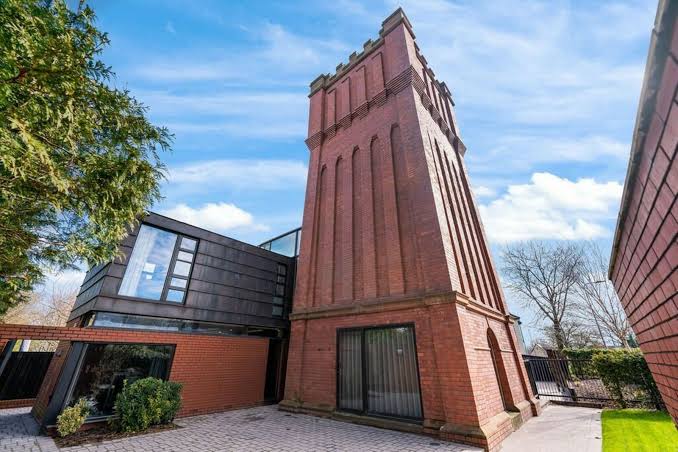
A water tower built in the 1800s has been transformed into a $3.7 million home in the UK, and the conversion kept the one architectural quirk that most buyers would consider a headache: every room still follows the round shape of the original tank. According to Robb Report, the structure’s 19th-century industrial bones are now the whole selling point.
Water towers were never designed with human comfort in mind. They were built to hold enormous volumes of water high above the surrounding landscape, which meant thick walls, minimal windows, and a cylindrical shape dictated entirely by engineering, not aesthetics. Turning one into a livable, let alone a luxury, home requires working with that geometry rather than against it, and the results tend to look like nothing else on the market.

Curves Where Corners Usually Go
That’s exactly the appeal here, per the Robb Report listing. Instead of squaring off the interior with conventional framing, the renovation preserved the round footprint of the original tank throughout the home, meaning bedrooms, living spaces, and everything in between curve rather than corner. It’s a layout that would be a nightmare to furnish with standard rectangular furniture, and also exactly the kind of eccentric detail that gets a historic conversion attention in a market full of identical new builds.
Adaptive reuse projects like this one occupy a strange corner of the real estate world. They’re rarely the cheapest option, since retrofitting a structure never meant for daily living, plumbing, insulation, windows, load-bearing considerations, tends to cost more than starting from scratch. But buyers willing to pay for one aren’t shopping for efficiency. They’re shopping for a story, a piece of industrial history that can’t be replicated, and a home that photographs like nothing else in the listings.
The UK has no shortage of decommissioned water towers, and a growing niche of architects and developers have made a business out of turning them into residences, often preserving the exterior silhouette while gutting and rebuilding the interior. This particular conversion, at $3.7 million, sits at the higher end of that niche, reflecting both the scale of the original structure and the craftsmanship required to make round rooms genuinely livable rather than just novel.
For a certain kind of buyer, that novelty is precisely the draw: a home that started life holding drinking water for a town, now holding a mortgage instead, with every curved wall a reminder of what it used to be.
Leave a Reply