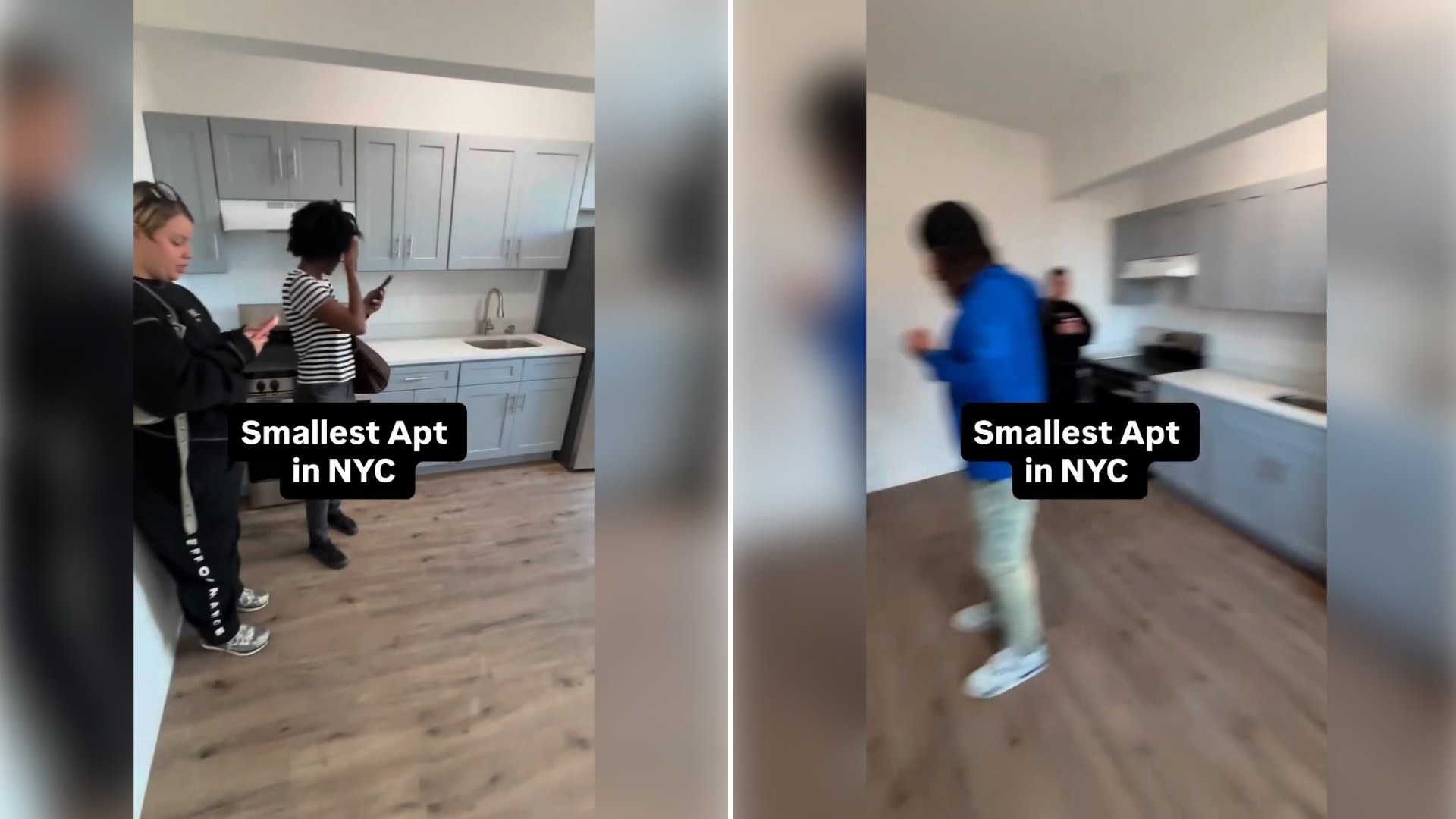
The door opens onto what can only be described as a sliver of a room, and the reaction is immediate. Standing just inside the threshold of one of New York City’s smallest studio apartments, a man’s face does most of the talking before he even gets a word out, a mix of disbelief and dark amusement at what’s technically being marketed as a place to live. He steps carefully through the space, as if measuring it with his own body, because there’s barely enough room to do anything else.
Throughout the walkthrough, he keeps up a steady stream of skeptical commentary, pointing out just how little floor space separates one wall from the other, questioning where a bed would even go, and wondering aloud who exactly this apartment was designed for. It’s less a real estate tour and more a slow-motion reaction video, the kind where the apartment itself becomes almost a supporting character in his growing disbelief. By the time he reaches what passes for a kitchen area, his tone has shifted from surprised to nearly incredulous, especially once the price tag being asked for the space enters the conversation.
View this post on Instagram
Videos like this one tap into a very specific and very widespread frustration, the sense that housing costs in major cities have detached almost entirely from what’s reasonable given the size and quality of what’s being offered. As @vince_nyla418 demonstrates by simply walking through the door and letting his face do most of the reacting, sometimes the most effective commentary on an absurd housing market doesn’t need much narration at all, the space speaks for itself the moment the camera pans across it.
New York City in particular has developed something of a cultural shorthand around impossibly tiny apartments commanding impossibly large rents, a phenomenon rooted in genuinely unique constraints. Land in dense urban cores is limited and expensive, older buildings were often subdivided decades ago into smaller units to maximize the number of tenants a landlord could house, and demand from people determined to live in specific neighborhoods, close to work, transit, or a particular lifestyle, remains high enough that even the smallest units rarely sit vacant for long. The result is a market where square footage and price can feel almost unrelated to each other, something that consistently shocks people who are used to housing markets in smaller cities or more spread-out suburban areas, where the same rent might cover triple or quadruple the space.
For anyone actually apartment hunting in a market like this, videos like this one, however entertaining, double as a useful gut check before signing a lease. Real estate professionals who work in dense urban markets often advise renters to calculate a true cost-per-square-foot figure before committing to any listing, since a lower total rent number can sometimes mask a genuinely worse value than a slightly higher rent attached to a much larger unit. It’s also worth physically visiting a space, or at minimum reviewing a detailed floor plan with actual measurements, rather than relying on photos alone, since wide-angle lenses are notoriously good at making cramped rooms look far more spacious than they actually are in person.
There’s also a broader psychological adjustment that seems to be at the heart of why videos like this one strike such a chord. Living in an extremely small space requires a completely different relationship with belongings and daily routines than living in a more conventional apartment, one where storage has to be vertical and multipurpose, where furniture often needs to fold, stack, or serve more than one function, and where the concept of “extra space” essentially doesn’t exist. Some renters genuinely thrive under those constraints, treating the challenge almost like a minimalist lifestyle experiment, while others find the trade-off simply isn’t worth it no matter how central the location. What this walkthrough captures so well, in the end, isn’t really about one apartment or one price, it’s the very real tension so many city dwellers navigate between wanting to live somewhere central and vibrant and being asked to accept less and less physical space in exchange for that privilege.
That tension isn’t likely to resolve any time soon, and videos like this one function as a kind of ongoing public record of how it’s playing out in real time, one absurd listing at a time. For viewers outside major cities, the appeal is partly voyeuristic curiosity, but for anyone actually weighing a move into a market like New York’s, there’s genuine value in seeing the unfiltered reality before signing anything. A few extra minutes spent watching someone else’s disbelief play out on screen is, in the end, a far cheaper education than discovering the same disbelief firsthand after the lease is already signed.
It’s also worth remembering that reactions like the one caught on camera here are a genuinely valuable filter for other renters scrolling past. A video that plainly shows both the size of a space and the cost attached to it, without softening either detail, gives viewers a more honest reference point than most curated listing photos ever will, letting them calibrate their own expectations against someone else’s real, visible reaction rather than a polished marketing description written specifically to make a small space sound charming rather than cramped.
Leave a Reply