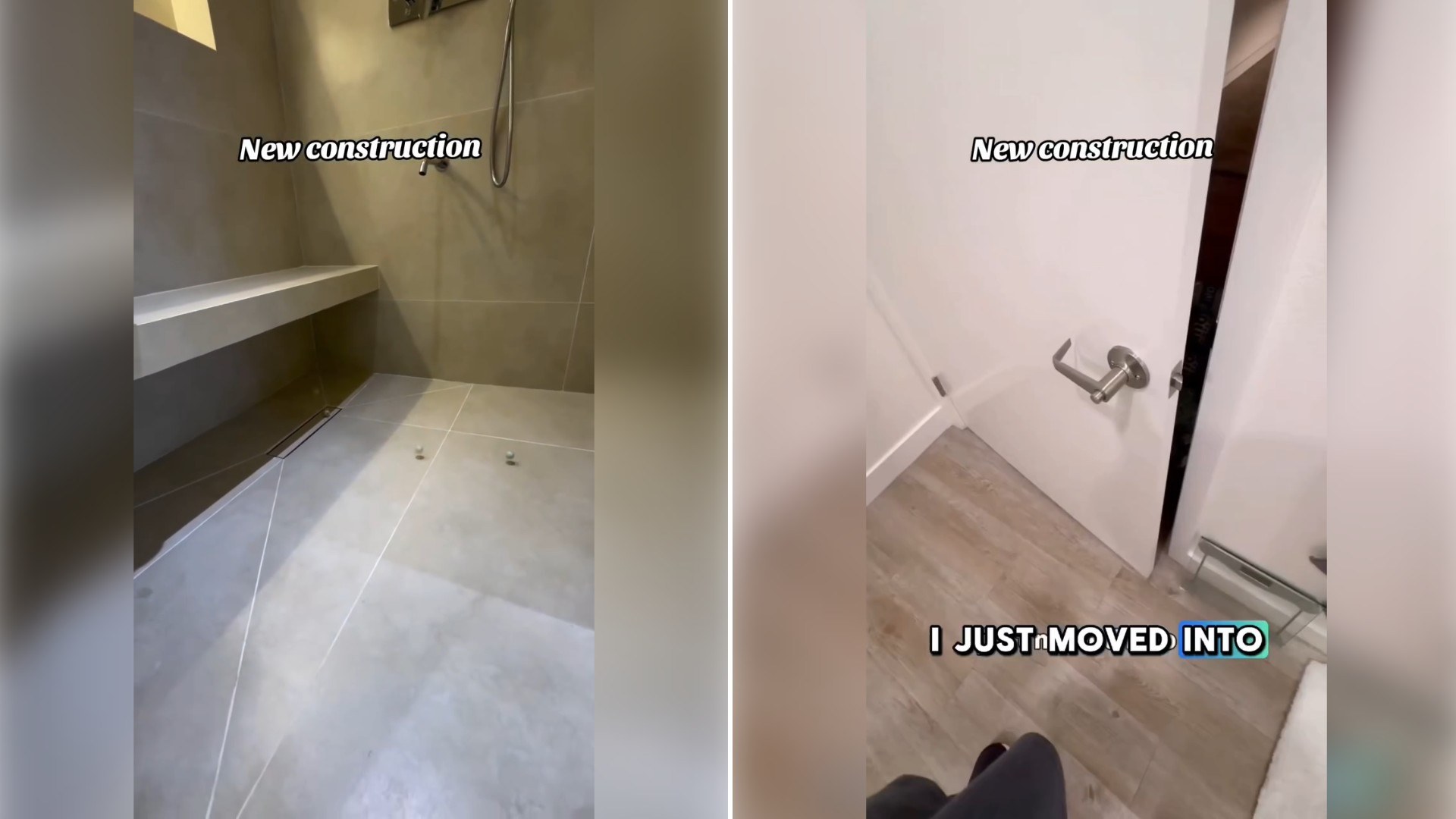
On the surface, everything about the bathroom looked exactly the way a brand-new, $800,000 home should look: clean tile, fresh caulking, a faucet that had probably never been touched before that morning. That’s precisely what makes the next few seconds of the video so unsettling. After turning on the faucet, the homeowner picks up a UV flashlight, and the moment the beam sweeps across the wall, the illusion of a flawless new build starts to crack.
What the light reveals isn’t visible to the naked eye under normal lighting, a scattering of stains across the walls that had gone completely undetected until that exact moment. The reaction on camera is a mix of disbelief and quiet frustration, the kind that comes from realizing a major purchase, one made with the expectation of getting something entirely new and untouched, might be hiding problems that no walkthrough or inspection had caught. The caption drives the point home simply and bluntly: even a brand-new construction home, priced well into six figures, can hide real problems that only surface once someone knows exactly where and how to look.
Part of what makes this kind of reveal so effective is the contrast it draws attention to. New construction is marketed, understandably, on the promise of a fresh start, nothing worn, nothing inherited from a previous owner’s habits or mistakes. As @theinspiration_guy shows by simply flicking on a UV light in his own bathroom, that promise of newness doesn’t always hold up once tools designed to reveal what’s hidden get introduced into the equation, and that gap between expectation and reality is exactly the kind of moment that tends to stop people mid-scroll.
UV flashlights have become a genuinely popular inspection tool among homeowners and renters alike, largely because certain organic residues, including some bodily fluids, certain cleaning chemical residues, and specific types of mold or mildew, fluoresce or glow under ultraviolet light in ways they simply don’t under ordinary household lighting. Hotel guests have used the trick for years to check mattresses and bathrooms before settling into a room, and the same logic applies just as well to a newly built or newly purchased home, where a stain left behind during construction, a plumbing mishap, or an installation error might otherwise stay hidden behind fresh paint and grout for years.
For anyone about to move into a new build or a newly renovated space, this kind of low-cost, low-effort inspection is worth adding to a pre-move checklist. A basic UV flashlight is inexpensive and widely available, and running it across bathroom walls, behind toilets, along baseboards, and inside cabinets before fully moving belongings in can catch issues while there’s still time to raise them with a builder or seller. It’s also worth pairing a UV check with a simple sense-based inspection: running every faucet and shower to check water pressure and look for slow drainage, opening and closing every window and door to check for proper sealing, and checking under sinks for any sign of past leaks that may not be immediately obvious.
There’s a broader lesson here too about what “new” actually guarantees, and what it doesn’t. New construction reduces the likelihood of certain problems, outdated wiring, old plumbing materials, decades of accumulated wear, but it doesn’t eliminate the possibility of human error during the build process itself. Construction crews move through homes quickly, often juggling multiple projects at once, and small mistakes, a pipe not properly sealed, a spill never fully cleaned, can slip through even a generally solid build. Buyers and renters alike are often encouraged to treat a final walkthrough not as a formality but as a genuine last chance to catch what a rushed inspection might have missed, bringing along tools like a flashlight, a level, and yes, even a UV light, rather than relying purely on a visual glance and a builder’s assurance that everything is in order. What this video ultimately captures, beyond the shock of the reveal itself, is a reminder that due diligence doesn’t end the day the keys are handed over, and that sometimes the most valuable home inspection tool costs less than twenty dollars and fits in a kitchen drawer.
There’s also a quieter takeaway here about the limits of appearances generally, one that extends well beyond home inspection. A surface that looks flawless under normal lighting isn’t necessarily flawless, it simply hasn’t been examined under the right conditions yet. That same logic applies to plenty of other purchases and decisions people make on the basis of a quick glance rather than a closer look, and videos like this one serve as a small, memorable reminder that a little extra scrutiny, applied at the right moment, tends to be far cheaper than dealing with a hidden problem after it’s already been lived with for months.
It’s a lesson that extends well past bathrooms and UV lights, too. Anyone who has ever been surprised by a hidden issue after signing a contract, accepting a job, or trusting a first impression can relate to the specific discomfort of realizing that “looks fine” and “is fine” are not always the same thing. The homeowner in this video simply happened to have the right tool on hand to prove the point visually, but the underlying instinct, to look a little closer before assuming everything is exactly as it appears, is one worth carrying into far more decisions than just a bathroom inspection.
Leave a Reply