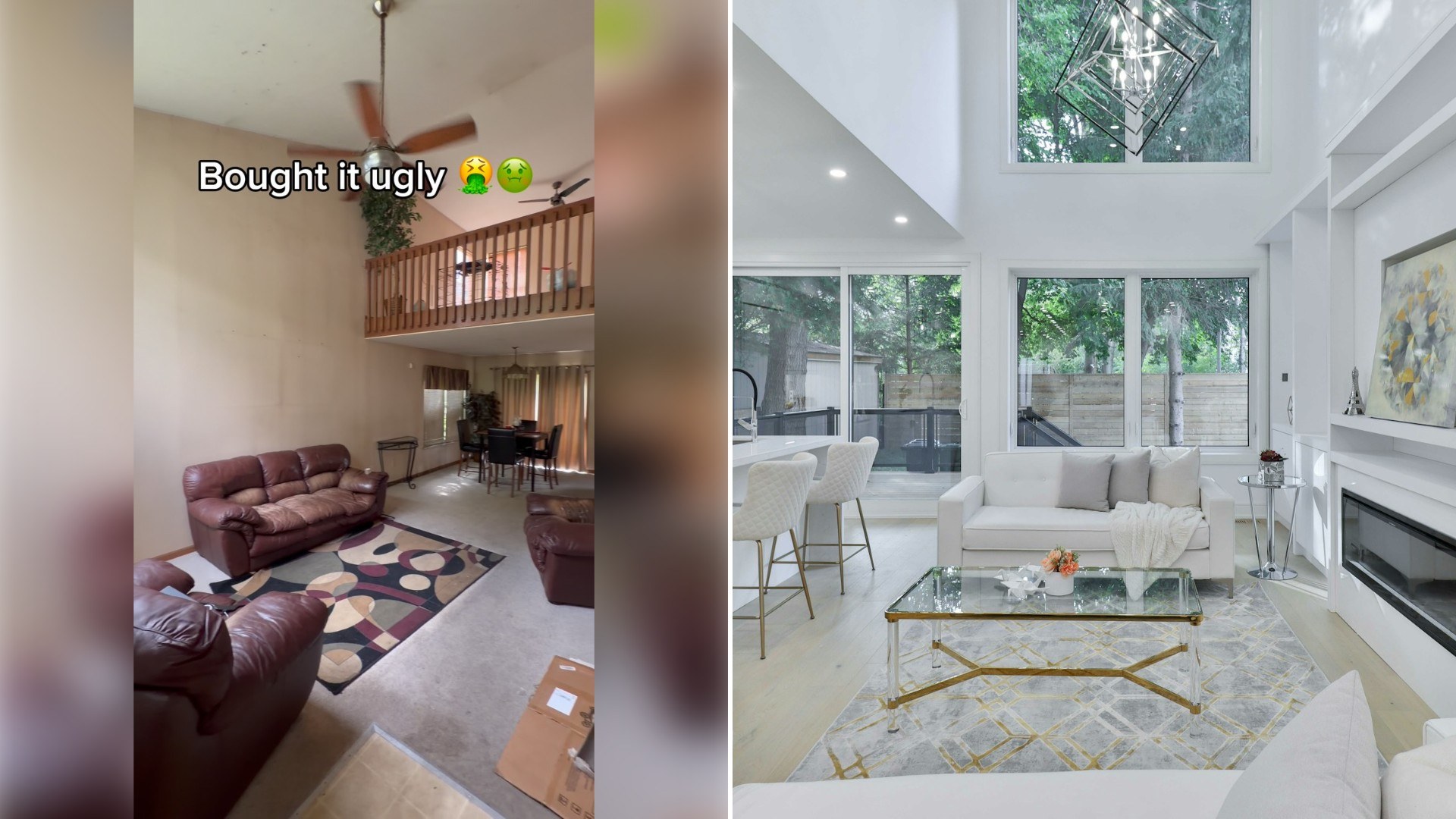
A house flipper walks through a cluttered, dated property he bought, then cuts to the fully renovated, staged version after spending $63,000 on the flip. The reel intercuts messy “before” shots of the same rooms with their polished “after” counterparts, emphasizing the scope of the transformation. The caption frames it as turning something bought “ugly” into a modern, market-ready home. The $63,000 figure is doing most of the narrative work: it is precise enough that anyone with even a passing sense of renovation costs can immediately gauge the scale of the undertaking, instead of being left to eyeball it from the footage alone.
What the before shots capture isn’t neglect so much as accumulated dated choices, carpet that belonged to an earlier decade, cabinetry that had simply outlived its finish, light fixtures that did the room no favors. None of it reads as damage. It reads as a property that time passed by while the market around it kept moving, which is exactly the kind of starting point that makes a flip’s math work in the first place.
View this post on Instagram
Flipping accounts live or die on whether they can make a dollar figure feel earned rather than asserted, and @flip_with_nithin leans into that by pairing the $63,000 number directly against rooms viewers can actually see, rather than quoting a total budget and cutting straight to a finished listing photo. That pairing is what lets a viewer do their own rough math in their head as the clip plays.
There’s a particular kind of credibility that comes from a flipper being willing to show the worst room in the house rather than cherry-picking the one space that photographed best. A kitchen with cabinetry that clearly needed replacing, a living room with carpet that had seen better decades, these aren’t flattering shots, and including them anyway signals that the $63,000 wasn’t spent papering over a problem but genuinely addressing one.
Sixty-three thousand dollars sits in a particular zone for flip budgets: large enough to cover more than cosmetic work, small enough that it still reads as a disciplined renovation rather than a blank-check gut job. Viewers who follow flipping content tend to have a rough internal sense of what that kind of money typically buys, and a number in this range tends to land as believable rather than suspicious.
The structure of the video, before footage first, then the reveal, isn’t an accident of editing. It mirrors how a buyer actually experiences a flipped property in real life, walking in cold with no context, then only learning the backstory afterward from a listing agent or a curious neighbor. Recreating that sequence for viewers is part of why the format keeps getting reused across the flipping niche.
Comment sections on flip content like this tend to fixate on the number itself, people guessing at purchase price, arguing about whether $63,000 was enough or too much for the scope shown, debating what they would have prioritized differently. That argument is itself a form of engagement the creator benefits from, since it keeps people parsing the video rather than scrolling past it.
What’s notable about this particular flip is how little of the $63,000 story depends on a single showstopping feature. There’s no marble island or dramatic skylight carrying the whole transformation. Instead the number is spread across a dozen smaller, less glamorous fixes, the kind of unglamorous allocation that flippers with real experience tend to recognize immediately, even if casual viewers skim past it.
Whether this particular house sells quickly or sits on the market, the clip has already accomplished something separate from the sale itself: it turned a routine flip into a piece of content specific enough that strangers with no connection to the property still wanted to watch the whole thing play out.
It’s worth pointing out how much restraint went into not inflating the story further. A $63,000 renovation isn’t a small sum, but it also isn’t the kind of figure that would make headlines on its own. The creator didn’t need to round it up, dramatize the purchase price, or frame the project as some once-in-a-lifetime discovery. The number was simply allowed to be what it was, and that plainness is arguably why it reads as credible rather than performative.
Flipping content also carries an implicit argument that a lot of viewers respond to without necessarily articulating it: that an ugly house is not a dead end but a starting point, provided someone is willing to put in both the money and the time to see it through. For an audience that scrolls past countless polished listing photos every week, a video built entirely around the gap between a property’s worst version and its best version offers something those listings can’t, a visible record of the labor in between.
The pacing of the edit matters here too. Rather than dumping all the before shots up front and all the after shots at the end, the reel threads them room by room, which keeps the $63,000 figure attached to specific, visible changes instead of letting it float as an abstract total. A viewer watching the kitchen transform doesn’t just see a nicer kitchen, they see a portion of that budget accounted for in real time.
There’s also a quieter lesson in here for anyone eyeing their own fixer-upper: the properties that look the most discouraging in person are sometimes the ones with the clearest, most straightforward path to a return, precisely because so little about them is subtle or structural. Dated finishes are expensive to look at but often cheap to fix relative to the alternative, which may be part of why a flip like this one can hit a number like $63,000 and still land as a smart, well-run project rather than a financial stretch.
Leave a Reply