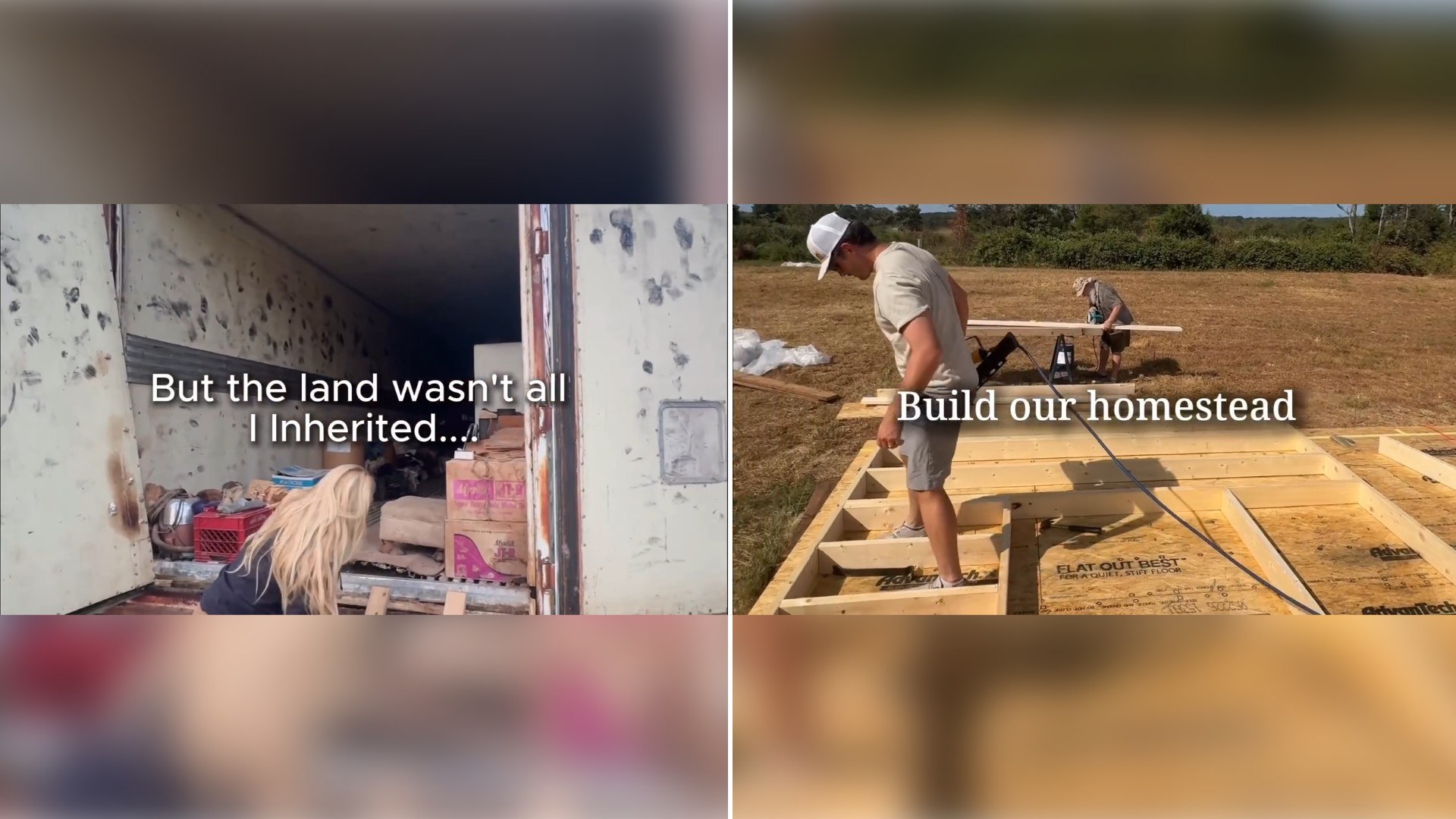
A 230-acre spread doesn’t stay hidden by accident. The couple behind this reel makes clear that the land had simply been left alone for years, tied up in family memory rather than active use, until it passed down from a great-grandmother who hadn’t lived there herself in a long while. The footage doesn’t dwell on how it sat idle; it treats the inheritance as the real turning point, the moment a piece of family history stopped being an abstraction on a will and became an actual address they’d have to drive to, walk through, and decide what to do with.
What makes the clip land is the sheer scale of what’s being shown. This isn’t a single room or a backyard, it’s fields, tree lines, and outbuildings spread across acreage large enough that no single camera angle captures all of it. The “before” shots linger on knee-high grass swallowing fence posts and a farmhouse that clearly hasn’t been occupied in years, while the “after” segments show cleared paths and a new wooden frame rising where nothing stood before, a visual shorthand for how much ground, literal and otherwise, had to be covered between the two.
View this post on Instagram
As @daisyonthefarm tells it, the land isn’t being treated as a blank investment opportunity so much as unfinished family business, something that was always eventually going to need someone to show up and deal with it.
Two hundred thirty acres is an unusual starting point for a renovation story, mostly because so much of what needs fixing isn’t a kitchen or a bathroom but fencing, drainage, and years of brush that have to be physically cleared before any construction conversation can even begin. That distinction matters: this is a couple figuring out where the property line actually runs and which of the existing structures are even worth saving, long before anyone discusses cabinetry or paint.
Inheriting a working farm, even one that stopped working years ago, comes with a different kind of pressure than buying one outright. There’s no inspection report to fall back on and no seller to ask why a barn roof sags the way it does. Whatever answers exist are buried in family memory, which may or may not be accurate, and the couple has to treat the land itself as the only reliable witness to its own history.
Rural Missouri acreage tends to carry a particular kind of continuity that a suburban teardown project doesn’t, since a property this size was almost always built for a specific agricultural purpose rather than general living. Restoring it means reckoning with that original function, even if the couple’s plans for the land ultimately look nothing like what it was used for a generation or two ago.
There’s also a financial reality sitting underneath a project like this that’s easy to miss in sixty seconds of footage. Two hundred thirty acres represents taxes, insurance, and upkeep costs that scale with the land itself, not just the house sitting on it, which means every month of inaction after an inheritance like this only adds to the bill. Choosing to move onto the property rather than sell it off is as much a financial decision as a sentimental one.
The video also captures something a lot of inherited-property stories skip past: the discomfort of being the generation that finally has to make the call. Selling would have been simpler, and almost certainly faster, but it would have meant letting a piece of family history pass to strangers, which isn’t a trade the couple seems willing to make once they’re actually standing on the land themselves.
What comes through in how the couple frames their own project is less about restoring one specific structure and more about restoring use, bringing fields back into some kind of rotation, making old buildings safe to enter again, and turning a property that existed only as a line item on a will into somewhere they actually live. That shift, from inherited asset to daily reality, is the real subject of the clip even when the footage is just grass and lumber.
There’s a reason a 230-acre farm reads so differently from a single fixer-upper house: at that size, no one couple can do all the work alone, and the footage hints at a years-long timeline rather than a weekend project. Every cleared acre shown in the reel almost certainly represents a disproportionate amount of unseen labor, the kind that doesn’t compress neatly into a thirty-second clip no matter how it’s edited.
It’s also worth noting what the couple chose to show versus what they could have shown. A less candid version of this story might have opened on the finished frame and skipped the overgrown fields entirely, presenting the farm as a clean slate rather than a genuine mess that took real effort to even assess. Leading with the knee-high grass and sagging fence line instead sets honest expectations for anyone following along, and it’s part of why the eventual progress reads as earned rather than staged.
Moving a life onto 230 acres also means confronting logistics that a smaller property never forces into view, where the nearest hardware store is, how far equipment has to travel, whether existing power and water lines even reach the parts of the land they intend to use. None of that makes for dramatic footage, but it’s almost certainly eating up more of the couple’s actual time than anything that ends up in a thirty-second edit, and it’s the kind of groundwork that separates an inherited farm that gets restored from one that quietly reverts back to overgrowth within a few years.
Whatever the farm eventually becomes, the video already captures something a lot of inheritance stories never get around to showing on camera: the actual first steps of turning a forgotten piece of land back into a home, with all the physical labor and uncertainty that implies long before anything looks finished.
Leave a Reply