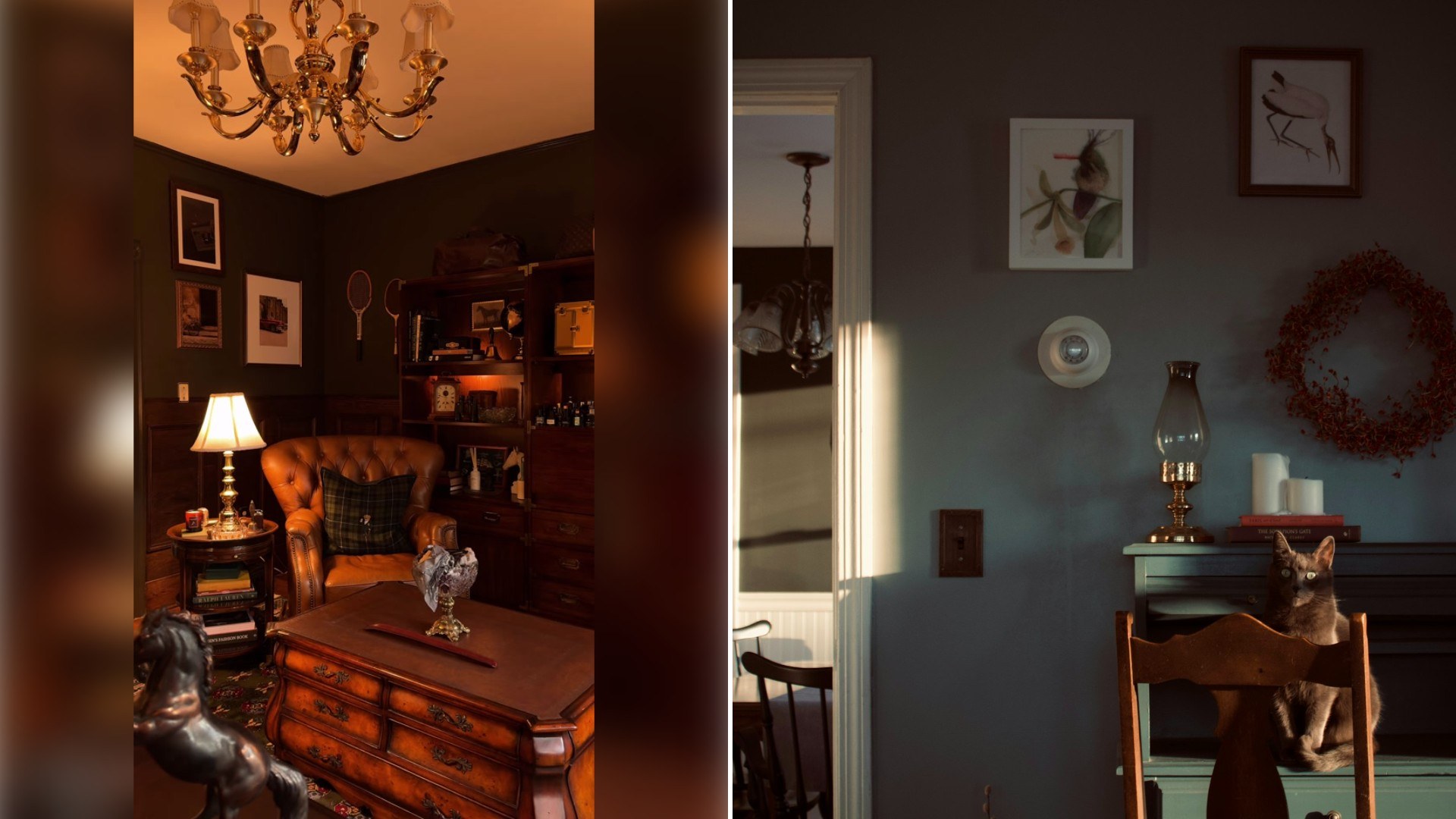
A creator documents the renovation of a room from a messy, mid-demo construction state (prying trim, sanding walls) into a polished, styled home office/man cave, set to a beat-synced montage of the hands-on work and the finished reveal.
What stands out in the finished room isn’t just that it got built, it’s the specific aesthetic the creator was chasing: dark wood paneling, a chandelier, and a leather chair that together read closer to a private members’ club than a typical converted spare bedroom. The reference point is clearly a more traditional, old-money interior style, the kind usually associated with menswear catalogs rather than DIY renovation accounts, and watching that look get built from demo-stage lumber and trim is part of what makes the transformation feel earned.
@huntervought Hard work always pays off! 🤌 #mancave #ralphlauren #mensoffice #homeoffice ♬ original sound – HunterVought
The hashtags @huntervought chose for the post, pairing a specific brand name with “man cave” and “men’s office,” signal exactly who the clip is built to reach: an audience already primed by a particular visual language of leather, wood, and old-world detailing, rather than a general home-renovation crowd.
What the demo footage adds that a straight before-and-after photo wouldn’t is a sense of scale. Prying trim and sanding walls by hand is slow, unglamorous labor, and showing it here, even in a sped-up, beat-synced montage, keeps the finished chandelier-and-leather-chair result from reading as something bought off a showroom floor rather than built room by room.
There’s a specific kind of satisfaction in watching a space get reassigned a new identity entirely, not just redecorated but reclassified, from a construction zone to a den with a clear sense of who it’s for and what it’s meant to feel like. That reclassification is arguably more interesting to viewers than the materials themselves, since it says something about how people are using spare rooms now versus how they might have used the same square footage a decade ago.
The beat-synced editing style itself deserves attention, since it’s doing a specific job: compressing what was likely a multi-week build into a rhythm that makes each cut, each new piece of trim, each coat of stain feel like a beat in a song rather than a separate task on a list. That structure is part of why the room’s completion lands with more impact than a simple photo comparison would.
Converted “man cave” spaces like this one occupy an interesting niche in home content because they’re explicitly personal rather than resale-minded. Nobody is staging a dark wood-paneled office with a chandelier for a future buyer’s taste; it’s built around one person’s specific vision of what a den should feel like, and that specificity is part of why it stands out from more neutral, broadly marketable renovation content.
It’s also worth noting how much the choice of a leather chair and a chandelier does to signal permanence rather than a trend-chasing redesign. Those are pieces meant to anchor a room for years, not furniture picked for how it photographs this season, and that long-view approach fits naturally with a renovation that clearly wasn’t rushed.
The original sound chosen for the edit, credited simply to the creator’s own account rather than a licensed track, adds another layer of ownership to the clip. Rather than borrowing a trending audio clip the way so much short-form content does, the beat driving the montage appears to be something the creator put together specifically for this reveal, which fits with the broader sense that the room itself was a deliberate, personal project rather than a quick flip.
Framing a converted room as both a “man cave” and a “men’s office” is itself a small but telling detail, since it suggests the space is meant to serve two purposes at once, somewhere to work and somewhere to retreat, rather than being built strictly for productivity or strictly for leisure. That dual identity is part of why the styling leans traditional and clubby instead of toward the minimal, all-white home office look that dominates a lot of other renovation content.
The “hard work always pays off” caption is doing something slightly different than the usual renovation-reveal framing, too. Most of these clips let the footage make the argument on its own, but here the creator states the thesis directly, turning the room itself into proof of a broader work ethic rather than just a finished design project. That framing invites comments about effort and payoff as much as it invites comments about taste.
It’s worth pointing out how much of the finished room’s character comes from contrast with its own starting point. A chandelier reads very differently hanging in a room with exposed trim and sanding dust still visible in the earlier footage than it would in a glossy, pre-staged showroom photo, and that contrast is exactly why creators choose to show the demo stage at all instead of cutting straight to the reveal.
There’s also a generational angle worth noting in how this kind of traditional, clubby aesthetic has resurfaced on a platform built around short-form video. Dark wood paneling and leather furniture were, for a long time, associated with an older, more formal style of interior design, and seeing a younger creator rebuild that exact look from a gutted room suggests the style is being picked up again on its own terms rather than inherited wholesale from an older generation.
Whatever this particular room gets used for day to day, the clip has already done the harder work of making a construction-to-finished transformation feel like a coherent style statement rather than just a checklist of completed tasks.
Leave a Reply