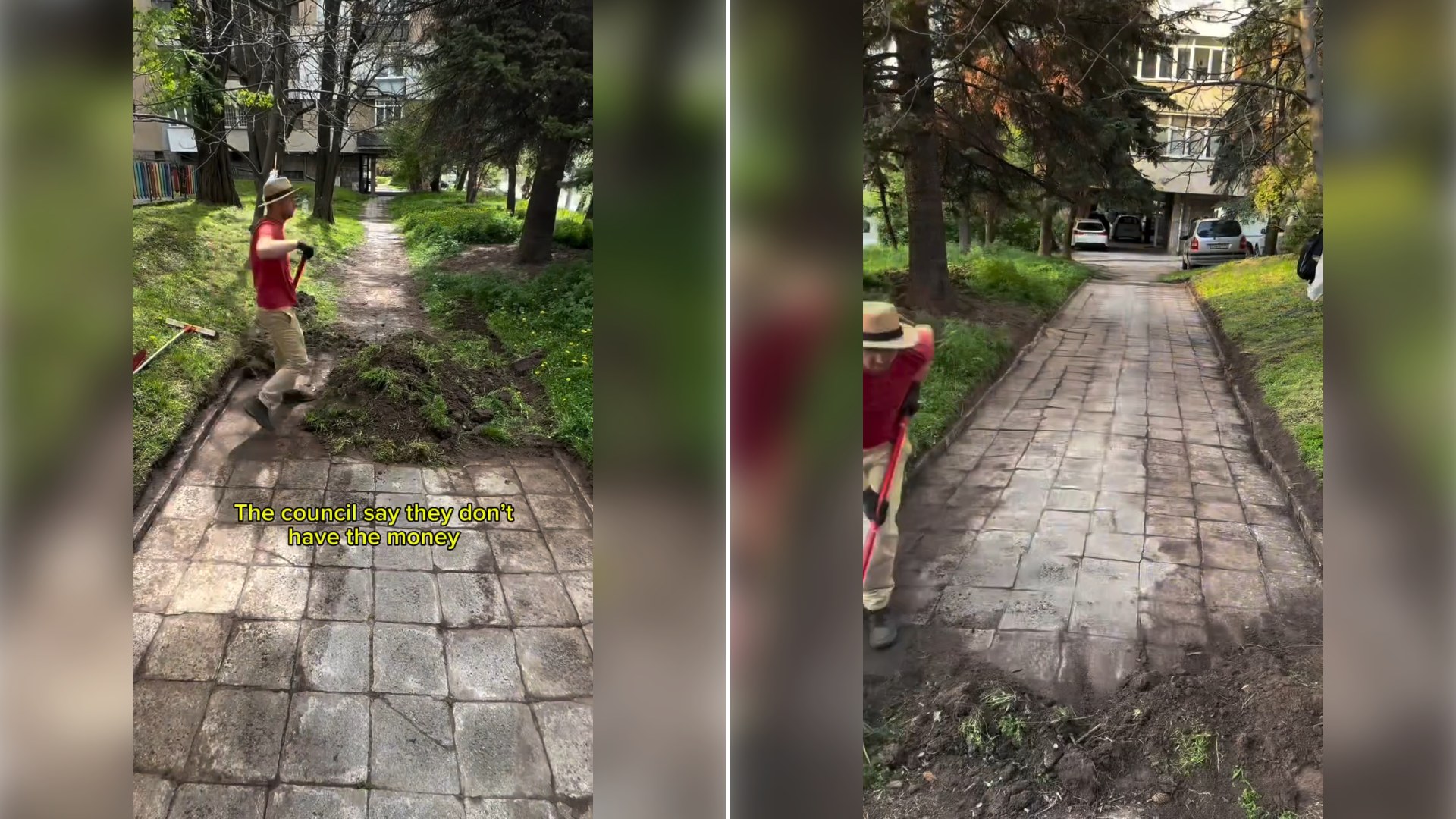
Sometimes the most satisfying renovation content has nothing to do with anyone’s actual house. @fixer.dad (Instagram) proves that point, taking it upon himself to personally clean and restore an overgrown public walkway near his home after years of frustrating bureaucratic delay. “I don’t like bureaucracy,” he says plainly, before showing exactly what he did about it instead of continuing to wait.
There’s a genuinely satisfying quality to watching someone bypass institutional frustration entirely and simply solve a problem with their own two hands. Public infrastructure maintenance, sidewalks, walkways, shared green spaces, often falls into a kind of bureaucratic limbo where responsibility is technically assigned but practically neglected, leaving residents to either wait indefinitely or take matters into their own hands.
This kind of grassroots infrastructure maintenance reflects a longstanding, if somewhat under-discussed, tradition of residents stepping in where local government falls short. Community gardens, informally maintained public spaces, and neighbor-led cleanup efforts have long filled gaps that official maintenance budgets and priorities don’t always address quickly enough to match actual community needs.
There’s a reason this kind of content resonates so broadly beyond the specific neighborhood involved. Nearly everyone has experienced some version of frustration with slow-moving local bureaucracy, a pothole that doesn’t get fixed, a streetlight that stays dark for months, a public space that falls into disrepair despite repeated complaints. Watching someone simply solve the problem directly offers a satisfying kind of vicarious agency that filing another complaint never quite provides.
It’s worth considering, too, the genuine legal and liability questions that can complicate this kind of well-intentioned individual action. Public infrastructure typically falls under specific jurisdictional authority for good reason, liability concerns, maintenance standards, coordination with utility lines, which means a resident taking independent action, however helpful, exists in a bit of a gray area that most municipalities haven’t fully worked out how to address.
This kind of project also speaks to a broader renewed interest in hands-on civic participation that goes beyond simply voting or attending town meetings. There’s a growing appetite, visible across plenty of similar content, for direct, tangible community improvement, a kind of practical, visible civic engagement that feels more immediately rewarding than the often slow, opaque channels of official local government processes.
There’s also something worth appreciating about how this kind of individual action can actually shift institutional behavior over time, even if indirectly. A visibly improved walkway, maintained by a resident out of sheer frustration, can put informal pressure on local officials to finally prioritize what they’d been deferring, especially once the project gets public attention and community members start asking why a private citizen had to do the work the county should have handled.
It’s also worth noting the genuine physical labor and planning this kind of project actually requires, even though it might look simple compared to a full home renovation. Clearing significant overgrowth, assessing and repairing walkway surfaces, and doing all of it without professional equipment or municipal resources demands real resourcefulness and sustained effort from someone motivated purely by frustration and community pride rather than any personal financial incentive.
In the end, this project resonates because it reframes home improvement content beyond the boundaries of a single property. Taking care of a home, for some people, clearly extends to taking care of the shared spaces surrounding it too, and sometimes the most impactful renovation isn’t the one inside your own walls.
Leave a Reply