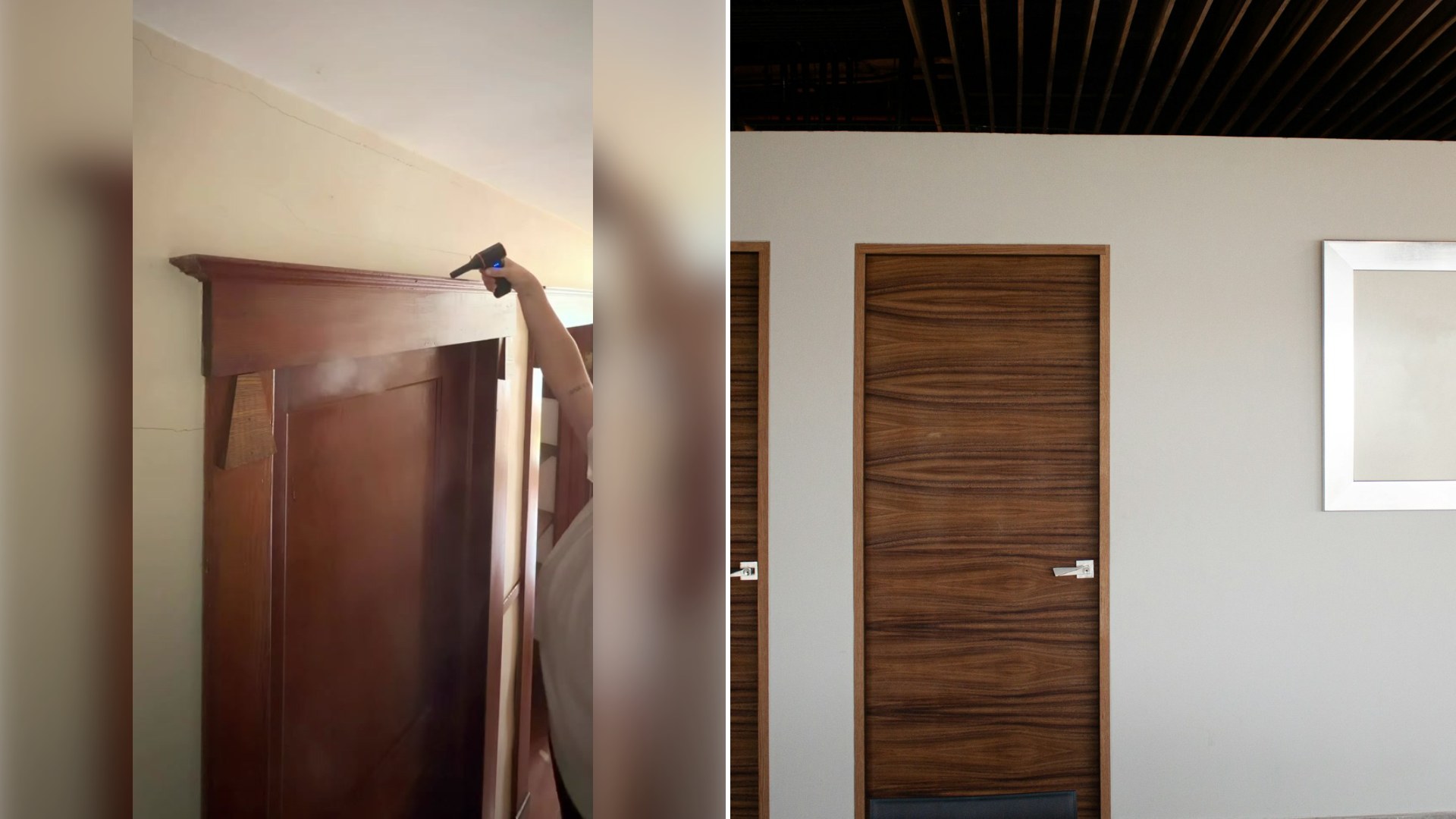
Century-old homes carry details that simply don’t exist in new construction, and @ashtonboughtahouse continues documenting exactly that kind of preservation work in a TikTok showing the painstaking process of staining and finishing the original wood door frames inside their 106-year-old house.
Original woodwork from a build this old represents a level of material quality and craftsmanship that would be prohibitively expensive, if not impossible, to replicate today, which makes restoring rather than replacing these frames a decision with real long-term value beyond simple nostalgia.
There is something genuinely meditative about this kind of restoration content, slow, careful, incremental work that stands in deliberate contrast to the fast-cut, dramatic reveals that dominate most renovation media.
Door frames in particular tend to get overlooked in renovation planning, treated as a minor architectural detail rather than a defining feature, even though they frame literally every transition between rooms in a home and accumulate visual impact across dozens of daily interactions.
The decision to document this as an ongoing series rather than a single finished reveal also reflects something valuable about how old-home restoration actually works, a process measured in years and individual rooms rather than a single weekend transformation.
Wood this old typically requires a specific kind of patience to restore properly, careful stripping of old finishes, repair of any damage accumulated over a century, and a finish that respects the wood’s original character rather than masking it under something generic.
There is a broader cultural appreciation building for exactly this kind of preservation work, a growing recognition that older homes often contain irreplaceable materials and craftsmanship that a full gut renovation would simply discard.
Comment sections under this kind of restoration content tend to fill with fellow old-home owners sharing their own door frame, trim, or molding restoration stories, creating a genuine community around a fairly niche but passionate corner of home renovation.
This kind of content also does real educational work for anyone who has just purchased an older home themselves, offering a specific, visual roadmap for a restoration project they may not have realized was even possible before seeing it done.
There’s a real financial logic buried in this approach too, since restoring existing original woodwork, while labor intensive, often costs considerably less than sourcing comparable custom millwork to match a home’s original architectural character.
The 106-year age of this particular house adds real weight to the project, meaning these door frames have outlasted multiple owners, multiple decades of changing design trends, and are now being given the careful attention needed to outlast several more.
It’s worth appreciating, too, how much research this kind of restoration typically requires, identifying the original wood species, matching historically appropriate stains and finishes, and understanding how the material has aged before attempting to refinish it.
This kind of patient, detail-focused renovation also offers a useful counterpoint to the pressure many homeowners feel to pursue dramatic, Instagram-ready transformations, proving that quiet, careful preservation can be just as compelling to watch.
For anyone who has inherited original woodwork in an older home and wasn’t sure whether it was worth saving, this video offers a clear, encouraging answer, that original materials this old are often worth the extra effort required to bring them back.
There’s also a reminder here about the value of documenting a long restoration project in parts, since a single finished reveal would lose the texture of the actual process, the careful sanding, the test patches, the slow transformation from worn to refinished.
This kind of ongoing documentation also builds real anticipation among followers, who get to track a project’s progress over weeks or months rather than only seeing a single polished before-and-after.
The broader trend toward preserving rather than replacing original architectural details reflects a meaningful shift in how homeowners value their houses, treating a century-old building’s original materials as an asset worth protecting rather than an obstacle to a modern look.
For homeowners currently weighing whether to restore or replace original trim and millwork of their own, this video offers a useful case study in exactly how much character careful restoration can recover from materials that might otherwise get discarded during a renovation.
There’s something quietly satisfying, too, about watching a single detail this small receive this much careful attention, a reminder that a home’s overall character is often built from exactly these kinds of unglamorous, easily overlooked elements.
Whatever room comes next in this restoration series, the door frames finished so far already demonstrate the kind of payoff that patient, detail-oriented work can produce in a house old enough to have earned real architectural character.
And for anyone watching who owns a home with original woodwork quietly sitting underneath decades of paint or wear, this video is a useful nudge to consider what might be hiding there, waiting for exactly this kind of careful attention.
It is also worth remembering that door frames like these have survived a century of changing design trends already, which makes the current restoration less a trend-driven choice and more a continuation of a material that has already proven its staying power.
And once this particular door frame is fully finished, it will quietly outlast whatever renovation trend happens to be popular by the time anyone gets around to touching it again.
In the end, a 106-year-old house doesn’t get restored all at once, it gets restored one carefully finished detail at a time, and these door frames are proof that the patience required is very much worth it.
Leave a Reply