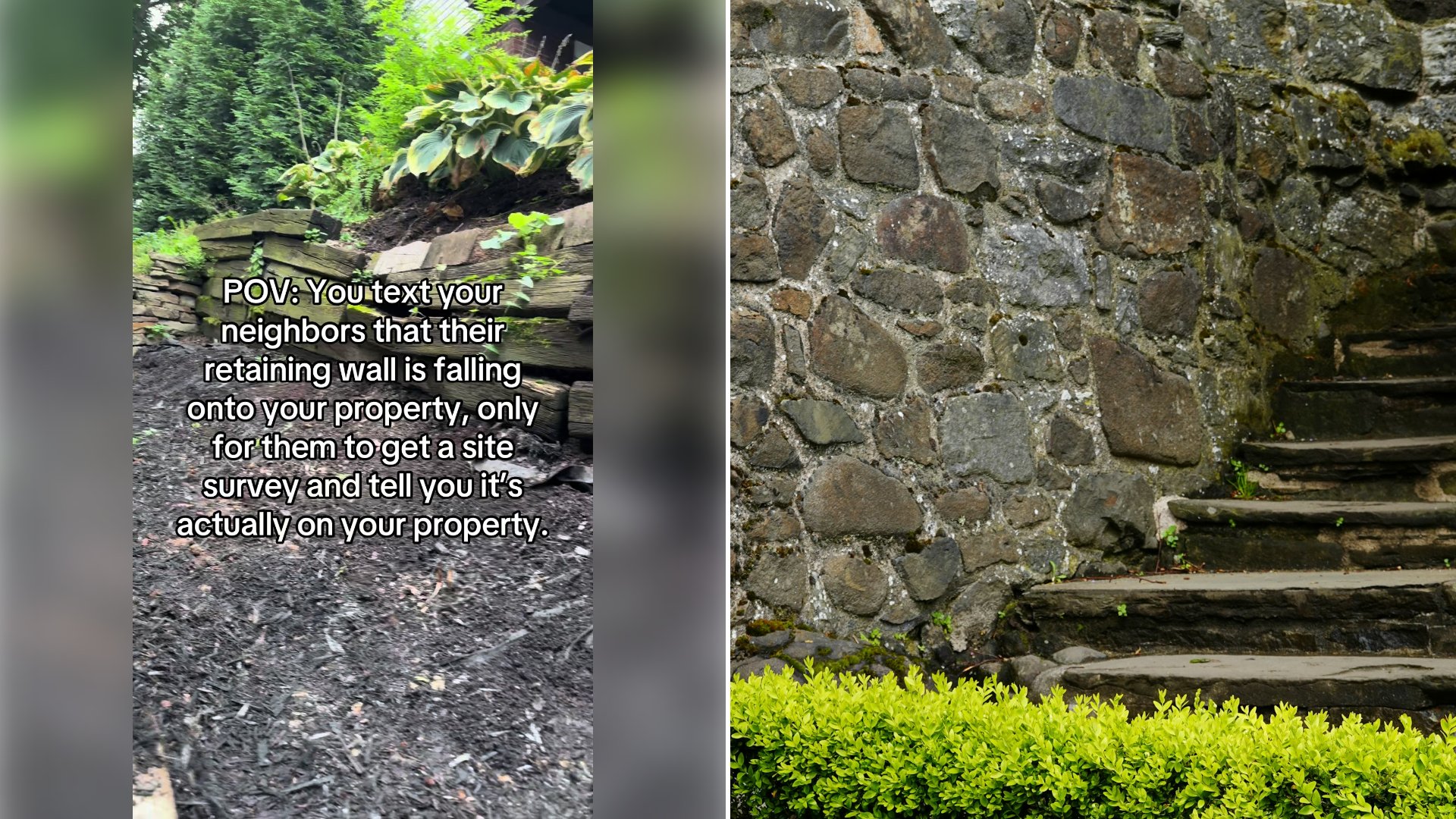
A Pittsburgh homeowner who posts as @nikkiandnico on TikTok walked her followers through one of those homeowner moments that is dreaded by basically everyone who has ever shared a property line: texting a neighbor to say, as gently as possible, that his retaining wall looks like it’s about to fall onto your land. The on-screen text lays it out plainly: “POV: You text your neighbor that their retaining wall is falling onto your property, only for them to get a site survey and tell you it’s actually on your property.” The twist is the whole point — what started as an awkward warning about someone else’s crumbling wall ended with her finding out the wall, and the liability that comes with it, was hers all along.
@nikkiandnico
Before the survey results came back, the dread on display is extremely relatable: a decrepit, visibly failing wooden retaining wall sitting right along a shared property line, leaning or buckling in a way that makes it obvious it won’t hold forever, and the stomach-turning decision about whether to say something to the neighbor or just hope it holds another season. Then comes the twist that reframes the entire video — a professional site survey places the wall itself on her side of the line, meaning the stress of flagging someone else’s problem instantly becomes the stress of now owning the fix herself.
Retaining wall failures are a surprisingly common and expensive category of home repair, and the legal question of who has to pay almost always comes down to exactly what this video turned on: where the wall physically sits relative to the recorded property line, and which parcel’s soil it is actually holding back. A wall built entirely within one owner’s property, even if it happens to protect a neighbor’s yard from erosion or shifting, is generally that owner’s sole responsibility to maintain and repair. A wall that straddles a property line, or one explicitly built as a shared improvement between two parcels, can trigger shared-maintenance obligations instead, which is why a professional survey, not a tape measure or a guess based on an old fence line, is the step that actually settles the question.
Retaining walls fail for a predictable set of reasons: poor or absent drainage behind the wall lets water pressure build up and push the structure outward, the original materials weren’t rated for the soil load they’re holding back, or decades of freeze-thaw cycles have simply worn down a wall that was never built to last this long in the first place. Wood retaining walls, like the one shown in this video, are especially prone to rot and structural failure over time compared to concrete, segmental block, or engineered stone systems, which is part of why older wooden walls are disproportionately represented in these kinds of “it’s about to collapse” homeowner videos.
Once a wall is confirmed to sit on your property, most homeowners’ insurance policies won’t automatically cover the repair or replacement cost unless the failure caused sudden, specific damage covered under the policy’s terms — ordinary wear, rot, or gradual structural failure is typically treated as a maintenance issue the owner is expected to have caught earlier, not an insurable loss. That makes the kind of proactive documentation this video shows, flagging a problem before it actually gives way, valuable for more than just being a good neighbor; it can also be the difference between a planned repair and an emergency one after the wall lets go and takes part of a yard, fence, or structure with it.
The video resonates because almost every homeowner with a shared property line has faced some version of this dilemma, and the twist ending is a reminder that assuming a problem belongs to the neighbor is exactly the kind of assumption a survey exists to check.
More from Willow and Hearth
- Arkansas Court of Appeals Let an Old Fence Stand as the Property Line in One 2026 Ruling and Went the Other Way in 2024, Showing Why a Fence Alone Does Not Decide Who Owns the Land
- Homeowner Says He Stayed Calm When a Neighbor Poured Concrete Over His Prize Roses, Then Showed a Buyer a 1965 Easement Map Placing the Neighbor’s Garage on the Sewer Line
- Neighbor Back From Holiday Finds the Planter She Built to Stop Cars Crossing Her Front Lawn Has Been Moved and Rubber Slabs Laid Down With a Brick on Top
Leave a Reply