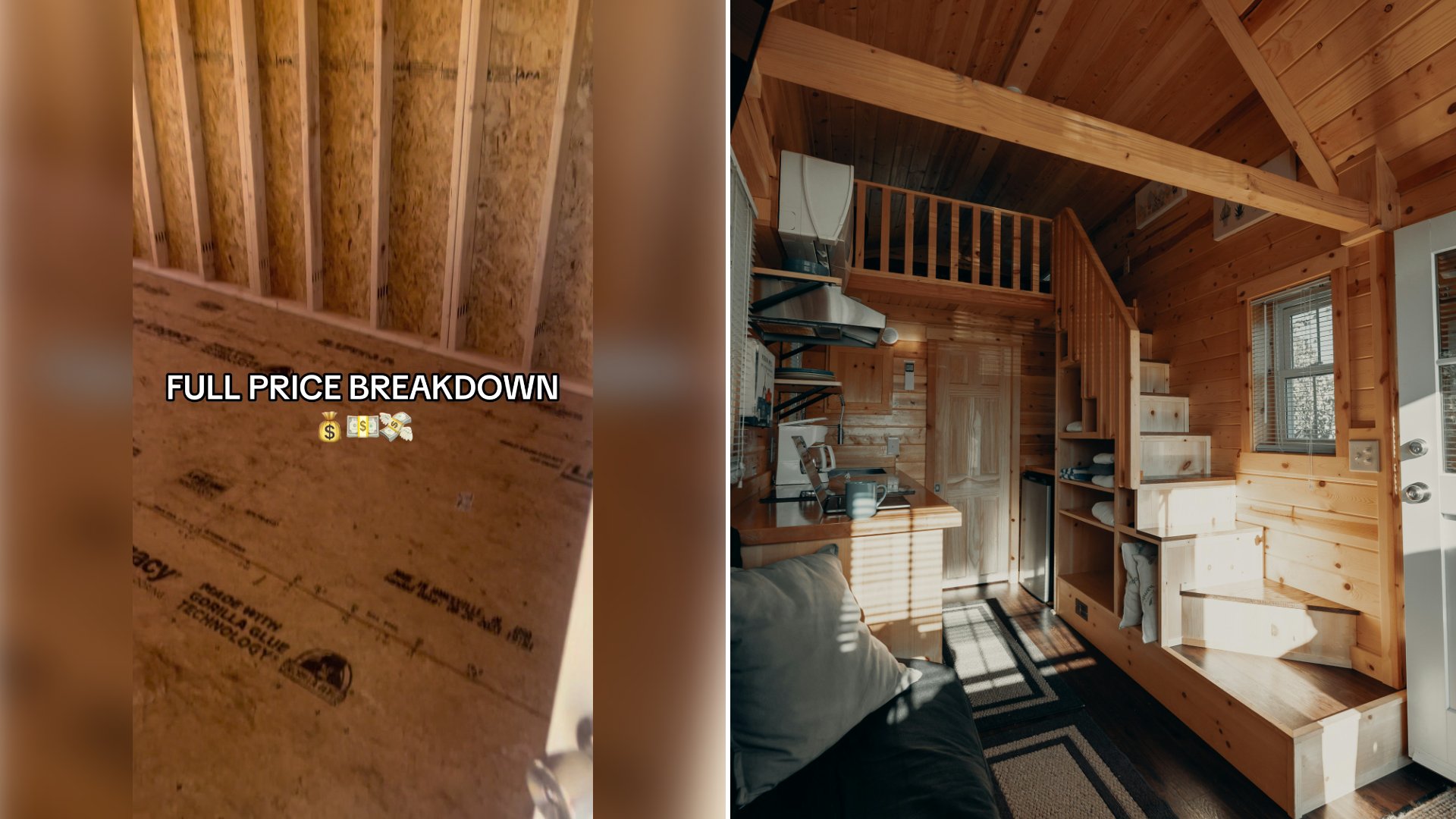
Tiny homes keep growing in popularity, but few stories are as down to earth as this one. @elly.bewley shared on social media that she and her husband Briggs got married, bought a shed, and turned it into their home, all at 19 years old. She laid out a full price breakdown for anyone curious about doing the same, and the numbers she shares are worth a closer look.
@elly.bewley
The starting point, she says, was a shed measuring 14 by 40 feet. It cost the couple $16,000, and delivery was free. From there, the work began. Framing out two rooms inside the shell, including nails, lumber and all the little extras, ran around $700, according to Elly.
Next came electrical, and this is where the couple had an advantage. Briggs is an electrician, so they saved some money on labor. Even so, Elly says that materials and getting a service range to the property added up to roughly $5,000. After the wiring was done, they moved on to plumbing. This was a job they chose to hire out, and she says the total was about $2,000, which covered the materials, the installation, the connection of fixtures and the hot water heater.
The couple installed their own insulation. Elly says they skipped spray foam because it was far too expensive. Instead they bought five bags of the 16 inch size for the walls and three bags of the 23 inch size for the ceilings, and the total came to about $750. Drywall was a different story. They did not hang it themselves and paid someone else to do it, at a cost of $3,500.
Briggs’s stepdad stepped in to help with the cabinets. Elly says they had to be custom made because the ready made ones at the big home improvement stores did not fit the way they were supposed to. He also helped with the trim around the doors and the floors. She puts the materials for the cabinets and trim at a little over $2,000.
Then comes the detail that gives this story its twist. Because the space is so small, the couple did not need much granite. They were able to use remnants, and Elly says that saved them a bunch of money. She reports getting a beautiful piece of granite for just $25.
Flooring materials were about $700. Elly admits they went with the cheapest option they could find, and she has a clear piece of advice for anyone following along: do not do that. Her warning is a useful reminder that a floor is something you walk on every day, and that going with the lowest price is not always the smartest choice.
The bathroom was another team effort. Elly says Briggs’s stepdad helped with basically the entire room, so the couple only had to pay for the tile on the walls and the floor. They also used the same tile on the bathroom wall as they did for the backsplash in the kitchen. All of the tile was probably about $1,000. For heating and cooling, they put in mini splits on each side of the space, which she says cost about $2,000. The auto captions on her post are garbled at that point, so the exact number of units is unclear.
Elly says the grand total came to $36,200, give or take. She adds that the cabinets had just been installed, so the final reveal was still to come. One honest note for readers: the individual figures she lists add up to roughly $33,700, not the $36,200 she gives, which is a good sign that real projects always have extras. Treat the numbers as her own ballpark estimates rather than a firm quote.
Lessons From a Shed Conversion Budget
If this story has you wondering whether a shed could become a home, here are some general points to think about before you buy anything.
Check the rules first. Zoning, building codes and permit requirements vary a great deal from one town to the next. Some areas do not allow a converted storage building to be used as a dwelling at all, and others require inspections for electrical, plumbing and structural work. A call to your local building department before you spend money can save you from an expensive surprise.
Know where your skills end. This couple saved on electrical work because one of them is an electrician, and they brought in professionals for plumbing and drywall. That is a smart way to split a project. Do the jobs you can do safely and well, and hire out the ones where a mistake could cause leaks, fires or ugly finishes.
Do not skip insulation. A shed is built to store lawn equipment, not to keep people comfortable. Proper insulation in the walls and ceiling does a lot of the work of keeping a small space livable in both summer and winter. Spray foam performs well but costs more, and batts are a budget friendly option when they are installed carefully with no gaps.
Look for remnants and leftovers. Elly’s twenty five dollar granite is the best example of why small spaces can be a budget advantage. Countertop yards, tile outlets and salvage stores often sell offcuts at a steep discount, and a tiny kitchen or bathroom needs only a small piece. Reusing the same tile in more than one spot, as the couple did, also helps keep the cost down and gives the home a cohesive look.
Spend where it counts. Elly’s flooring advice is worth taking seriously. Cheap materials can wear out quickly, and replacing them later costs more than choosing something sturdy up front. Think about which surfaces you touch and use daily, and put your money there.
Plan for a contingency. Every renovation runs into surprises, and a small cushion in your budget can keep a stalled project moving. A common rule of thumb is to set aside ten to twenty percent beyond your estimate.
Ask for help from people you trust. The stepdad who helped with cabinets, trim and the bathroom is a big part of how this home came together. Family, friends and neighbors with building experience can offer tools, time and know how that no store can sell you.
Whether a shed conversion is right for you depends on your climate, your local rules and your own budget. What Elly’s breakdown shows is that a young couple with a plan, some practical skills and willing relatives can build a home on a budget far below what many people expect to spend. Her message to anyone interested is simple: plan carefully, hire out what you must, and do not cheap out on the floor.
Leave a Reply