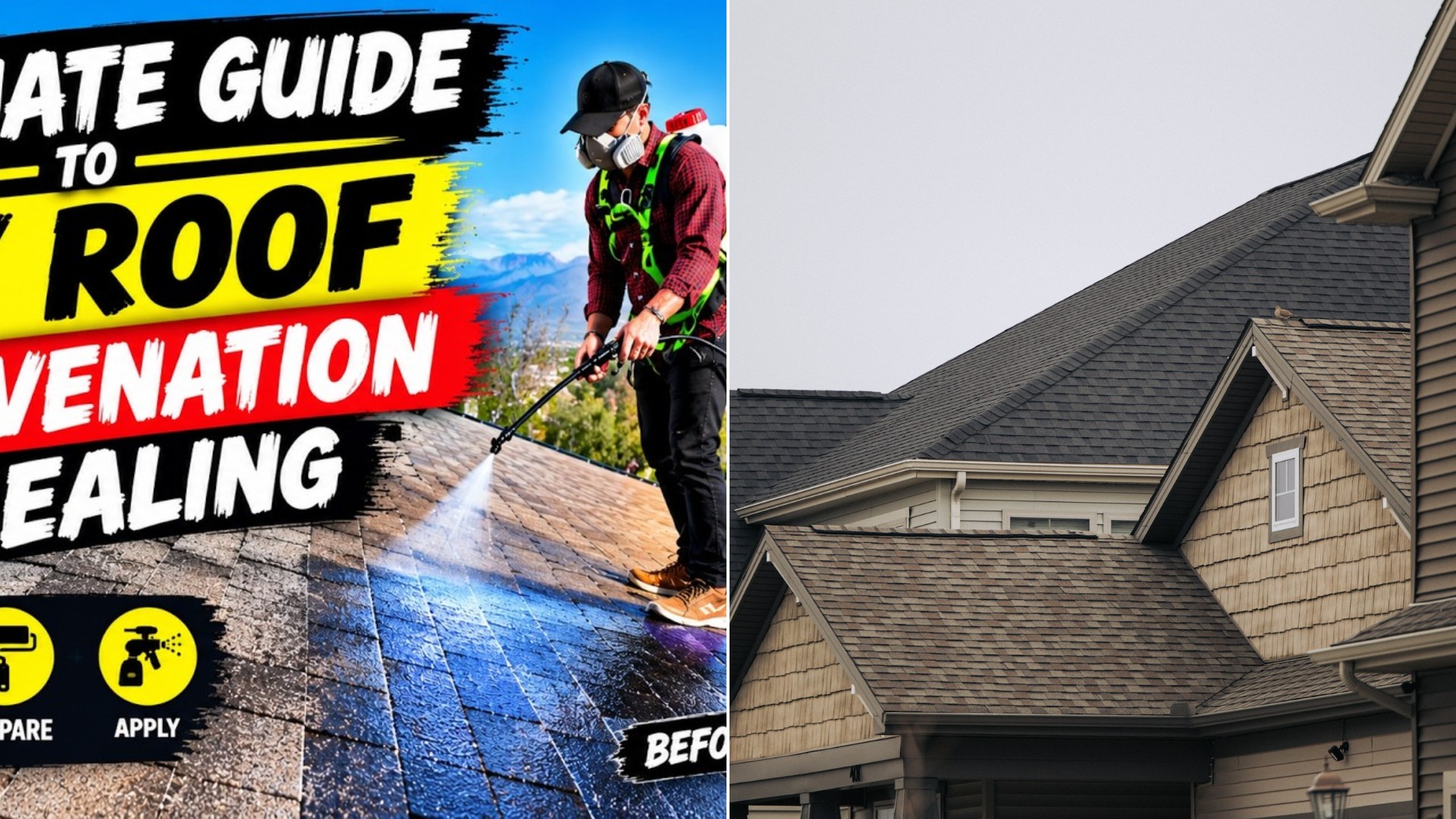
A roofer in Utah says most of what goes wrong with a roof is something you can spot from the top and fix before it turns serious. “In my personal experience, 95% of problems you could see on top of a roof,” says Paul of Spider Roofing.
His company has been doing this for about half a decade, and in a walkthrough on his YouTube channel he shows how a homeowner can inspect, repair and spray an asphalt shingle roof to extend its life.
Paul says most of the preventative work can be done with tools from Home Depot. If a roof has serious structural damage, caved-in wood or major leaks, he says it is time to call a professional. For everything else, he says, “realistically, majority of stuff you can do yourself.”
“We Can’t Take It Back From The Dead,” So Check The Granules First
Step one is safety. Paul says ladders are one of the main places accidents happen, so strap the bottom in, stand on something stable, and attach the top of the ladder to something on the roof. Go one rung up.
Step two is finding out whether the roof is a candidate at all. He says a sealing treatment helps a roof last longer, but “we can’t take it back from the dead.”
The key is granulation, the layer of granules on top of each shingle. He wants to see at least about 50 to 70% granulation. Fiberglass showing through is the bigger worry, because once it does, he says, the shingle is no longer waterproof.
A shingle has three parts, according to Paul. Granules on top protect against sun, wind, snow and hail. Below is a layer of asphalt that waterproofs the roof and holds the granules, then fiberglass matting and another asphalt layer.
As the sun beats on it, the asphalt turns brittle and the granules come off. Exposed asphalt does not reflect sunlight, so the decline speeds up. His advice is to act early, since the earlier you do it, the more years you get.
Measure The Roof On A Free Map Tool Before You Buy Anything
Paul shows an easy way to size up a roof. Find your address on Google Earth, use the measure distance and area tool, and trace the outline of the house. In his example the roof comes to 3,022 square feet.
The roof’s pitch matters too. Measure it with a phone or level. His example roof is about 17 degrees, roughly a 4 in 12 pitch, which gives a multiplier of 1.054. Multiply 3,022 by 1.054 and you get about 3,185 square feet, or about 32 squares.
A $9 Piece Of Rubber Can Stop A Common Leak
Before any spraying, Paul does a tune-up. He says these are the things he does on almost every roof, and they get rid of 90% of the problems.
First he uses caulking. He favors Geocel 4500, which he says costs about $12 online, and he says two or three tubes per roof is usually enough. Any silicone or adhesive from Home Depot should work pretty well.
Then he looks at the plumbing boots, which connect to bathrooms or kitchens. He says the rubber gasket on these can destroy roofs after years in the sun. Rather than tearing the whole thing off and damaging the shingles around it, he stretches a gasket repair over it, about $9 at Home Depot.
For a boot with damaged plastic, he uses a heavier-duty boot that he says costs about $30.
The mistake he sees homeowners make most is sealing around the bottom edge of the boot. Water that gets behind is supposed to run underneath and escape. Caulk that line, he says, and you trap the moisture. If you see it sealed, “it’s most likely a homeowner mistake or just a really bad contractor.”
He also re-caulks the nails and metal gaskets, since silicone breaks down after about 5 to 7 years, which is about how often he says you should be up there anyway.
Nail Pops, Ridge Caps And A Hole Fixed With Flashing
Next he walks the roof for soft spots and damaged shingles. A lifted shingle is usually a nail pop, where water rusts a nail and pushes it up. He hammers it back down, and on an architectural shingle he uses a crowbar. Then he puts a couple of dots of caulk on either side. Not a line all the way along, because that traps water.
The ridge is a common place to fail, since the shingle bends there. The fix is easy. Buy ridge shingles, match the color, and put them on top. He recommends 2 inch nails rather than the usual inch and a quarter, since you go through an extra layer. Cover the exposed nails with caulk.
For a hole in a shingle, he says that if the roof is 12 years or older, he highly discourages replacing shingles. They get brittle, and unless you are experienced you will probably do more damage than good.
His fix is a piece of flashing from Home Depot slipped under the shingle, with caulk applied vertically, not horizontally, so it does not trap water.
The Spray Treatment He Says Can Help Avoid Replacement
With repairs done, Paul cleans the roof. In dry Utah, a leaf blower is enough. In wetter places with algae streaks or moss, he says you need to scrape and clean first.
The coating is a modified acrylic that he says soaks into the asphalt, replaces lost granules, reflects sun and adds waterproofing, while letting water vapor escape. He says it has been around about 30 years. He says he uses it because he trusts it most, and that other sealants exist.
He sprays with a 4 gallon backpack sprayer, which he says costs about $80, plus a mask like you would use for house painting. He suggests a piece of cardboard as a shield for plants, cars and driveways.
Each gallon covers about 300 square feet per pass, and he does two passes, so a gallon covers about 150 square feet. For a first try he suggests marking a 10 by 30 foot square and getting a gallon on it. The first coat should drip a little, it dries in 30 minutes in the sun or up to 5 hours in shade, and once it is dry to the touch you spray the second coat horizontally if you went vertically first.
He goes heavier on the south and west sides, since they take the most sun.
How Long He Says It Lasts
Paul says a roof with 100% granulation can see 7 to 10 years from the treatment. A shingle with 50% granulation or less might get five years or so, but it still helps.
He adds that the shingles should not be glued to each other afterward, since that would trap water.
The takeaway, in his words, is that maintenance works best early. A few tubes of caulk and a walk around the roof every 5 to 7 years may cost far less than the bill for a new roof.
More Stories You May Like
- Realtor Says A 1970s House Was Maintained Really Well But The Inspector Finds An Air Conditioner Built Into The Garage Door And Spray Foam Stuffed In Drywall Holes
- Wife Tours the Farmhouse Style Kitchen Where Her Husband Built a Solid Mahogany Sink and the Island Top Is the Last Spalted Maple From Their Property, Because She Says It Did Not Come From a Showroom
- Energy.gov Says Turning Your Thermostat Back 7 To 10 Degrees For 8 Hours A Day Can Save As Much As 10% A Year And It Costs Nothing To Try
Leave a Reply