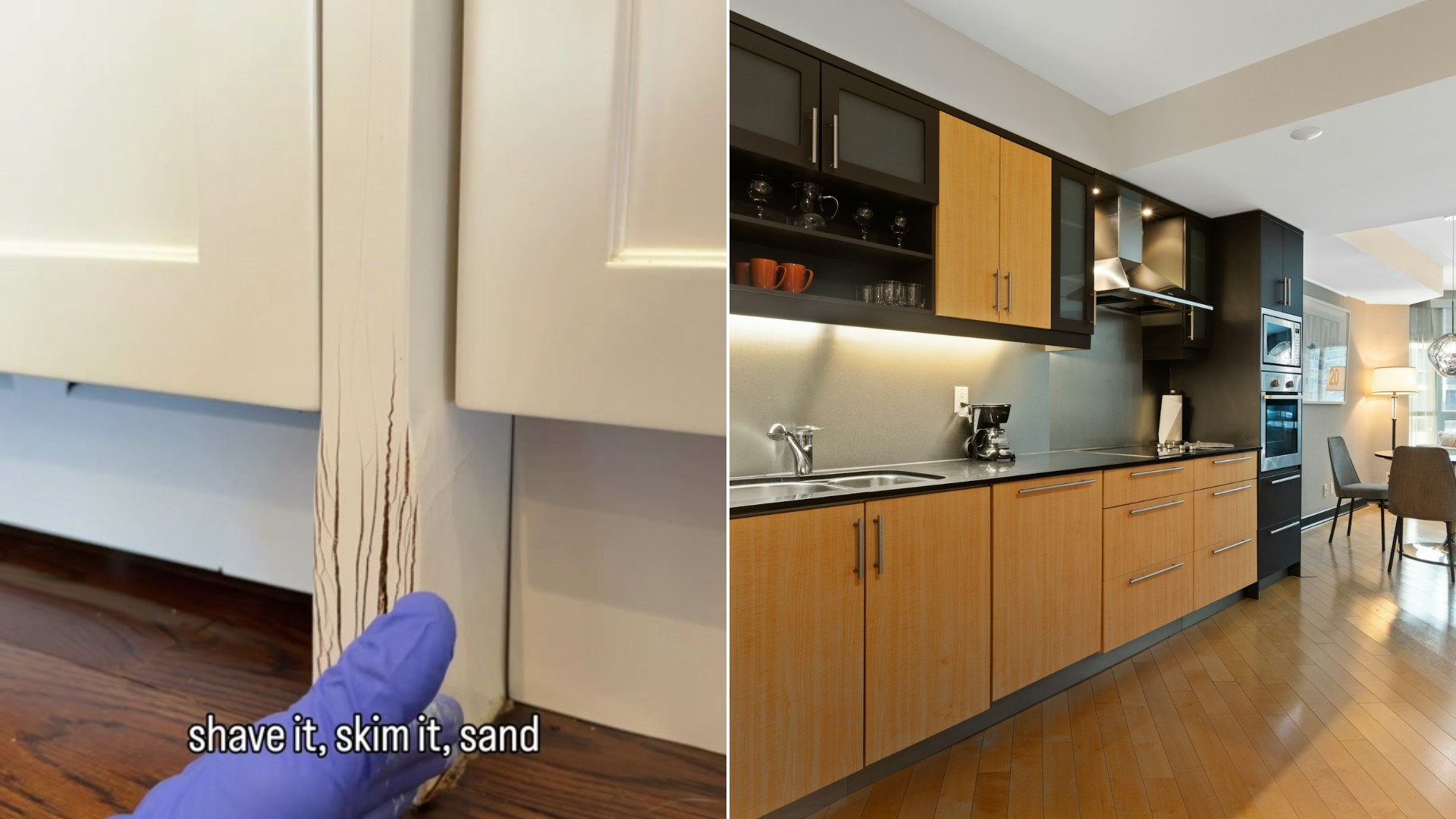
Water and kitchen cabinets are a bad mix, and nobody knows it better than the cabinet repairman behind @morethanjustacabinetguy. His latest job was what he calls an “MDF water damage nightmare,” and the way he got through it is a lesson for anyone with a soggy cabinet at home.
The problem was a swollen cabinet side wedged right against a refrigerator. His plan, in his words, was simple to say and hard to do: “Glue it, seal it, clamp it, shave it, skim it, sand it, paint it.”
The trouble started with the fridge itself. Both sides of the cabinet had swelled, each in its own direction, and he says there was “no removing this fridge.” Whatever he did had to happen with the appliance staying exactly where it was.
@morethanjustacabinetguy
Swollen Cabinet Stuck Against The Fridge Left Him Only One Way To Fix It
His first move was to clamp the swollen panel down and see how far it would squeeze back in. Pressing a swollen panel back toward its original size is a gamble, but with the fridge fixed in place it was the only road open to him.
The swollen material also had to be hardened up. The only way to do that, he says, is to inject a hardener inside the wood.
Then came the clock. He clamped the panel in a very timely manner, before the hardener could set up. Once it starts to set, you cannot move the piece, so the clamping has to happen fast.
“It Smokes, It Gets Really Hot And It’s A Very, Very Toxic Odor”
This is the part of the video that stopped a lot of do-it-yourselfers in their tracks. He says he highly recommends that you never use the popular method of sealing MDF with CA glue, the same family of glue many people call super glue.
His reason is blunt. According to him, the glue has a chemical reaction with the MDF, and it smokes, gets really hot and gives off a very toxic odor. He says he has to wear a respirator and make sure he has great ventilation whenever he does it.
So why would anyone use it at all? He admits there is one pro: it is done in seconds, rather than waiting overnight for something to harden. For a tradesman on a tight day, that speed is tempting, but he clearly wants homeowners to think twice.
He even adds a story from his own family. His father, he says, has gotten that glue in his eye twice, which he calls strange, “cause usually that’s kind of something you only ever do once.” It is a funny line, and it is also a good reminder that glue and eyes do not mix.
Sanding Down Almost An Inch And A Half Of Swollen Material
With the panel hardened and held, the work turned to bulk. He says there was a lot to take off, so he wondered out loud whether he could shave some of it away first to reduce his sanding time.
He cut off a bunch and got the panel down to almost an inch and a half. The target was an inch and a half, but he decided it was a good stopping point and planned to sand the rest.
The sanders got some attention, too. He says he does not love his rectangle sander because it seems to scratch everything. He allows that sanding is scratching by definition, but says the orbital sander does a better job and leaves a much smoother finish, though for this particular spot the rectangle was the perfect tool.
There was one more wrinkle. He has a sanding light for the orbital sander, which he calls great, but none for the rectangle. He joked that maybe somebody could help him out and send one.
Not Bad For A Few Hours Of Work, And No Need To Rip Out The Whole Panel
Once the shaving and sanding were done, he finished with a coat that ran a little. He smoothed it out with a brush, then let it dry, with sanding and a top coat still to come. He jokes that it all happened because it was past his lunch hour and he was really hungry.
His summary: “Not bad for a few hours and repair work.” The comparison he draws is with the alternative, which is ripping out the entire panel or cutting inside it and notching it.
Even then, he points out, you would still be gluing it, using Bondo, sanding and painting. So he did the same steps without tearing anything apart. He also says he worked on the sink doors during the same visit, and that the paint would lay down better as it cures.
What Every Homeowner Should Know About MDF And Water
MDF, short for medium-density fiberboard, is made from wood fibers pressed together with resin. It is smooth, it takes paint well and it is common in cabinet parts, which is why it shows up in so many kitchens.
The weak point is moisture. When MDF gets wet, the fibers soak it up and the board swells, and it generally does not shrink back to its original size once it dries. That is exactly the situation the cabinet repairman faced, with both sides pushing outward.
Kitchens give water plenty of ways in. A slow leak under the sink, a dishwasher hose, a refrigerator water line or even a mop that keeps hitting the bottom edge of a cabinet can all feed moisture into the board over time.
The first rule of any repair like this is to find and stop the water source. There is no point hardening, filling and painting a panel that will simply soak up more water next month.
- Check under the sink and behind appliances regularly for damp spots, stains or a musty smell.
- Wipe up spills at the base of cabinets right away instead of letting them sit.
- Keep raw, unpainted edges of MDF sealed with primer and paint, since edges absorb water fastest.
- Make sure any room where you glue, fill or sand has fresh air moving through it.
Safety Comes First, Even For A Quick Fix
His warning about the glue is worth taking seriously. If a professional says he needs a respirator and strong ventilation for a method, a homeowner working in a closed kitchen should think carefully before trying it.
The same goes for hardeners and fillers. Read the label on any product you use, open the windows, and wear gloves and eye protection. His family story about glue in the eye is a good enough reason to put the safety glasses on.
His approach also shows a smart way to think about big, ugly damage. He chose to save the existing panel with hardening, clamping, shaving, filling, sanding and painting instead of tearing out a whole cabinet section around a fridge that could not move.
That choice cost a few hours rather than a full rebuild, and he says it came out really good. For anyone staring at a swollen cabinet edge, his main lessons are to stop the water, take your time with each stage, protect your lungs and eyes, and let paint cure before judging the finish.
More Stories You May Like
- Former Realtor Teams Up With Two Other Realtors To Get Around Client Commission Agreements On Eight Home Sales, Then The Regulator Says He Deleted Emails, Lied To Investigators And Must Pay $627,000
- Homeowner Hosts 141 Guests During 36 Short Term Stays Despite Neighborhood Rules, Then The State Supreme Court Votes 5 To 4 That Renting It Out Is A Business And Upholds $8,528 In Fines
- Woman Pays $4,500 For A New York Apartment, Then Says A Banging Condenser Has Kept Her From A Full Night’s Sleep Since She Moved In And The Landlord Says They Cannot Fix It
Leave a Reply