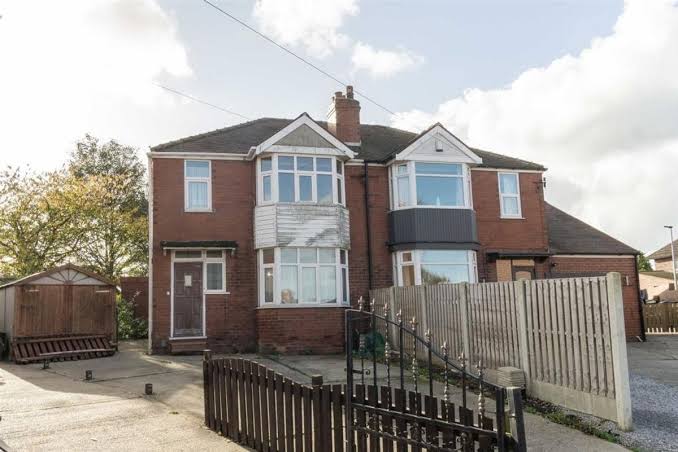
Kelsey was 19 and Brad was 21 when they bought a corner house in South Yorkshire that had sat empty for years, its walls streaked with mold and its back garden so overgrown it had turned into something closer to a small forest. They paid £135,000 for it in December 2023. Eighteen months later, they sold the finished house for £425,000 — a £290,000 jump that started with two people who had never renovated anything before deciding the ugliest house on the street was worth a shot, according to Yorkshire Live’s reporting on the project.
Starting from studs and mold
The house wasn’t a fixer-upper in the cosmetic sense. It was, by the couple’s own account documented in local reporting, genuinely unliveable when they took ownership — years of vacancy had left mold across the walls, and the garden had gone completely feral. Brad, who had industry knowledge from working in the trade, knew from the first viewing that the layout needed a fundamentally bigger kitchen and living space than what existed. Planning approval came through in late February 2024, and the real work started that March.
What followed was close to a full gut renovation. The couple stripped the interior back to bare brick, tore out ceilings and anything touched by damp, and knocked down the wall separating the kitchen from the dining room to open the ground floor up. They added a double-storey extension that more than doubled the size of the original house, rewired the entire property, and installed new gas central heating from scratch. A new staircase went in along with a completely reconfigured layout: a new master bedroom with en-suite, a redone main bathroom, and a four-bedroom footprint by the time it was finished — up from whatever the original cramped layout had offered.

The parts nobody puts in the highlight reel
None of this happened on a television-renovation timeline. The couple worked through the project across evenings and weekends for months, layering in an open-plan kitchen and dining area, a utility room, a garage, and eventually a fully landscaped garden with its own outbuilding to replace the overgrown lot they’d started with. Brad has talked about the extension as the single biggest undertaking of the whole project, more than doubling the house’s footprint on its own — the kind of structural work that turns a renovation from cosmetic into genuinely load-bearing.
The couple documented the entire process on TikTok, where their account grew to more than 113,000 followers and their videos collected upward of 5.6 million likes — an audience that watched a mold-streaked, forest-choked corner lot turn, room by room, into a four-bedroom family home with a finished garden. Kelsey has described the social media growth as unexpected, given she’d never really engaged with platforms like that before starting the renovation account.
Why the number matters more than the aesthetic
The renovation reveal itself — bare brick and mold giving way to an open, light-filled living room and a landscaped yard — is the kind of transformation that plays well on video precisely because the “before” is so convincingly rough. But the more interesting number here isn’t the finished paint color or the kitchen layout. It’s the spread between purchase price and sale price: £135,000 in, £425,000 out, on a property that most buyers in the original condition would have walked straight past.
That gap is the actual argument for buying the worst house on a good street rather than a move-in-ready house on an average one. It takes capital, time, and in this case a genuine trade background to pull off — Brad’s industry knowledge shaped decisions throughout the project that a couple without that background might have had to pay a contractor to make. But the arithmetic, once the renovation was done, is hard to argue with: a young couple bought the house nobody wanted, lived in it while they rebuilt it, and walked away with nearly triple what they paid, plus a home that looked nothing like the one they started with.
Source: Yorkshire Live
Leave a Reply