If you are about to spend $50,000 on a kitchen, a builder with more than 15 years of experience has a warning for you. He says most people learn these lessons the hard way, about six months after the check clears.
The builder behind @BuiltByBeckerMedia says he gives the same talk to every client who tells him they are ready to write a check. Every point, he says, will either save you money or save you from a kitchen you will eventually hate.
It starts with a decision most homeowners get backward.
“The Color Can Wait. The Plumbing Can’t.” Lock In The Layout Before Anything Pretty
Everybody wants to start with the fun stuff, like cabinet color, backsplash and hardware. The builder says that is the last decision, not the first.
What decides whether a kitchen works for the next 20 years is the work triangle, the path between the sink, the stove and the fridge, and where the plumbing lands. Moving plumbing, he says, is the single most expensive thing you can do in a kitchen, three to five times the cost of leaving it on the wall.
If you fall in love with a finish before you settle the layout, you end up bending the whole kitchen around a pretty picture instead of how you actually cook. He tells clients to settle the sink, the stove, the fridge, the aisles and how they cook before they ever look at materials.
Cabinets Can Eat 30 To 40% Of A $50,000 Budget, And One Can Cost As Much As A Used Car
Here is where he says the money actually goes, because it surprises people every time. Cabinets are the single biggest line item in the room, and they can take 30 to 40% of the entire budget. At the high end, he says, a single cabinet can cost as much as a used car.
Labor, which covers demolition, plumbing, electrical and installation, is another 20 to 35%. Countertops take 10 to 30%, depending on what you pick. Appliances, flooring, lighting and backsplash split whatever is left.
He puts real numbers on a $50,000 kitchen:
- Cabinets: $15,000 to $20,000, probably for a 15-box kitchen.
- Countertops: $4,000 to $7,000 for regular quartz, and you can double it for quartzite, marble or soapstone.
- Appliances: $6,000 to $10,000 for a simple package.
- Labor: $10,000 to $15,000.
- The rest covers flooring, lighting, the sink, backsplash and hardware.
He says those buckets apply at every price point, so you just scale them up or down.
The 10 To 20% Rule He Makes Every Client Follow Before Demolition Starts
The one rule the builder makes every client follow is to hold back 10 to 20% for what you will not see. When crews open walls, they can find old wiring, a surprise leak or mold. On a $50,000 job, that is $5,000 to $10,000 you can bet something will need.
If you spend every last dollar on the plan, he says, the first surprise stops the whole job cold. Then you are waiting and paying for the crew to come back.
Same $50,000, Two Clients, And One Kitchen “Looks Like It’s Been Attacked” In 3 To 5 Years
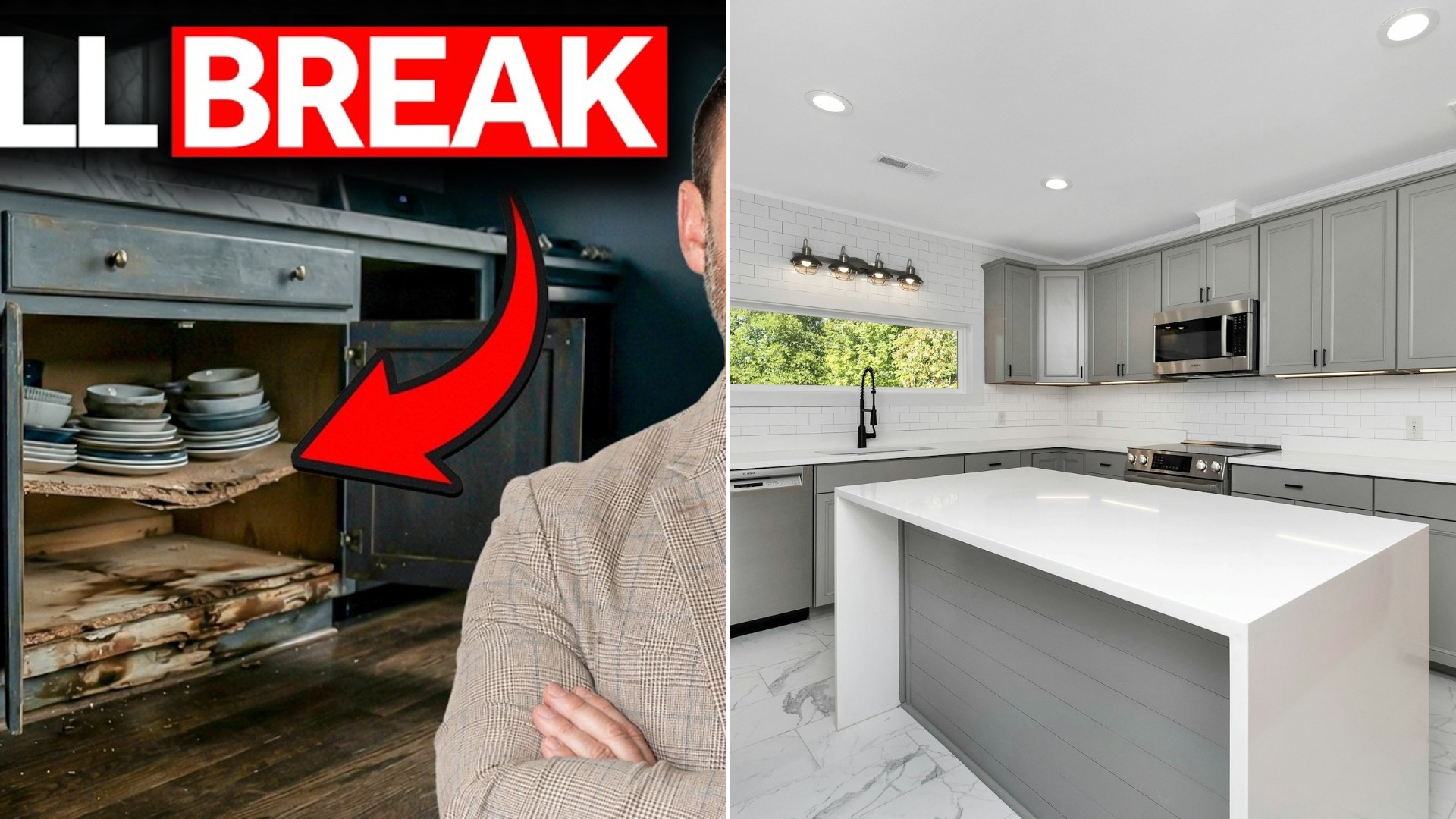
You cannot afford to spend big on everything, so he says to spend on what is permanent and used every day. That means plywood cabinet boxes, good hardware instead of particle board that sags, a real range if you cook, and the sink and faucet because they get beaten up the most.
You can save on the backsplash, countertops, hardware and paint, since those are swappable. Value engineering, as builders call it, belongs on the decorative items. The backsplash you can change later, but cabinet boxes, probably not.
His clearest example is two clients with the same $50,000. One puts it into plywood boxes, soft-close hardware, a real range and nice quartz, with simple subway tile and basic hardware. The other blows the budget on a designer backsplash, fancy pulls and an expensive countertop, then goes cheap on the boxes underneath.
Three to five years later, he says, the second kitchen looks like it has been attacked. It has sagging shelves, doors that do not close properly, and particle boxes that break apart at the first leak. Same money, completely different outcome.
The Hidden Costs That Blow Up A Budget At Week Three
None of these show up on the pretty quote, he says. They show up on the final bill. Electrical upgrades come first, because an old panel may not handle a modern kitchen, and once the electrician opens it up, “we’re having a different conversation.”
The others are moving plumbing, permits, and the drywall, patching and paint that follow any time a wall is opened. Before you sign, he wants you to ask your contractor to spell these out.
- What is the panel situation?
- Are we moving plumbing?
- What permits do we need?
- What does the patch and paint run afterward?
He wants that conversation before you write the check, not at week three when the walls are already open.
Build For How You Cook, Not For How It Photographs
His last point is that the Instagram kitchen and the working kitchen are two different rooms. A giant island looks incredible in a photo, he says, but if it breaks your work triangle, you end up doing laps around the kitchen while making dinner. It is beautiful and exhausting.
Before designing anything, he suggests answering honest questions.
- How many people cook in the kitchen at once?
- Do you actually cook, or mostly reheat?
- Where does the trash go?
- Where do the groceries land when you come in from the car?
Design around the real answers, he says, and you get a kitchen that works around your life for 20 years. Design around a photo, and you get a kitchen that looks great and fights you in real life. His bet is that the layout is the thing most homeowners are about to get wrong, because everybody wants to start with pretty.
More Stories You May Like
- Renter Confronts Self-Described Property Manager Who Showed Up With a Stranger Planning to Move Into Her Son’s Bedroom Even Though the Owner Never Countersigned Her Lease
- Kitchen Countertop Guide Warns That Quartz Can Crack From A Hot Pot While Marble Etches From A Drop Of Lemon Juice And Granite Needs Sealing Every 1 To 2 Years
- Overpricing Skipping The Obvious Repairs And Over Renovating Before Listing Are The Three Seller Mistakes That Can Cost Real Money On A Sale
Leave a Reply