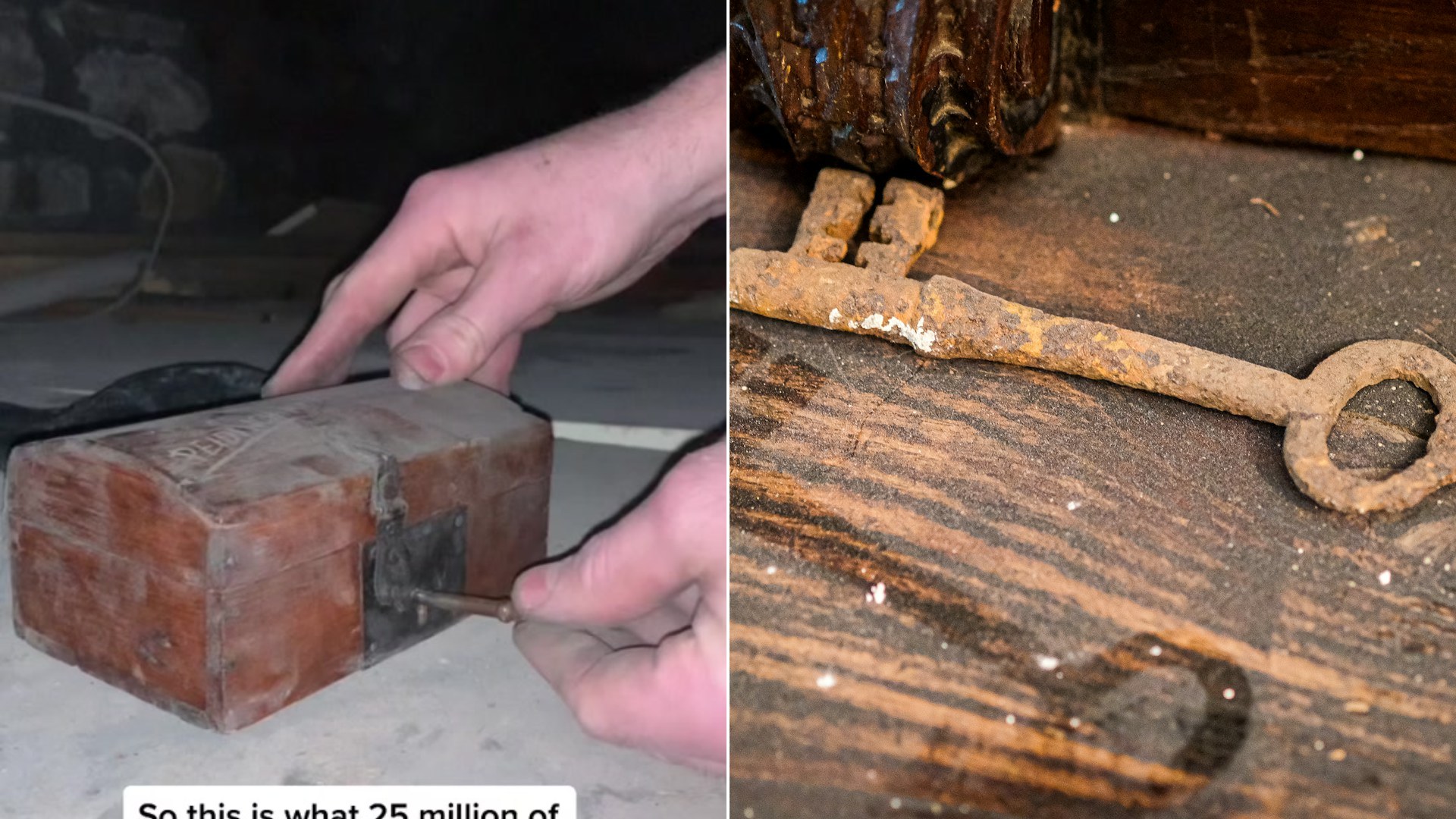
Some old-house stories start with a leaky pipe or a bad paint job. This one starts with a box hidden inside an attic wall. The creator behind @geebeetv says the box turned up during a renovation, and that a key was rattling around inside a mirror nearby. In the follow-up, the owners say a huge crowd had been waiting to see what was in it, so they finally opened it up.
What came out was a small collection of strange objects that nobody would expect to find tucked behind plaster and lath. Here is what the homeowners say they found, and a look at why people have been hiding things inside houses for centuries.
@geebeetv
What was inside the box
The creator opens by saying this is what 25 million people wanted to see. For anyone who missed the first part, they explain that they found the box in their attic wall, and that the key to it was rattling inside a mirror. Their takeaway is simple and a little spooky: “Someone didn’t want us to find it. But we have.”
The items they list are an odd mix:
- A small pendant necklace.
- What looks like a burnt piece of an Ouija board, covered in wax.
- A second key.
- A lock of hair.
The owners say they are not sure why any of it was hidden. But the second key gave them an idea. If there is a second key, they point out, there could be a second box, and they promise to keep looking. That is the kind of cliffhanger every old-house owner understands, because once you find one hidden thing in a wall, you start tapping on every other wall in the place.
Why would anyone hide objects in a wall?
It may feel like a movie plot, but hiding objects inside buildings is a real and well-documented habit. Archaeologists use a very plain name for it: “ritually concealed building deposits.” According to History.com’s look at colonial superstition, belief in witches was widespread in past centuries, and people tucked items into walls, floors and chimneys to ward off witches and evil spirits. Hearths were a favorite spot because people believed witches could fly down a chimney.
The items were not always spooky-looking. Worn shoes, often children’s or women’s, have turned up under floors, behind hearths and above doorways. “Witch bottles” holding things like hair, fingernail clippings, pins and salt have also been found, and hundreds have been discovered in England alone. Nobody left a diary explaining the practice, so much of what we know comes from what builders and owners later dug up.
Does that mean the box in this attic was a protective charm? Nobody can say, and the owners do not claim to know. But a lock of hair, a keepsake necklace and a pair of keys are the kind of personal items that people have long treated as meaningful, whether as a memory, a secret or a bit of folk magic. Another possibility is far more ordinary: somebody simply wanted to keep a few private things where nobody would find them, and then forgot or never came back.
A quick word on the Ouija board
The most eye-catching item is the wax-covered, burnt piece the owners say looks like part of a Ouija board. That detail is worth a little context. As Smithsonian Magazine explains, the board grew out of the American Spiritualism craze of the 1800s. The Kennard Novelty Company was formed in 1890, and attorney Elijah Bond received a patent in February 1891 for what the Patent Office considered a “toy or game.”
The article also points to the ideomotor effect, small muscle movements that people make without realizing it, as the reason the pointer seems to move on its own. In other words, the history of these boards is a lot more about parlor games and grief than anything supernatural. If the piece in the attic wall really is part of an old board, it would be a fun clue about roughly when the box may have been hidden, since the boards have been made for well over a century. Still, the owners only say it “looks like” one, so it is best to treat that as a guess until an expert takes a look.
What to do if you find something hidden in your walls
Most hidden finds in old houses are harmless. Still, a few sensible habits will help you protect both the object and yourself.
- Stop and photograph first. Take pictures of exactly where and how the item was sitting before you move it. Position can tell you a lot about how old something is and why it was placed there.
- Handle with clean, dry hands. Old paper, fabric and hair are fragile. Avoid tape, glue or cleaning products, which can cause damage that cannot be undone.
- Be careful with wax and burnt items. Residue can flake or smear, so keep the piece flat in a box or folder rather than carrying it loose.
- Look for the next clue. Keys, labels, initials and dates can point to a previous owner. Your county recorder or a local historical society may be able to help you trace who lived there.
- Wear a mask and gloves in attics. Old insulation, dust and droppings are a real hazard when you start opening up walls, no matter how exciting the find.
- Ask a local expert. A historical society, museum or antiques appraiser can help you date what you found.
The hunt for box number two
For now, the owners say they will keep searching. A second key does not guarantee a second box, but it is enough to keep any curious homeowner up at night. It might open the first box’s lid, a drawer, a trunk or something else entirely. Or it may have been meant for a lock that disappeared long ago.
That is part of the charm of an older house. Every wall has been built, patched, papered and painted by people you will never meet, and every so often one of them leaves a note to the future, whether on purpose or by accident. This family now has a pendant, a key, a lock of hair and a burnt scrap of mystery to show for their renovation, and a very good reason to keep their flashlight handy.
If you have ever opened a wall and found something that did not belong, you know the feeling: equal parts thrill and a tiny shiver. The best advice is to go slowly, take notes and enjoy the story, whatever it turns out to be.
Leave a Reply