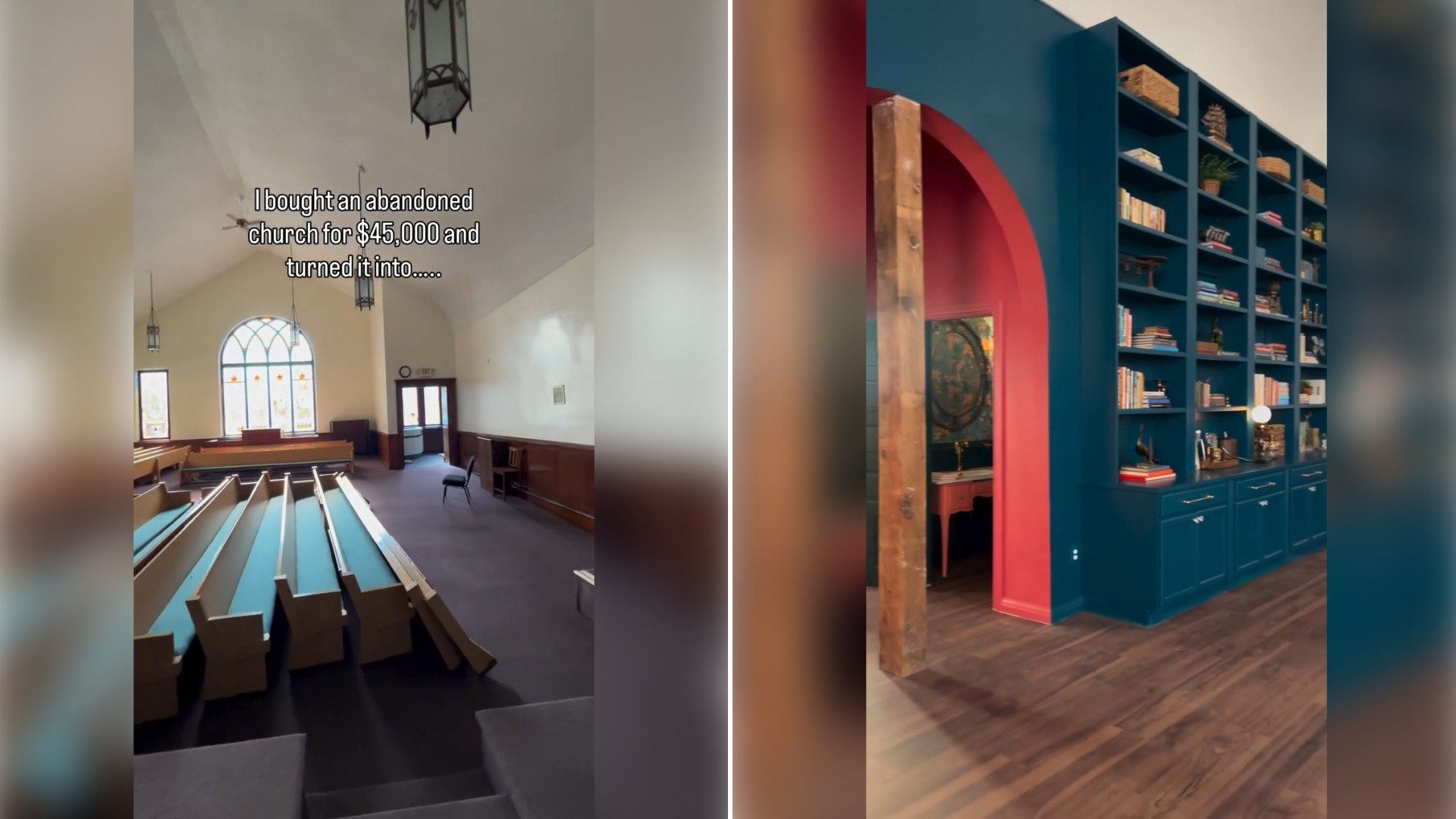
A creator tours a former church that he purchased for $45,000 and has been converting into a personal residence, showing the original pews and architecture alongside completed renovated living spaces. On-screen text frames it as a story about risking everything to chase an unconventional homeownership dream. It’s a small story on its face, but it’s told with enough specificity, real numbers, real rooms, real reactions, that it ends up saying something bigger about how people actually live.
View this post on Instagram
As @houseofvitrail frames it, there’s no attempt to smooth over the messier parts of the story, and that candor is a large part of why the post has resonated with people well beyond the creator’s usual audience.
Forty-five thousand dollars for an entire building, even a deconsecrated and badly aging one, is a number that immediately reframes the whole video for anyone who follows real estate prices. A single-family home at that price in most markets would be a teardown at best; an intact structure with soaring ceilings, stained glass, and original architectural detail at the same price point is the kind of gap that makes viewers stop scrolling just to understand how it’s possible.
Converting a former church into a residence involves a category of challenges a standard home renovation never has to face. Ecclesiastical buildings are typically designed around a single enormous open sanctuary rather than discrete rooms, which means a conversion has to solve for heating and cooling a cavernous space, carving bedrooms and bathrooms out of an architecture never meant to be subdivided, and working around features, pews, altars, stained glass windows, that most buyers would either have to preserve creatively or remove at real cost and effort.
Zoning and permitting for a religious-to-residential conversion can also be far more involved than for a typical remodel, since many municipalities classify former churches under separate codes for assembly buildings, parking requirements, and historic preservation review, any of which can slow a project down in ways that never make it into a sixty-second highlight reel.
The pews and architectural salvage visible in the footage aren’t just atmospheric set dressing, they’re a real decision point for anyone converting a sacred space: tear everything out for a blank-slate renovation, or build the new home around what’s already there and lean into the building’s original character as a selling point rather than a liability.
Buying a structure this unconventional also means accepting a resale pool that’s much smaller than a typical house would have. Not every buyer wants to live somewhere with forty-foot ceilings and a bell tower, which is part of what keeps the entry price so low in the first place, and part of the risk the creator is explicitly naming when he frames the purchase as risking everything.
Comment sections under a video like this one tend to fill with a mix of structural questions, how is a space this size heated affordably, what happens to the stained glass, is the foundation sound, and a kind of wistful envy from viewers who grew up driving past an empty church in their own town and always wondered what it would take to actually live in one.
Insurance is another piece of the story that almost never comes up in a viral conversion video but matters enormously in practice. Underwriters tend to treat a former religious building as an unusual risk, lacking comparable properties to price against and often carrying older electrical and roofing systems behind an impressive facade, which can make coverage harder to secure and more expensive than a standard homeowner’s policy for a conventional house of similar size.
There’s also a financing wrinkle worth naming: a lot of conventional mortgage lenders are reluctant to write loans against properties that don’t fit a standard residential comparable, which means a purchase like this one may have required cash, a specialty lender, or some combination of the two rather than a typical thirty-year mortgage, a detail that helps explain why a building this striking was still sitting on the market at a price that low.
Churches built decades or even a century ago also tend to come with genuinely excellent bones from a craftsmanship standpoint, old-growth timber framing, masonry built to outlast generations, stained glass that would cost a fortune to replicate today, even when the systems around that structure, wiring, plumbing, insulation, are long overdue for a full replacement. That tension, beautiful architecture paired with dated infrastructure, is a recurring theme in almost every unconventional-building conversion story, and it’s very likely part of what’s eating into the budget on this one as much as anything cosmetic.
Converting a sanctuary into a private home also raises a quieter question that doesn’t come up in most renovation content: how to live respectfully inside a space that, for generations, meant something entirely different to the people who built and used it. Plenty of adaptive-reuse projects lean into that history, keeping an altar niche as a reading nook or leaving stained glass intact as a window rather than removing it, treating the building’s past as part of what makes the finished home worth having rather than something to be erased.
Whatever the finished church ends up looking like, the appeal of this story was never really about square footage or even about the forty-five-thousand-dollar price tag on its own, it’s about watching someone take a building most people only ever see from the outside and turn it, piece by piece, into somewhere an ordinary life can actually happen.
Leave a Reply