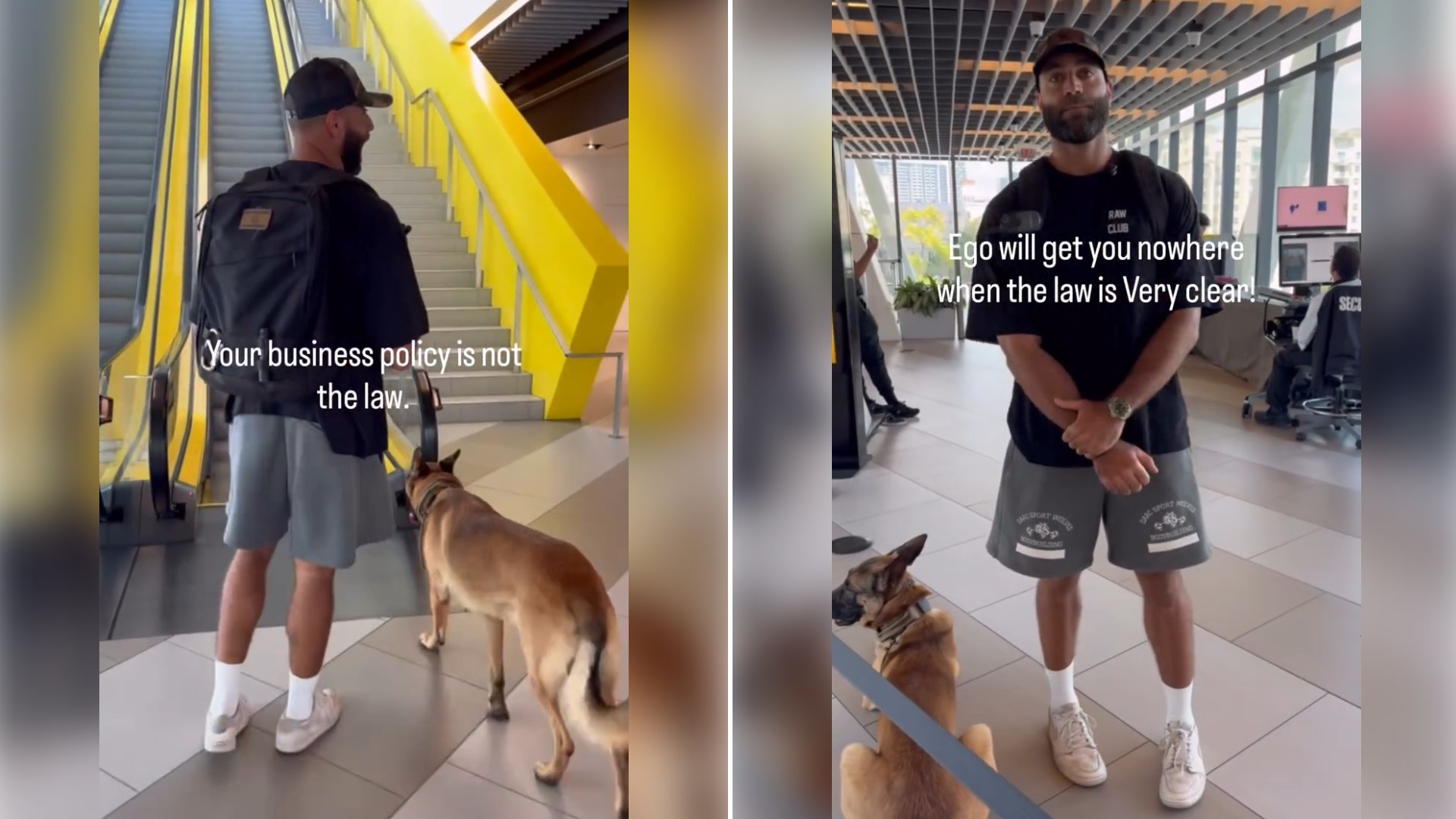
For people who rely on service animals, a simple errand can turn into an unexpected negotiation over rights most security staff were never properly trained on — a dynamic captured in a recent Instagram video from @jaxonlaze.
His caption opens with a measured, almost resigned observation: “I don’t expect security guards to know the laws as it pertains to service animals and the ADA but I …” According to the video, the creator documents a confrontational encounter with facility security regarding his rights to bring a service animal into public spaces. The exchange, caught on camera, shows the kind of friction that can arise when a legal right runs up against staff who simply don’t have clear guidance on how to apply it.
The video doesn’t specify which facility this took place at or the exact nature of the security team’s objection, but the caption’s framing suggests this wasn’t the creator’s first time navigating this exact kind of pushback — a sense of familiar frustration rather than total surprise at the encounter. That pattern, of having to repeatedly explain and assert a legal right in the moment, is part of what makes these videos land the way they do for viewers who share similar experiences.
The video reached a wide audience well beyond his existing following — 2.6 million views on an account with 228,000 followers — a reach that reflects broad public interest in seeing how these encounters unfold, and frustration, among viewers with service animals of their own, at how often the same misunderstandings seem to repeat.
The recurring nature of these encounters — evident in the caption’s resigned tone — points to a broader pattern that goes beyond any single facility: a persistent gap between what federal law actually requires and what frontline staff are trained to recognize in the moment.
Advocacy organizations for people with disabilities have pushed for years for more consistent staff training on service animal law specifically because these encounters, while often resolved without lasting harm, can be exhausting to repeat over and over in spaces that are supposed to be open to everyone.
Service Animals and the Law: What Businesses Get Wrong
The Americans with Disabilities Act gives people with disabilities the right to be accompanied by a trained service animal in most public places, but the law’s specifics are narrower — and more commonly misunderstood by staff — than many people realize. Under the ADA, staff are generally only permitted to ask two questions: whether the animal is required because of a disability, and what task it’s trained to perform. They cannot require documentation, a special ID card, or a demonstration of the task, and cannot ask about the specific nature of someone’s disability.
It’s also worth knowing that the ADA’s protections apply specifically to trained service dogs (and, in limited circumstances, miniature horses) performing a specific task — not emotional support animals, which fall under different, more limited legal protections and are not covered by the same public-access rights.
If you’re a business owner or staff member, a little training on these specific rules can prevent an uncomfortable and potentially legally risky confrontation. If you’re someone who relies on a service animal and runs into pushback, calmly stating the two ADA-recognized questions and their required answers is usually the fastest way to resolve a misunderstanding — and if a business still refuses access improperly, the Department of Justice’s ADA division accepts complaints directly from the public.
It’s also worth knowing that businesses that repeatedly deny access to a legitimate service animal can face legal consequences beyond a single uncomfortable encounter, including complaints filed with state attorney general’s offices in states with their own disability access laws layered on top of the ADA. Keeping a simple record of dates, locations, and what was said during any denial of access can matter if a pattern of violations needs to be documented later.
Carrying a small card summarizing the two ADA-permitted questions, while not required, is a practice some service animal handlers use specifically to de-escalate these encounters faster, offering staff something concrete to reference rather than relying on memory of a law they may not have been trained on at all.
You can watch the full video and follow @jaxonlaze on Instagram for more.
Leave a Reply