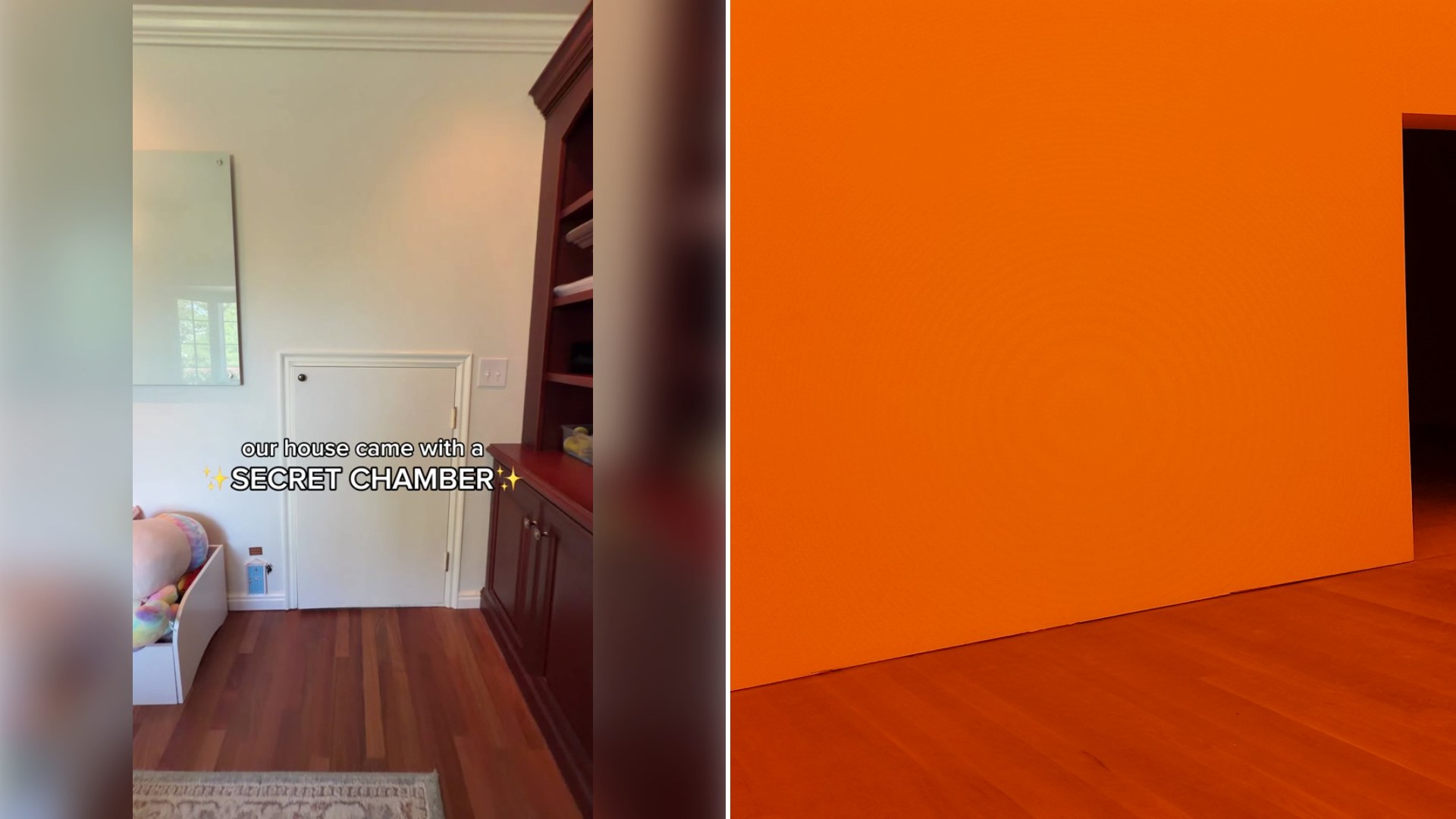
Renovation projects have a way of turning into archaeology, and few discoveries capture that feeling quite like what creator @kyliekatich (TikTok) stumbled onto mid-project: a secret room concealed behind the wall of her closet. What started as an ordinary renovation task turned into a real-time reveal, camera rolling, as she worked through the wall and realized there was an entire hidden space waiting on the other side.
There’s a reason hidden-room content performs so reliably well across every platform, and it has less to do with real estate than with childhood. Almost everyone grew up fantasizing about a secret passage, a false bookshelf, a crawl space nobody else knew about. Watching an adult actually find one, unscripted, in the middle of a mundane home improvement task, taps directly into that dormant wish fulfillment in a way staged content never quite manages.
It also says something about how much of a home’s history remains invisible to its current owners. Houses get renovated, walls get framed over, additions get bricked up, and unless something forces a homeowner to open that wall back up, decades of a building’s past can sit completely sealed off. Every time one of these discoveries surfaces online, it’s a small reminder that the house you live in may hold more than the floor plan on file at the county recorder’s office.
The renovation itself is also worth sitting with. Closet demolition is one of the more unglamorous corners of a remodel, easy to approach on autopilot, which is exactly what makes a genuine surprise mid-task land so hard. The best home-discovery content isn’t staged around the reveal, it happens to someone who wasn’t looking for anything more than a slightly bigger closet, and that authenticity is impossible to fake.
There’s a broader renovation-culture trend at play here too. As more people buy older homes rather than new construction, driven partly by affordability and partly by a genuine appreciation for pre-war craftsmanship, stories like this one are becoming more common. Older houses were built in eras with different standards, different family sizes, different ideas about privacy and storage, which means they’re far more likely to contain spaces that simply don’t map onto how we use homes today.
It’s also worth thinking about what hidden rooms like this originally served. A concealed space behind a closet wall could have been a servant’s passage, an old pantry, a Prohibition-era storage spot, or simply the byproduct of a clumsy mid-century addition that sealed off part of an older structure. Without documentation, homeowners are often left to speculate, turning their renovation into a bit of amateur detective work layered on top of the construction itself.
For anyone currently house hunting or planning their own renovation, there’s a practical lesson tucked inside the spectacle: it pays to ask questions before swinging a sledgehammer. A contractor or inspector familiar with a home’s era and construction style can sometimes spot clues, an oddly shaped nook, inconsistent wall thickness, a door that leads nowhere, that hint at something worth investigating before it becomes an accidental on-camera surprise.
This kind of video also reflects why renovation content has become such a dominant genre of home media. It isn’t polished, it isn’t curated for aesthetics the way a finished-room reveal is, and that rawness is precisely the appeal. Viewers aren’t watching for design inspiration here, they’re watching because the unpredictability of an old house, caught on camera in real time, is more compelling than almost anything that can be scripted.
In the end, what makes this discovery so satisfying isn’t just the hidden room itself, it’s the reminder that a house is never fully known the moment you buy it. Every wall is a small unopened question, and every renovation carries the quiet possibility of turning up something nobody expected. That possibility, more than any finished design, is what keeps so many of us watching home renovation content in the first place.
Leave a Reply