A basement egress window costs $4,244 on average nationwide, with most homeowners spending between $2,723 and $5,898, according to Angi’s 2026 cost data. That single window is also the difference, legally, between a basement “rec room” and a basement bedroom, because most building codes won’t let an agent or appraiser count a below-grade room as a legal bedroom without one. The requirement comes from the International Residential Code’s Section R310, which sets exact minimums for the opening’s size, shape, and height off the floor. Meet those numbers and a finished basement room can be marketed, appraised, and sold as an actual bedroom. Miss them, and it’s permanently a “bonus room” no matter how nice the finishes are, which matters more than most homeowners realize when it’s time to sell, since a real estate listing that overstates its bedroom count can create real problems during an appraisal or a buyer’s final walkthrough.
The Code Minimums, Exactly
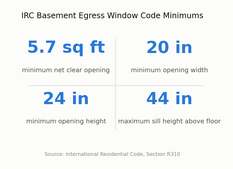
The International Residential Code requires a minimum net clear opening of 5.7 square feet, with the opening at least 20 inches wide and 24 inches high in every direction, and a maximum sill height of 44 inches above the finished floor. All of those numbers have to be satisfied simultaneously; a window that’s technically wide enough but mounted too high, or one with enough combined width and height but not enough total clear area, still fails inspection. The math is specific enough that most contractors size the rough opening before quoting the job rather than after. Ground-floor rooms get a slightly easier bar under the same IRC section, with a minimum net clear opening of 5.0 square feet instead of 5.7, since there’s no window well or excavation involved and emergency exit is already simpler at grade level. Basements don’t get that break, precisely because a below-grade opening is the harder emergency-exit scenario the code is written around in the first place.
What It Costs by Window Size
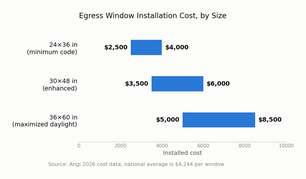
Angi breaks installation cost down by opening size, and the spread is wide. A minimum-code 24-by-36-inch window runs $2,500 to $4,000 installed, while a more generous 30-by-48-inch opening runs $3,500 to $6,000, and a 36-by-60-inch window built for maximum daylight can run $5,000 to $8,500. Every size in that range clears the IRC’s 5.7-square-foot minimum; the price climbs mainly with the excavation and window well work needed for a bigger hole in the foundation wall, not with the glass itself. Permits and inspections typically add another $150 to $500 on top of the installation price, and a drainage system for the window well, needed to keep groundwater from pooling against the new opening, can run another $500 to $2,000 depending on soil conditions and how much grading the yard needs.
What a Legal Bedroom Is Actually Worth
Real estate data suggests the payoff can run well past a $4,244 window installation. Going from a two-bedroom to a three-bedroom home, or three to four, has been shown to translate into a 5% to 15% bump in a home’s adjusted appraisal value, per real estate market data compiled by Clever Real Estate. On a $400,000 home, that range works out to $20,000 to $60,000 in added equity, an outsized return against a five-figure egress window project, though the exact number depends heavily on local market conditions, the specific bedroom count buyers expect in that neighborhood, and how well the rest of the basement is finished.
The Part That Trips People Up
Homeowners often assume any basement window with decent size counts, but sill height quietly disqualifies more finished basements than the opening dimensions do, since older homes frequently have window openings sitting higher than 44 inches off the floor. Retrofitting that usually means cutting into the foundation wall itself and adding a window well with proper drainage, which is most of what separates the cheap end of Angi’s cost range from the expensive end. Before finishing a basement bedroom around an existing window, it’s worth having a contractor confirm the sill height meets code, not just the glass size, since that’s the detail that turns a straightforward window swap into full excavation work. It’s also worth checking local amendments to the IRC before assuming a national number applies exactly, since some jurisdictions layer on their own additional requirements around window well ladders, emergency escape clearances, or minimum well dimensions that go beyond what the base code requires.
Leave a Reply