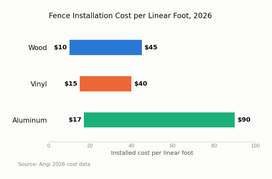
Aluminum fencing can cost up to $90 per linear foot installed, nearly nine times what wood fencing can cost at its cheapest end of $10 per linear foot, according to Angi’s 2026 cost data. That’s the kind of spread that makes “how much does a fence cost” a nearly meaningless question without a material attached to it. Wood, vinyl, and aluminum aren’t just priced differently; they’re built for different failure modes, which is why comparing them on installed cost alone misses most of what actually determines whether a fence is a good value ten or twenty years out. Here’s what each material actually runs, and how long it’s realistically expected to last once it’s in the ground, before you factor in the upkeep that separates a fence’s best-case lifespan from its worst.
Wood: $10–$45 per Linear Foot, 10–25 Years
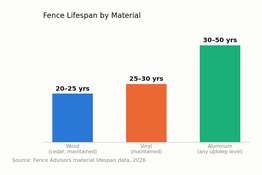
Wood is the cheapest material to get in the ground, running $10 to $45 per linear foot installed, and it’s still the material most people picture when they think “fence.” That low upfront cost comes with the widest lifespan swing of the three: a cedar wood fence lasts roughly 20 to 25 years with regular staining and sealing, but drops to just 10 to 15 years with no upkeep at all, per lifespan data compiled by Fence Advisors. That maintenance dependency is the real cost of choosing wood; skip the staining schedule and you’re replacing panels a decade earlier than the material is capable of lasting. Cedar specifically holds up better than pressure-treated pine over time because of natural oils in the wood that resist rot and insects, but even cedar needs that upkeep cycle to reach the top of its range rather than the bottom.
Vinyl: $15–$40 per Linear Foot, 20–30+ Years
Vinyl sits in the middle on installed cost, at $15 to $40 per linear foot, while offering a narrower and generally longer lifespan range than wood: 25 to 30-plus years maintained, or 20 to 25 years with no maintenance at all. The gap between vinyl’s best and worst case is much smaller than wood’s, mainly because vinyl doesn’t rot, and its maintenance ceiling is just an occasional rinse rather than a repaint-and-reseal schedule. That narrower range makes vinyl easier to budget around, since you’re not betting the fence’s lifespan on whether you actually keep up with yearly upkeep. Vinyl does have its own weak point, though: extreme cold can make the material brittle, and a hard impact in freezing weather is more likely to crack a vinyl panel than dent a wood or aluminum one.
Aluminum: $17–$90 per Linear Foot, 30–50 Years
Aluminum is the priciest material by a wide margin, running $17 to $90 per linear foot installed, and it’s also the only one of the three where maintenance barely moves the needle: aluminum fencing lasts 30 to 50 years regardless of upkeep level, since corrosion, not rot or UV breakdown, would be its main failure mode, and aluminum’s powder-coated finish resists that extremely well. For homeowners who want a fence they can genuinely ignore for three decades, aluminum’s higher sticker price is effectively buying out the maintenance requirement that wood and vinyl still carry to some degree. It’s also worth noting that aluminum fencing is typically more open and decorative by design, closer to a traditional wrought-iron look than a solid privacy screen, so the material choice often gets decided by the look a homeowner wants before cost or lifespan even enter the conversation.
What the Numbers Actually Mean for Your Yard
Run the cost-per-year math and the picture shifts. A wood fence at the low end of its price range but the low end of its lifespan works out to roughly a dollar per linear foot per year of use, similar to vinyl’s blended average, while aluminum’s higher upfront cost gets stretched across a longer, more upkeep-proof lifespan that can make it competitive over a 30-year ownership horizon despite looking expensive on day one. The material that looks cheapest on a contractor’s quote isn’t necessarily the material that costs the least by the time you’re the one replacing it, and that gap only shows up if you do the maintenance math before you sign the contract, not after the first panel starts sagging.
Leave a Reply