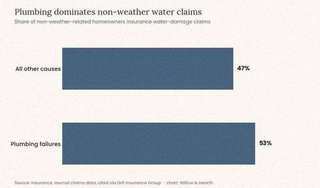
Thirty-four percent of homeowners now name plumbing as the single most common problem in their house, according to Hippo Insurance’s 2026 Housepower Report. That puts leaky supply lines, slow drains, and running toilets ahead of appliance failures, electrical gremlins, and every other category homeowners were asked about. It’s a shift from just a year earlier, when Hippo’s data showed water and roof damage dominating the list. Plumbing has also earned a less flattering distinction: it’s responsible for 53% of non-weather-related water damage insurance claims, more than every other cause combined. If you’ve ever patched a supply line yourself only to find a damp cabinet three weeks later, you already know why.
Why plumbing breaks more than it should
Part of the reason plumbing tops the list isn’t that pipes are inherently more fragile than wiring or ductwork. It’s that plumbing systems fail in ways homeowners notice immediately and often try to fix themselves before anyone with a license gets involved. A slow drip under the sink looks like a five-minute job. Swap a washer, tighten a fitting, done. Except modern supply lines run on compression fittings and sweated joints that don’t forgive an eighth of a turn too far or too little, and a wrench applied with more enthusiasm than technique cracks a fitting that was fine yesterday.
Compare that to an appliance breakdown, which usually announces itself with an error code and a clear “call someone” signal, or an electrical issue, which most people are reasonably afraid to touch. Plumbing invites DIY confidence that the failure rate doesn’t support.
The homeowner’s own data backs this up
Hippo’s separate survey on DIY mistakes found that 58% of homeowners spent more than they expected on a DIY project because of errors, and 47% admitted they underestimated the time commitment going in. When something did go wrong, 32% of those homeowners ended up filing an insurance claim to cover the damage. That’s a category plumbing fits into more often than any other trade, given how often a small leak becomes a ceiling stain in a neighboring room. Sears Home Services’ survey of DIY homeowners adds a blunter number: 46% needed a professional to redo work they’d already attempted, at an average cost of $1,600 on top of whatever the original project would have cost.
What actually goes wrong under the sink
The physics of plumbing failure is less forgiving than most home systems. Water finds every gap a joint leaves behind, and it does it slowly enough that you often don’t catch it until the drywall has already absorbed weeks of moisture. Compression fittings need to be seated straight: even a slight cross-thread will seal well enough to pass a quick test run and then fail under sustained pressure. PVC cement needs cure time that a lot of DIYers skip because the pipe “feels solid” after twenty minutes. And shutoff valves that haven’t been touched in a decade often don’t fully close, which means the “fix” starts with a valve that was never really off in the first place.
None of this means plumbing repairs are off-limits for a reasonably careful homeowner. Replacing a wax ring, swapping a faucet cartridge, or clearing a P-trap are well within DIY range with the right prep. The failures cluster around anything involving a soldered or compression joint under continuous pressure, and around jobs rushed because “it’s just a five-minute fix.” Given that this is now the single most-reported home problem in the country, the honest move is to treat plumbing with the same caution most people already extend to electrical work, not because it’s equally dangerous but because it’s equally unforgiving of shortcuts.
A cheap habit that catches most of this early
The gap between a $15 fitting and a $1,600 redo, per the Sears figures above, usually comes down to whether anyone checked the repair after the fact. A compression joint or a fresh solder connection can hold under a static pressure test and still weep slowly once the house settles back into normal use: hot water cycling, a washing machine’s fill valve slamming shut, someone leaning on the vanity. Running water through a new repair, then checking it again the next morning and again a week later, catches the slow failures before they’ve had time to soak into subfloor or drywall. It costs nothing but a few minutes, and it’s the step most DIY plumbing jobs skip entirely once the water runs clear on the first try.
What Hippo’s numbers really point to is a mismatch between how simple plumbing repairs look and how little margin they actually have for error. The systems that fail the most aren’t the ones people are most afraid of — they’re the ones that look easiest to fix on a Saturday afternoon.
Leave a Reply