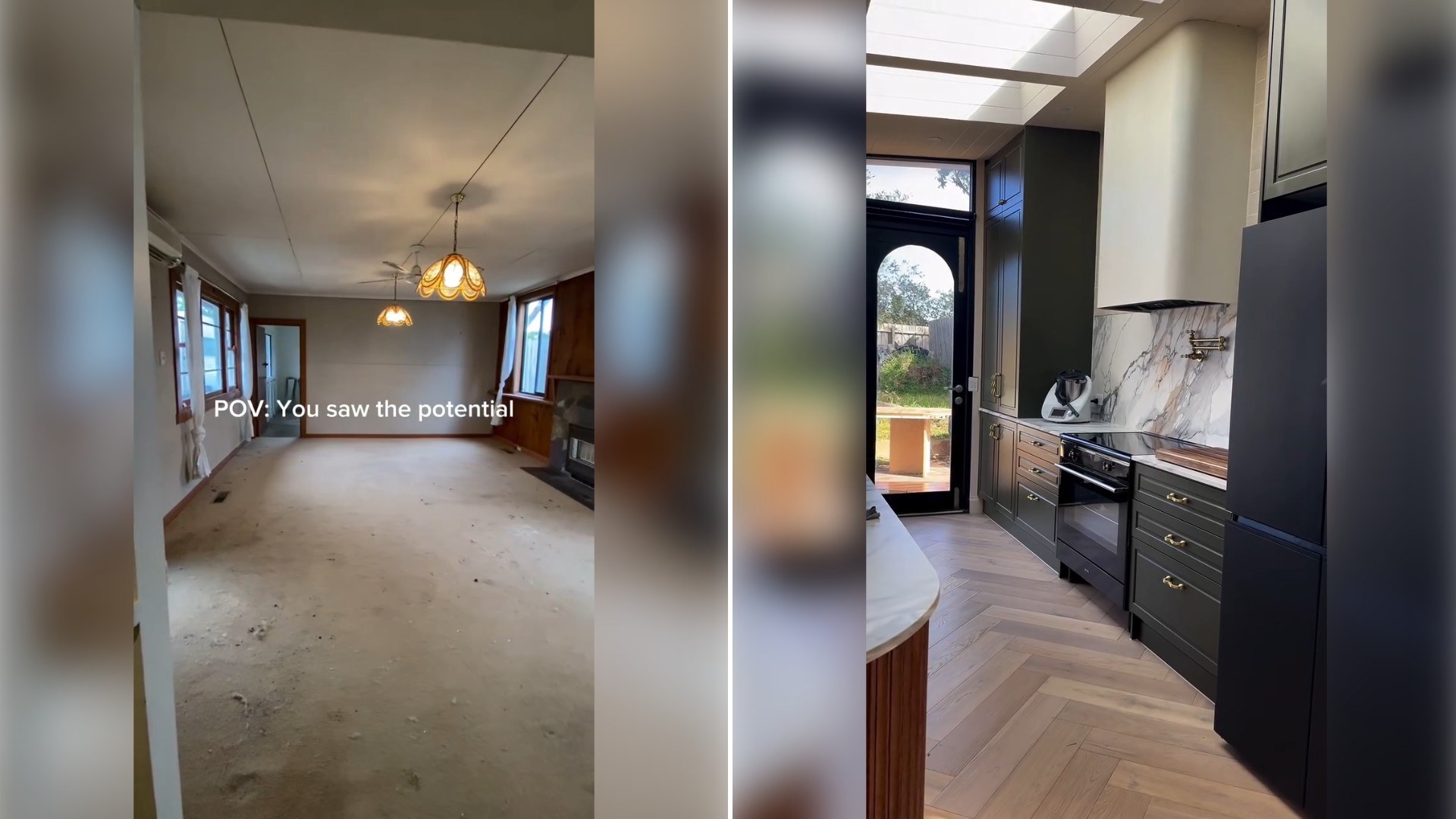
A creator shows a static shot of a completely rundown, empty hundred-year-old cottage as it looked at purchase, then cuts to the finished, cinematically shot transformation. The caption frames it as seeing the cottage’s potential from the moment they first walked in. There’s nothing staged about the setup here, just a straightforward premise that plays out exactly the way the caption promises, which is precisely why it’s resonated with the people who’ve seen it.
The footage leans on a single, static camera angle held steady across both shots, before and after, which makes the transformation read as an apples-to-apples comparison rather than a flattering edit stitched together from the most forgiving possible angles of each version of the room.
View this post on Instagram
As @samanthaeberhart tells it, the story is grounded in specifics rather than generalities, and that groundedness is exactly what separates a clip like this one from the more staged, aspirational content that tends to circulate in the same corners of social media.
“POV: you saw the potential” is a caption doing a lot of quiet work, because it reframes the entire before shot. Instead of asking viewers to simply marvel at a gap between ugly and beautiful, it asks them to imagine standing in that same empty, stripped-down room and somehow seeing the finished green-and-marble kitchen that eventually replaced it, a framing that turns the video into a kind of vision test as much as a renovation reveal.
A hundred-year-old cottage carries a very different renovation calculus than a newer property. Century-old structures typically come with outdated or nonexistent insulation, plumbing and wiring that may have been patched rather than fully replaced over the decades, and foundations that have had a hundred years to settle, shift, or develop issues a newer build simply hasn’t had time to accumulate. None of that drama necessarily shows up in a thirty-second before-and-after, but it’s almost certainly part of what made the “before” shot look as stark and empty as it does.
The choice to shoot the finished kitchen with deep green cabinetry against marble countertops and surfaces is itself a specific, considered design decision rather than a generic renovation default. Green has become one of the more popular departures from the all-white kitchens that dominated the last decade of home design content, and pairing it with marble signals an intent to make the space feel traditional and a little formal, fitting for a structure already a century old, rather than chasing a strictly modern look that might have clashed with the cottage’s original bones.
What makes a transformation like this one resonate beyond people specifically interested in historic renovation is the clarity of the premise: an empty, stripped room on one side, a fully styled, photographed, and lit kitchen on the other, with nothing shown of the actual demolition, framing, plumbing, or electrical work that had to happen in between. That gap is exactly where the viewer’s imagination does the heaviest lifting, filling in months of unglamorous labor the caption only gestures toward.
Comment sections under renovation reveals like this one tend to split between people asking for a full room-by-room cost breakdown and people simply reacting to how dramatically the space changed, and both reactions point to the same underlying appeal: a video that works equally well as inspiration and as a loose benchmark for anyone pricing out their own fixer-upper.
For anyone eyeing a similarly old, similarly rundown property, the real lesson in a transformation like this one isn’t the specific green-and-marble combination, it’s the discipline of being able to look at a gutted, century-old room and actually picture a finished version of it clearly enough to commit real time and money to getting there.
Whatever project this creator tackles next, the cottage transformation has already done the thing this particular format does best: turn a single dramatic before-and-after into proof that a hundred years of neglect doesn’t have to be the final word on what a house can become, and that the right vision, held onto long enough and backed by enough patience, can eventually catch up with reality, green marble and all.
There’s also a quieter point buried in the choice to film from the exact same angle both times. It would have been easier, and arguably more flattering, to shoot the finished kitchen from whatever angle made it look biggest or brightest, but holding the camera in the same position as the original empty-room shot forces an honest comparison, one where the viewer can trust that the transformation is real rather than an illusion created by clever staging and a wider lens.
For a hundred-year-old structure in particular, matching the camera position also does quiet work in proving the bones of the room didn’t change, only what filled it. The window placement, the ceiling height, the basic proportions of the space stayed constant, which means everything that reads as dramatically different, the cabinetry, the countertops, the lighting, the finishes, was a deliberate design decision layered onto an unchanged structural shell rather than a renovation that altered the room’s fundamental footprint. That distinction matters to anyone evaluating an old cottage of their own: the right finishes can transform a room without the structure itself ever needing to change, which is often the more affordable and more achievable version of a dramatic before-and-after than most viewers assume going in.
Leave a Reply