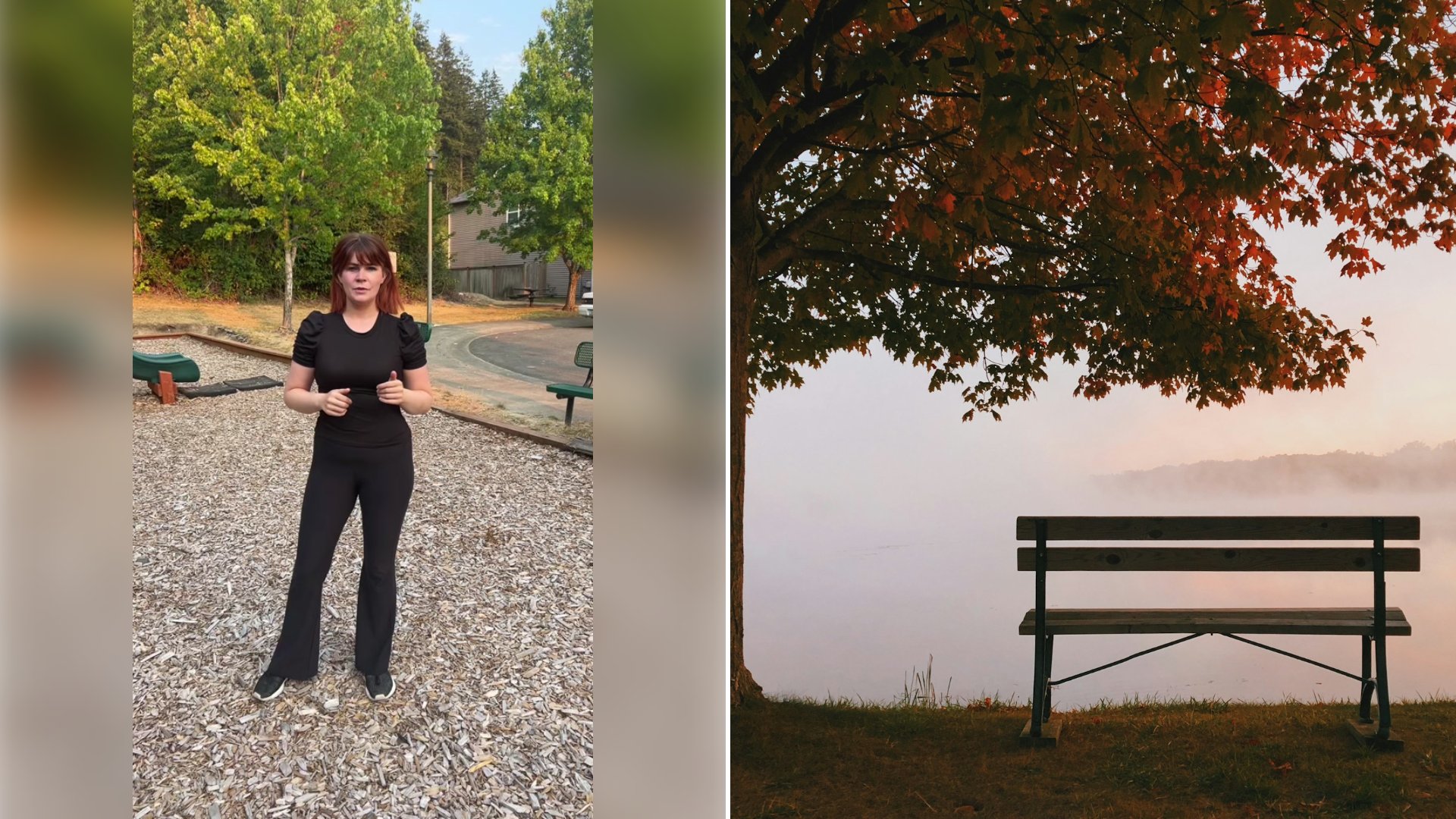
The tour starts with a reminder. “Remember the terrible HOA that fined me $90 for cosmetic violations after my house burned down?” the homeowner asks, standing at the edge of a neighborhood play area. “Well, they increased our fees to build this park.”
What follows is a two minute walk around that park, filmed by @absolutelynot19 and posted in August 2024. She calls it “this fabulous park they paid for with their extortion money,” and she does not find much to like. Her caption sums up the relationship: “My HOA is my arch nemesis.”
The playground in the video is a wooden set with a peaked roof, green slides, swings, yellow panels and two angled climbing walls dotted with green holds. Houses and parked cars are visible on the street beyond it. She begins at a yellow rope ladder hanging off one side of the tower, its lower rungs trailing loose on the ground. In her words, it is “a rope ladder that’s broken, that goes to nowhere.” She adds, “But if you’re crafty enough, you can get up on the roof, so that’s nice.”
Next are the monkey bars, which she says come with “a 10 foot drop” and run straight into the path of a swing, “with nowhere to go on the other side.” She walks through what that means for a child of seven or eight who manages to get up and start across: “Unless you can climb backwards, you’re dropping down.”
She points the camera up at the top of the structure, near a green tube, and says several bolts are missing. Then she moves along to the climbing walls. “You see two identical climbing walls. One of them is a busted plank,” she says, “which is very weird considering this is a brand new build.”
The bridge between the two sections gets a mixed review. It has a crossbar that, she says, “forces you to crawl, which is good, because it’s actually a pretty straight drop down here on both sides.” Her advice for families with small children is blunt: “You need two parents, one on each side, because they can just drop right off.”
Her larger complaint is about how a child is supposed to get up there at all. “There is no safe stairs or steps to get up here,” she says. “It’s just climbing walls, rope ladder to nowhere but the roof, and then a little rickety ladder.” And under it, by her description, is “rock hard, compacted dirt.” She jokes darkly that a fall would at least be over quickly.
From the other side she shows the second route between the two sections. The only ways across, she says, are the bridge “you’re forced to crawl through or a tunnel with, again, two straight drops down.”
She closes by going back to the fine. “I was very happy to pay my fines after you fined me for cosmetic violations after my house burned down. That was super reasonable and fair, by the way,” she says, with obvious sarcasm. “And yeah, this is what that paid for.”
In the caption she goes a step further, writing that the equipment “looks way to busted up to be brand new” and that she is “pretty sure” it was bought secondhand, with the rest of the money pocketed. That is her suspicion, and the video offers nothing to back it up. The fire, the $90 fine and the fee increase are likewise her account. The association is not named and its side is not heard.
Her complaints do line up with the things worth checking on any shared playground, whether or not your HOA built it. Start with the ground. Packed dirt does little to soften a fall, which is why public playgrounds use deep loose fill such as wood chips, or rubber surfacing, under and around the equipment. Then look up. Raised platforms and bridges should have guardrails or barriers on the open sides, and there should be a way to get up that a small child can manage.
Hardware is the quick test. Missing bolts, cracked boards and frayed rope are visible from the ground, and they are the kind of thing an association should fix before anyone plays on the set.
If you pay dues toward a project like this, you can ask questions before and after the money is spent. Ask the board in writing for the approved budget, the invoice or contract for the equipment, who installed it and whether it is rated for shared, public use as opposed to a single backyard. Ask whether the association’s insurance covers the playground and whether anyone inspected it before it opened.
When you spot a hazard, report it in writing with dated photos. A video tour like hers makes a clear record, and an email to the board or management company creates one they have to answer. Keep your own children off anything that looks broken in the meantime.
Buyers can use the same eye. Walk the common areas before you make an offer, because the state of a playground, a pool or a fence tells you how the board spends the fees you are about to start paying.
More from Willow and Hearth
- San Clemente Condo Owners Just Got Hit With a Sudden $26,000 Emergency Assessment From Their Own HOA, and the Numbers Behind That so Called Emergency Roof Repair Do Not Add up the Way the Board Claims
- Family Was Fined Fifty Dollars a Day Over a Scaled Back Holiday Light Display and They Are Lawyering Up Instead of Ever Taking the Lights Down
- Parents Leave A Three-Year-Old Alone On Playground Equipment, Then Give Another Family A Bitter Look When Their Own Kid Falls
Leave a Reply