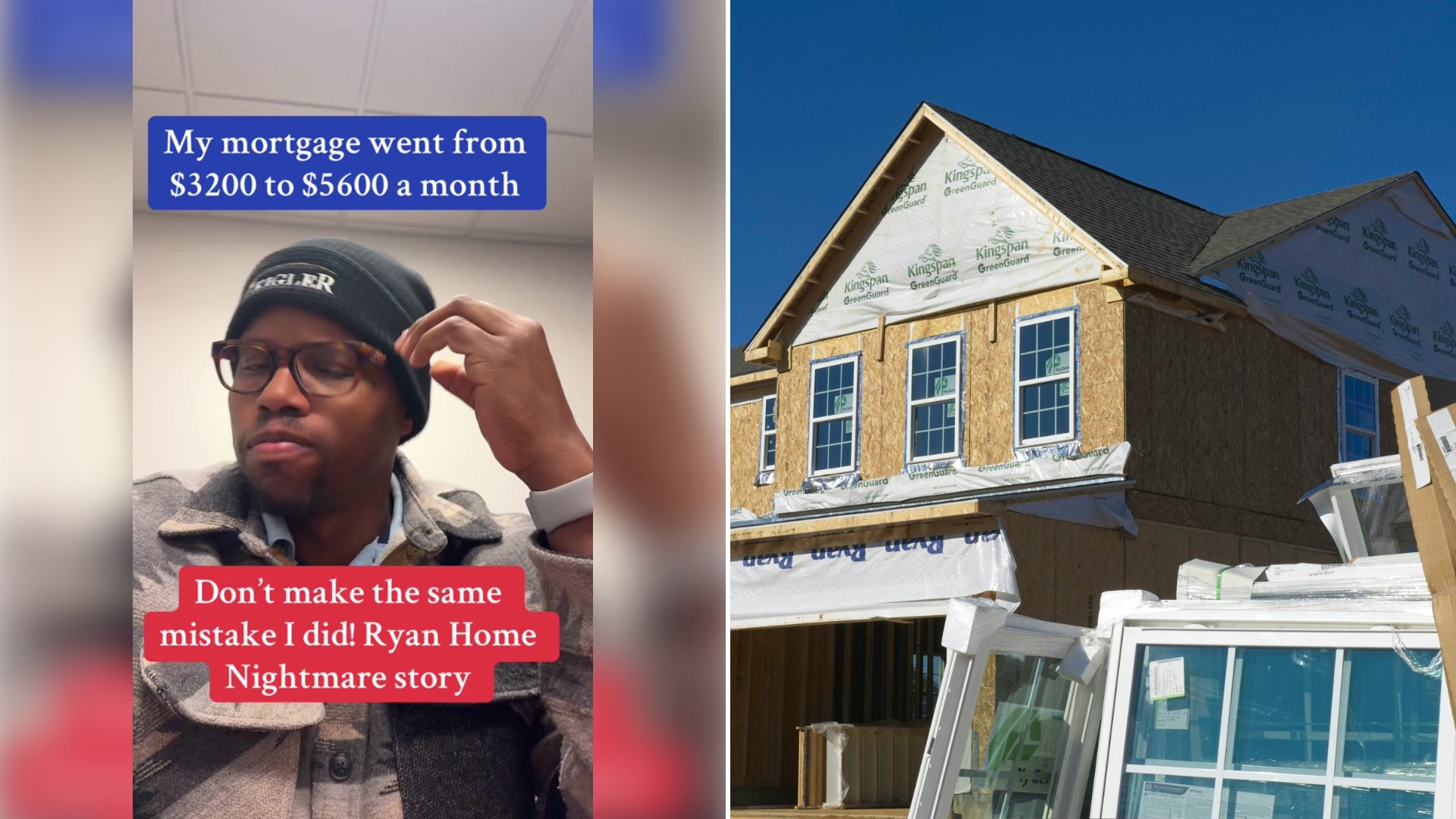
The first property tax bill on the finished house came to $16,000. Alonzo Massey, who posts on TikTok as @alonzomassey, called to ask whether it was a mistake. He said he was told it was correct.
That bill, he said in a video posted in February 2025, is why his monthly mortgage payment went from $3,200 to $5,600. “Don’t judge me here,” he said before giving the numbers. By then the house, in Antioch, Illinois, was up for sale.
Massey talks to the camera for nearly eight minutes in a black beanie and glasses. Two text boxes stay on screen the whole time: “My mortgage went from $3200 to $5600 a month” and “Don’t make the same mistake I did! Ryan Home Nightmare story.” The builder’s side is not in the video, so what follows is his account.
He said he was house hunting in 2022 and had offers on several homes turned down. Sellers, he said, wanted $50,000 to $60,000 over asking with no contingencies. So he bought new construction from Ryan Homes, the last house built in its subdivision. At signing the payment was “32 and some change,” and he was fine with it. “That’s what I expected,” he said.
He had a realtor who had been showing him houses. According to Massey, Ryan Homes does not pay a buyer’s realtor a commission on new construction, and he did not want the man to “come in and do free work” or to pay him out of pocket. He went through the purchase without him. “I guess I take the hit on that,” he said.
His explanation for the jump is that the payment he signed for was built on taxes for the land alone. The first bill “on the property with the home built” was the $16,000 one. He said that when he called about it he was told that, because his was the last home built, there were “plenty of comps in the area” that could have been used to estimate his taxes. His own view of why the land figure was used: “because it’s gonna show you a cheaper mortgage.”
The bill also reached backward. Because the taxes had been underestimated across 2022 and 2023, he said, “my escrow account is negative $11,000.” The new payment had to cover the higher taxes going forward and the shortfall already built up.
He ran the numbers without the shortfall too. Principal and interest came to about $2,700 and the taxes to roughly $1,300 a month, which put the lasting payment near $4,100. “Absolutely not,” he said. After the bill he looked up property taxes in Libertyville and Vernon Hills, which he called nicer areas. “No knock against Antioch, but it’s not Libertyville, it’s not Vernon Hills,” he said.
He had expected to stay seven to 10 years and have his kids grow up there. “I’m selling that home because we can’t afford it,” he said. “And I refuse to be house poor.” On what it cost him: “I did a lot of hard work to build my credit, save money for a home.” Then: “I just gave it away.” He ended the video looking for a new home and “starting all over again.”
Massey argued that a new construction builder “should have to show you property taxes” based on the value of the finished home. Had he seen that figure, he said, “I would have told them, no, I’m good. I’m not buying this.”
His caption reads “Please ask the right questions when buying a new construction home!” and he gives the question. Find the line on the builder’s paperwork that says taxes and ask, in his words, “Is this on before the house is built or after the house is built?” His cue to ask is an annual tax figure of “two or three thousand dollars” on a new house, though he allows that the right number depends on the area.
Then ask for the other number. He said a builder “can estimate what your taxes are gonna be based off what they sold you the house for.” Put the question and the request in an email so the reply is on record.
Check the comps yourself before signing, not after. If other houses in the subdivision are finished, look up what their owners are billed. Massey only went looking at tax records once his own bill had arrived.
With a real tax figure in hand, do the sum he did late: principal and interest plus one twelfth of the annual taxes. For him that was about $2,700 plus about $1,300, roughly $900 a month more than the payment he signed for, before any shortfall.
If the builder will not pay your agent, get a price from an agent or an attorney for reviewing the purchase papers alone, tax estimate included. Massey skipped that review to spare his realtor unpaid work, and counts it as his own mistake in a deal that left him $11,000 behind in escrow.
Leave a Reply