The first line of text sits over a clip of an empty living room with dark floors and a row of white blinds: “In August of 2022, I bought my first home with Lennar Homes, which turned out to be the biggest mistake of my life.” @ashthorloki tells the rest in 79 seconds of her own photos, clips and documents, one block of on screen text at a time.
By her account, the first sign was her health. “Within 2 years I started to get really sick with breathing & gastrointestinal problems,” the second slide reads. The third says, “My childhood asthma came back & I started having multiple attacks daily.”
Then came the house itself. “I started seeing moisture problems in the home,” she writes over a close shot of a ceiling fixture. She says she went to the builder first: “Since I was under warranty, I put in a request with Lennar & the earliest they could come out was 10 days later.”
Her next slide is about the humidity. A screenshot of an online order history fills the screen under the line “I bought 7 dehumidifier’s on amazon, which did not even make a dent in the rising humidity levels,” followed by a photo of a wall thermostat.
“Mold started growing out of the crevasses of walls & vents,” the next slide says, over close shots of a wall seam and an air vent. Two photos of the same upper kitchen cabinet, the one above the microwave, follow with this text: “This is how quickly the mold was spreading. These were taken only a few days apart.”
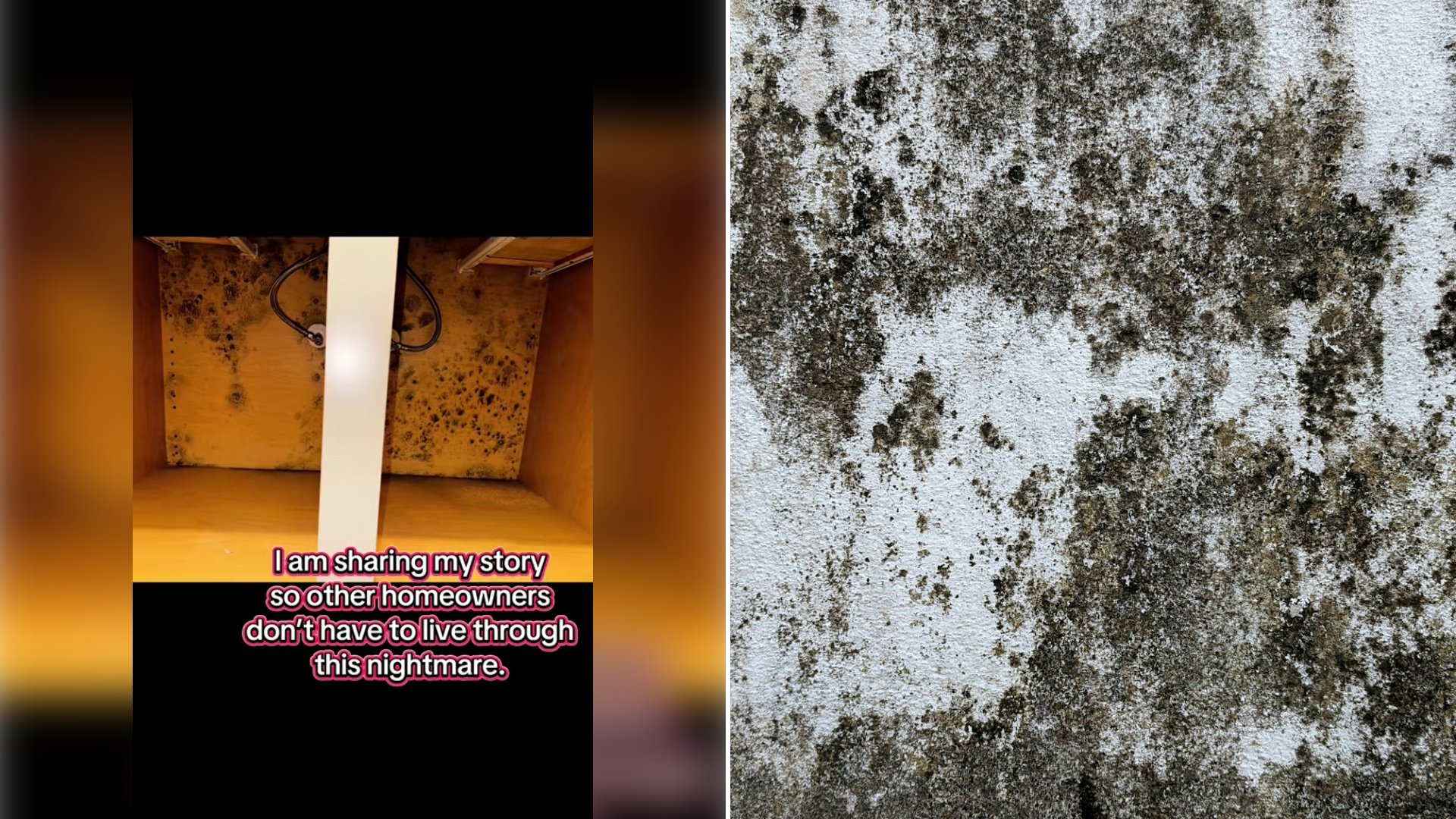
The next shots are taken under sinks, where dark spotting covers the cabinet floor and back wall around the drain pipe and supply lines. “The mold was in EVERY cabinet across the ENTIRE house,” the text reads. A pulled out drawer with dark specks on its base comes next: “Mold growing inside drawers.”
Her account of the builder’s answer takes two slides. The first, shown over a page of tables, reads: “Despite mold growing out of the literal walls, Lennar stated the levels ‘weren’t elevated’ & I only needed a few cabinets & 1 sq foot of Sheetrock replaced.” The second: “Lennar also told me it was not part of their ‘protocol’ to test for mold behind the walls & that my walls ‘were dry’ despite having moisture gauge readings this high.” Behind that text is a handheld moisture meter pressed to a wall, its display reading 42.4 in one photo and 36.0 in another.
She says she then brought in a second opinion. “I hired my own mold inspection company & the results were devastating,” she writes over a lab table that lists rooms of the house, and then over a floor plan crowded with red labels that the page describes as the mold counts put into the floor plan. A letter with the names blacked out follows, under the words “My house was deemed UNINHABITABLE.”
One image is lit blue and shows a surface covered in pale specks. “The air quality in the house was so bad,” the text says. “This is mold seen using a black light & hidden to the naked eye.”
The last documents are medical. “I then went to see my doctor because of how bad my breathing problems were getting,” she writes over a redacted clinic record. The next slide reads, “She ordered a chest X-ray & at only 27 years old I had developed a lung nodule.” Two chest images follow with the line “I have been in an active lawsuit with Lennar since July 2024.”
The video ends on more photos of spotted cabinet interiors and the sentence “I am sharing my story so other homeowners don’t have to live through this nightmare.” She posted it on September 19 with the caption “DONT FORGET ABOUT MY STORY WITH A LENNAR HOME NIGHTMARE!” Everything in it is her account. The video carries no response from Lennar and does not say where the lawsuit stands.
The Paper Trail in Her Video, in the Order She Built It
Whatever the outcome of her case, the slideshow doubles as a list of what a homeowner under a builder warranty can document from the first damp patch. Start with the warranty request. She names the gap between asking and the earliest visit, 10 days. File yours in writing, save the confirmation, and note the date you asked and the date someone came.
Photograph the same spots on a schedule. She shows two shots of one cabinet that she says were taken “only a few days apart.” Pick fixed angles, shoot every cabinet, drawer and vent, and keep the original files with their dates.
Take your own readings. She photographs a moisture meter against the wall with the number showing. If a builder tells you a wall is dry, a dated photo of the display at that exact spot is what you have to set against it.
Get the builder’s finding in writing. Ask for the scope of the proposed repair, which in her telling was a few cabinets and one square foot of drywall, and ask which tests were done and which were not, including behind the walls.
Bring in an independent inspector and ask for what hers produced: lab results by room, the counts marked on a floor plan, and a written conclusion about whether the house can be lived in.
Keep the spending and the health records together with the rest. Her video includes the order history for the seven dehumidifiers, a doctor’s visit record and a chest imaging report. Receipts and records with dates are far easier to gather as you go than to rebuild two years on.
More from Willow and Hearth
- Homeowner Documents Visible Foundation Cracks in His New Build, Disputing the Builder’s Claim That Nothing’s Wrong
- Home Inspector Documents Critical Safety Defects Found Inside a Newly Built House
- Illinois Homeowner Says His Mortgage Went From $3,200 to $5,600 a Month After a $16,000 Tax Bill on His Ryan Homes New Build, and He Put the House Up for Sale
Leave a Reply