When the power to a house fails, you expect the lights to go out. When the television goes dark but the rest of the house limps along, something stranger is going on. That is exactly what happened to a woman living in an old log house, according to an explainer from Kilowatt Nation, and the clue that cracked the case was written across her outside wall in black.
One day her TV simply quit. Her son came over and checked the set, and there was nothing wrong with it. Then he walked outside and saw a long black scorch mark burned into the logs, running up the outside wall of his mother’s house. His first thought was lightning, but there had not been a storm in days.
The real cause was up where the power line meets the house. The bare wire that carries her electricity back to the pole had come apart, and the current had to go somewhere.
How The Current Took The Cable-TV Road
With its normal path broken, the electricity took the only road left: the cable-TV wire. It climbed her wall and ran the full 250 feet to the pole until that wire melted and burned. Luckily, the cable melted open before the logs got hot enough to catch fire. Her lights had been dimming for a while before the TV died, an early sign that something was wrong.
The explainer says an engineer who studied the case wrote that with the neutral open, the shield of the TV cable was the only return path left, and its first connection to ground was at the utility pole.
What That Bare Wire Actually Does
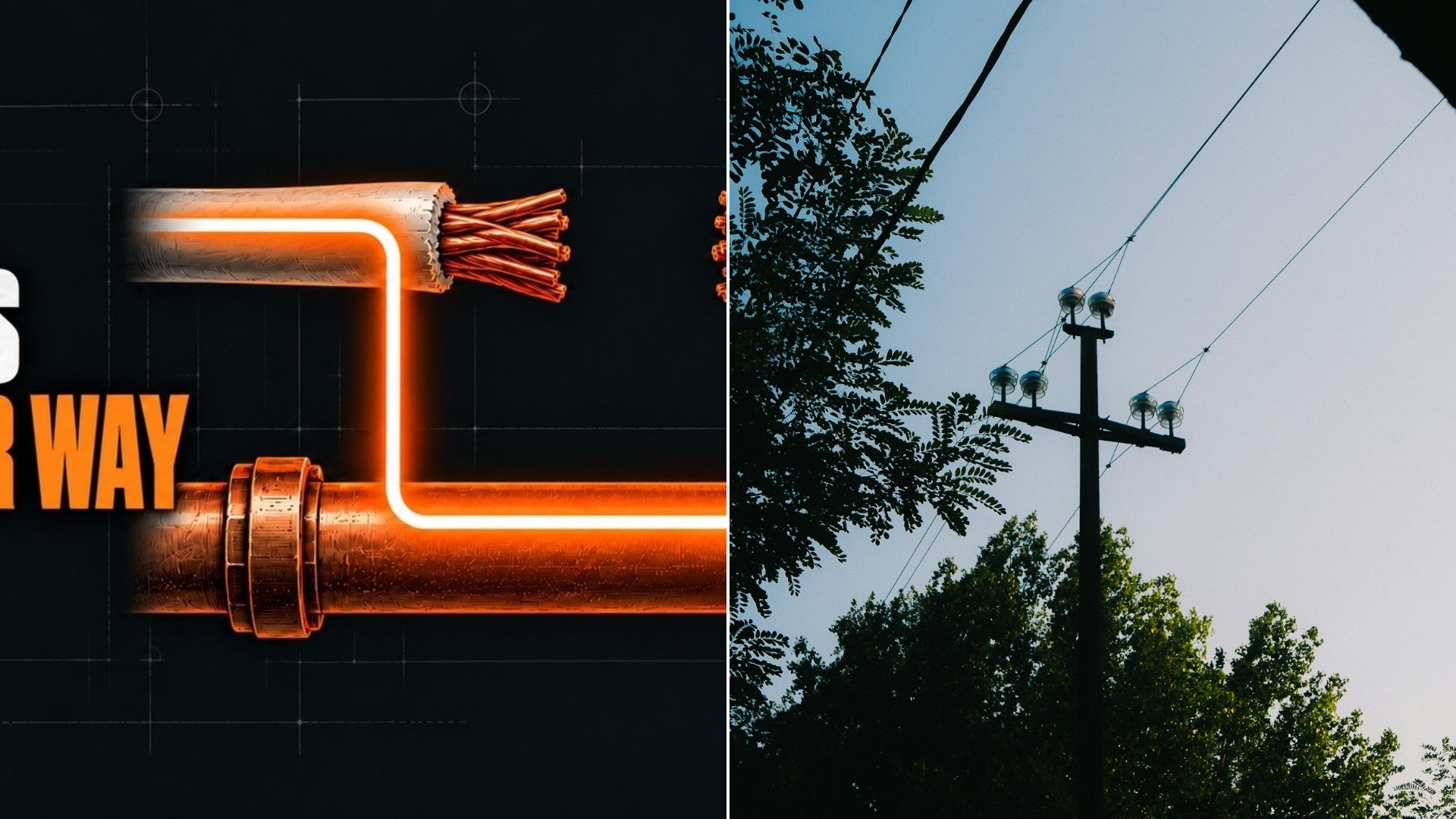
Look up at the cable running from the pole to your house and you will usually see three wires twisted together like a rope. Two are covered in insulation. Those are the hot wires that bring power in. The third is bare metal, and that is the neutral, the way back to the transformer. On many cables the bare wire also holds the whole cable up across the span, and some are made with steel inside for strength. It looks like the least important wire up there, but when something goes wrong it can be just as live as the other two, so the advice is to treat every wire on that cable as live.
Electricity only flows in a loop. It leaves the transformer, does its work in your house and has to get back. The transformer coil makes 240 volts from end to end, and the neutral connects to the exact middle, which is how you get 120 volts at a regular outlet. Big appliances like an oven, a dryer or a water heater use the full 240. Everything else lives on one half of the house or the other, and the neutral carries only the difference between the two halves.
Why Some Lights Get Brighter While Others Dim
When the neutral breaks, the house does not go dark. The two halves end up in line with each other, sharing the 240 volts unevenly. The explainer uses a simple example: a 100-watt bulb on each half gets 120 volts, but switch on a 1,200-watt toaster on one half and its side collapses to around 17 volts while the bulb on the other half gets about 223. The math is simplified, but the direction is right. Turn something big on in one half, and the voltage in the other half shoots up.
That is why lights in one part of a house can brighten while others dim at the very same moment, and why it shifts every time a refrigerator, microwave or furnace fan cycles. Some homeowners even decide the house is haunted. The power company is supposed to deliver between 114 and 126 volts, but with an open neutral one safety regulator says each half can swing anywhere from zero to 240.
The Damage Can Run Far Beyond One TV
The explainer lists real cases. In Cowichan Bay, British Columbia, an electrical contractor measured 204 volts at an ordinary outlet, and a surge protector in the panel was worn down until it caught fire. A TV, hot tub controls and several light bulbs were ruined, though nobody was hurt. In Huntington, New York, in 2019, residents said a surge damaged appliances in at least 15 homes. In Cumming, Georgia, a homeowner lost roughly $6,700 worth of appliances and systems, and the utility said the failure could not have been reasonably foreseen and denied her claim.
The lesson in all three: when several appliances die on the same day, look past the appliances to the one wire that stopped holding the middle in place.
Your Water Pipes Can Carry The Current Too
Many houses give the current somewhere else to go. The panel’s neutral is tied to a ground wire, which runs to a ground rod and to the metal water piping. If the neutral breaks, current can ride the water pipe out to the street and into neighbors’ pipes. An engineer quoted in the explainer says an open neutral may never be detected and can go on for years, with the plumbing quietly saving your appliances. An electrician can check by clamping a meter around the ground wire on the pipe.
It works both ways, too. Your wiring can be perfect and your pipes can still carry a neighbor’s current. In Elmira, Ontario, a plumber removing a water meter saw an arc, and ten seconds later the copper ground wire on the pipe started buzzing, hissing and smoking. That is why Ontario’s electrical safety regulator tells plumbers to treat metal water pipes as energized and to clamp a heavy copper jumper across the gap before cutting a pipe or pulling a meter.
What To Watch For In Your Own House
- Lights that get brighter or dimmer when a big appliance switches on.
- Some rooms bright while others dim at the same time.
- Several appliances failing on the same day.
- A tingle when you touch a faucet, a tub or the metal case of an appliance.
- A cable-TV line that is melted or scorched.
If you see any of these, one electrician’s advice is short: call the power company first and have them check their equipment, because the cable to your house is usually theirs. Do not touch that cable, the meter or a scorched line. If the panel or the meter is hot, buzzing or smoking, get out and call 911. And if a plumber is going to cut a metal water pipe in your house, make sure he knows to jumper it first. Finally, do not let anyone unhook the ground wire from your water pipe or cable line to see what happens, since it may be the only thing carrying current home.
One quiet wire with no coat turns out to be holding up a lot more than the cable.
More Stories You May Like
- 60% Of Americans Had A Large Appliance Break Down In Five Years And 39% Of Them Tossed It Because They Could Not Find A Repair Person They Were Happy With
- 41% Of Homeowners Put Off A Repair That Ended Up Costing More Later And 77% Are Delaying Or Scaling Back Projects Because Of Rising Costs
- Builder Said Trust Me About This 2026 New Build And Then The Inspector Found Sticking Doors, Ants And A Bathroom Door That Will Not Shut
Leave a Reply