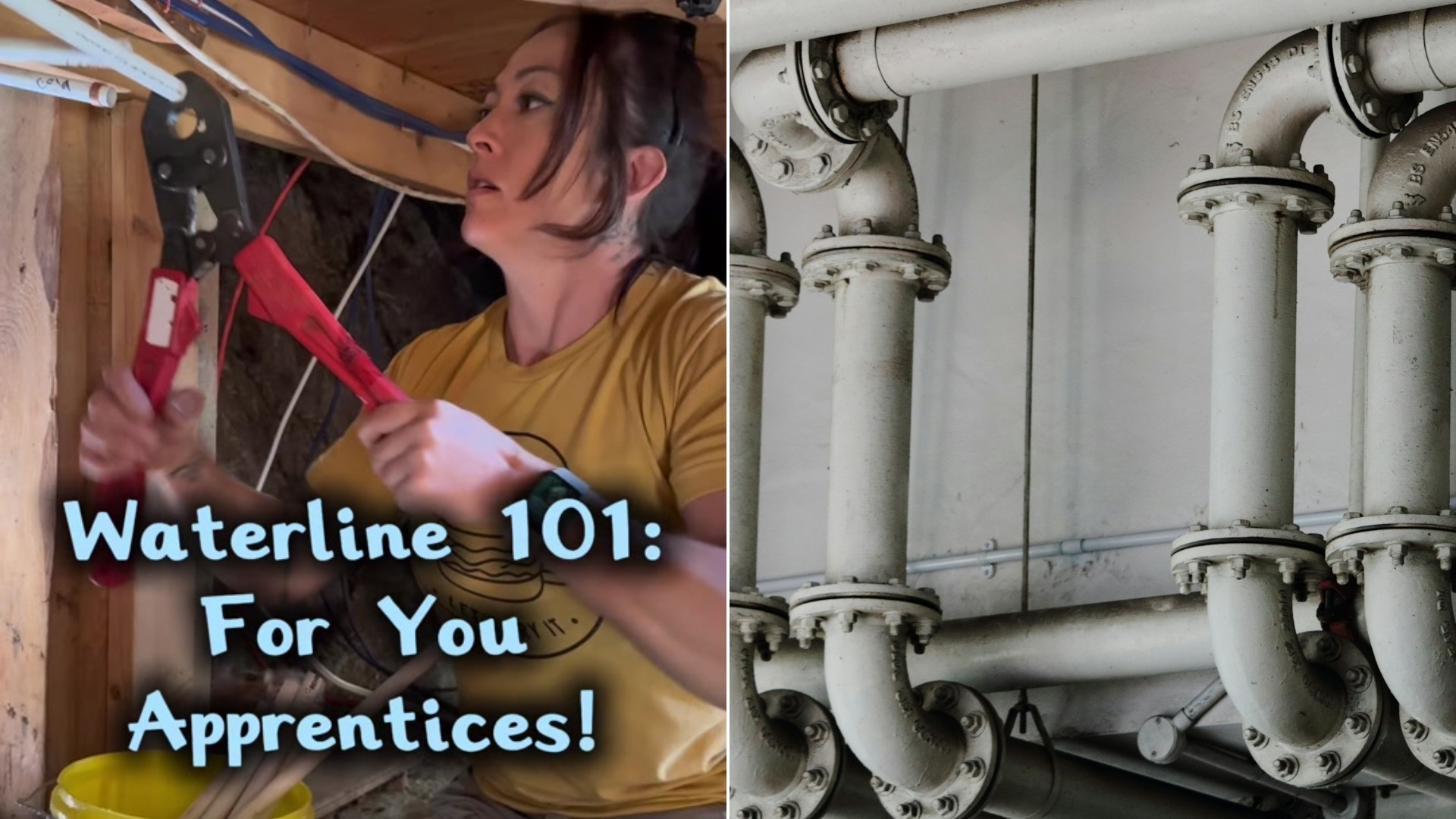
Every trade has one rule that gets repeated until it sticks, and for plumbing apprentices working with @the_ladyplumber, it is a simple one. Crimp each water line connection before you make the next one.
It sounds almost too basic to bother with. But the reason behind it is the kind of thing a homeowner would rather hear about on a screen than learn from a ceiling stain.
The rule is about order and habit. Finish one joint completely, then move on, and never leave a connection sitting there waiting for its ring to be squeezed down later.
@the_ladyplumber
One Skipped Crimp Can Hide Inside A Wall For Years
Water line connections made with crimp rings look nearly identical before and after the tool does its work. A fitting that has been pushed together and a fitting that has been properly crimped can sit side by side, and a quick glance will not always tell them apart.
That is exactly why the plumber’s rule is about sequence rather than about checking everything at the end. If every joint is crimped the moment it is made, there is no pile of unfinished connections to forget about.
A missed crimp is the sort of mistake that can pass a casual look. It may even hold for a while under light pressure, then let go when the system is fully pressurized, when the temperature swings, or when a faucet slams shut and sends a pressure surge through the pipes.
Why The Rule Is Taught To Apprentices First
Beginners are the ones most likely to get pulled in two directions on a job. They are told to cut here, measure there, hand over a tool, and finish the next run, and in the shuffle a joint can get left behind.
Teaching a fixed order takes the guesswork out of it. Make the connection, crimp it, and only then reach for the next piece, so the work is always in a finished state behind you.
Experienced tradespeople tend to say the same thing about careful habits in general. The techniques are rarely the hard part, and the shortcuts that creep in when someone is rushing are where the expensive trouble starts.
What A Crimp Connection Actually Is
Crimp connections are widely used with PEX, the flexible plastic tubing that has become common in home water supply lines. A fitting is inserted into the tubing, a metal ring is slid over it, and a crimping tool squeezes the ring so it grips the tubing and seals against the fitting.
Plumbers typically check the finished crimp with a go/no-go gauge, a small tool that slips over the ring when the crimp is correct and refuses to when it is not. That quick check is one of the simplest ways to catch a ring that was never fully squeezed or was squeezed crooked.
PEX tubing is generally rated for about 160 psi at room temperature, and household water pressure usually runs far below that, often somewhere between 40 and 80 psi. A properly made joint has plenty of margin. A missed one has none at all.
What Happens When It Goes Wrong
A leaking joint inside a wall or ceiling rarely announces itself with a gush. More often it starts as a slow weep that soaks insulation and drywall, feeds mold, and shows up weeks later as a stain, a soft spot, or a musty smell.
By then the repair is no longer a ten second squeeze with a tool. It can mean opening walls, drying out the cavity, replacing damaged materials and paying for a service call, all because one ring was skipped on a job that was finished months earlier.
Water damage is one of the most common and costly home insurance claims, and slow hidden leaks are among the hardest to catch early. That is the practical weight sitting behind a rule that fits in one sentence.
What Homeowners Can Take From It
If you are having plumbing work done, ask whether the new water lines will be pressure tested before the walls are closed up. A pressure test, where the system is filled and held at pressure while someone watches the gauge, is the standard way to expose a weak joint while it is still easy to reach.
Keep an eye on the finished work too. After any new plumbing job, check around fittings, under sinks and on ceilings below bathrooms over the following days for damp spots, drips or discoloration.
Know where your main water shutoff is, and make sure everyone in the house can find it quickly. A leak that is stopped in minutes does a fraction of the damage of one that runs until someone gets home.
Water meters can help as well. If you turn off every fixture and the meter dial still creeps, you have a leak somewhere, and finding it early is far cheaper than finding it late.
The Real Lesson Is About Finishing Each Step
The apprentice rule is a plumbing lesson on the surface, but it works for do it yourself projects of every kind. Finish each connection, fastener or seal before moving on, and do not leave the small step for later.
Later has a way of becoming never, especially in the middle of a long day. The plumber’s version is one sentence, and it is hard to argue with: crimp it now, because the one you skip is the one that finds you.
More Stories You May Like
- Plumber Shows A Double Wall Copper Drain In A Custom Utah Home That Steals Heat From Shower Water To Preheat The Cold Line Going To The Water Heater
- Plumbers Say A Water Heater Never Drained In 10 Years Should Probably Not Be Drained Now, Because Stirring Up The Sediment Can Cause Leaks And Valve Failure
- Allegheny County Signs A Law Making Landlords Pay To Relocate Tenants Forced Out Of Unsafe Homes, Because Taxpayers Were Covering The Bill For Negligent Owners
Leave a Reply