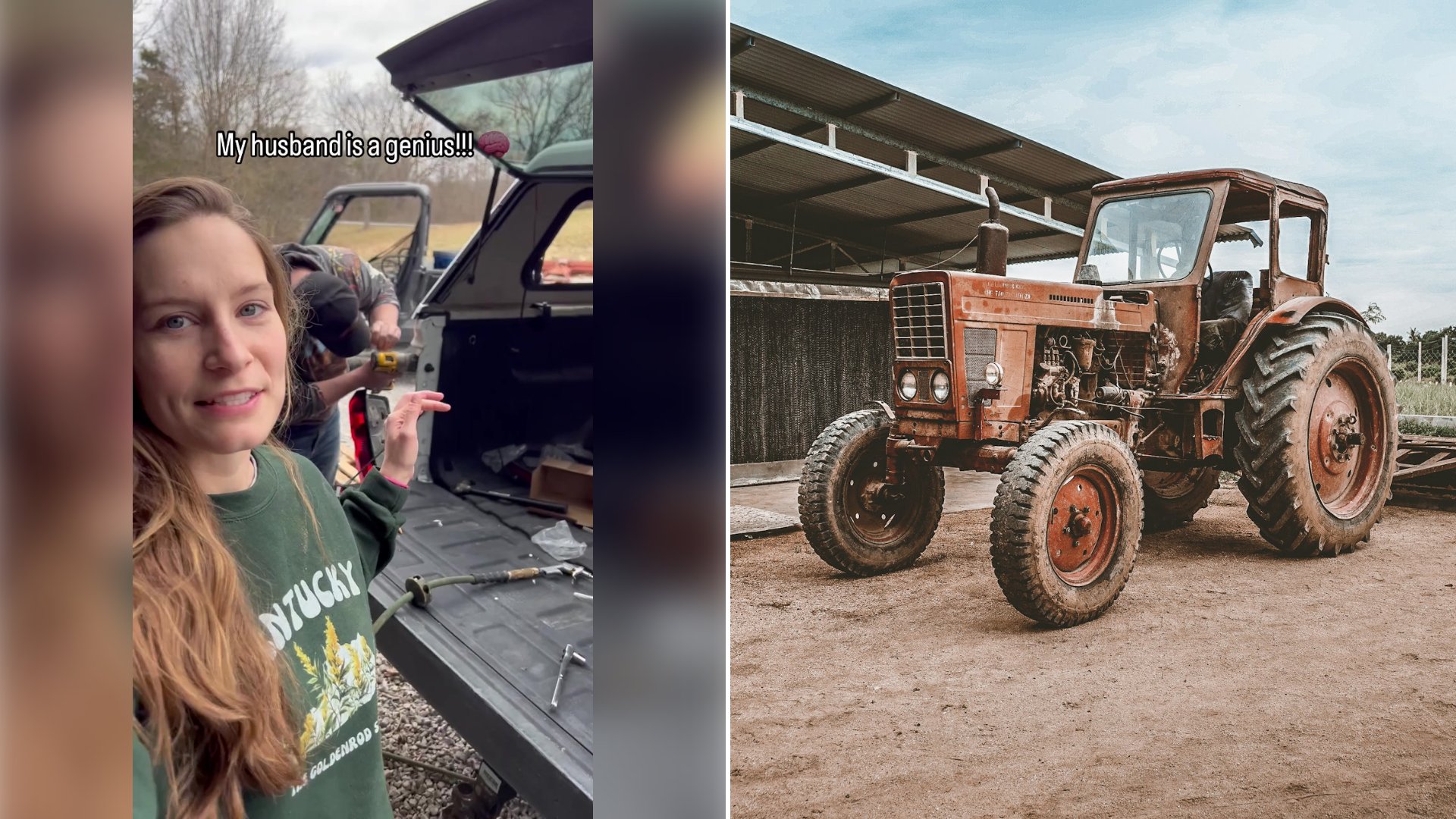
A 1959 tractor that has been handed down through a family is a treasure, but it is also a project waiting to happen. For the creator behind @collins.country, that project belonged to her husband James, a man she says was not raised on a farm. In the third part of a series she shared on social media, she walked through what he accomplished, and her opening line sets the tone. She calls him an absolute genius.
@collins.country
A Family Tractor With a Missing Piece
She explains that the tractor was given to them by her parents and her grandparents. It came with a story and, as she tells it, with a lot of issues. It also did not have a backhoe attachment. Her grandpa sold that part back in the 1990s, which meant the machine had been working with only half of what it could once do.
Most people would have left it that way, or looked for a newer machine. James took a different path. She says he found an old backhoe attachment online that would work with the tractor, and from there the real job began.
Taking Everything Apart
According to her, James completely tore the entire tractor apart, fixed everything and put it back together. That is a short sentence for what is a huge amount of work. She adds a detail that makes the scale easy to picture: a month before she shared the update, the tractor was in a thousand pieces all over their barn.
Anyone who has worked on old equipment knows that feeling. Bolts that have not moved in decades, parts that need cleaning, and a growing collection of pieces that all have to go back in the right place. Her description suggests that James kept the whole thing moving until the barn floor was clear again.
Fixing the Controls
One of the most interesting changes she describes involves the backhoe controls. She says the attachment had both hand controls and foot controls, but it was really touchy. So James re-routed everything so that it only has hand controls. In her telling, he made the parts for this himself, using all of the family’s old manual machining tools.
That detail says a lot about the project. By her account, they used the tools they already had, the kind of equipment that rewards patience and a steady hand, and turned them into custom parts for a machine that was built before many of us were born.
Running Two Machines at Once
The last big change she mentions is the hydraulics. She says James re-ran all of the hydraulics in series so you can run the loader and the backhoe at the same time. By her account, the finished tractor works flawlessly.
For readers who are not familiar with the term, a hydraulic system moves fluid under pressure to power the loader arms and the backhoe. When circuits are plumbed in series, fluid passes through one function and then continues to the next, which is the idea behind running both at once. It is her description that makes this claim, and the details of how it was built are known only to the couple, but the goal is easy to understand. Fewer stops and starts mean more work gets done in an afternoon.
What a First Time Restorer Can Learn
Whether or not you ever plan to rebuild a tractor, the story offers several lessons that apply to almost any big repair project.
Start with documentation. Before a single bolt comes off, take plenty of photographs and label bags of hardware. A machine in a thousand pieces is much easier to reassemble when you can see how it looked at the start. Write down where each hose and wire goes, and keep small parts sorted by area.
Clean as you go. Old equipment hides cracks, worn bushings and leaks under years of grease and dirt. Cleaning each part as it comes off lets you inspect it properly and decide whether it can be reused, repaired or replaced.
Use the manual. Service manuals for older tractors are often available in print or as reproductions, and they list torque values, fluid types and adjustment steps. Guessing is how small mistakes turn into large ones.
Respect the hydraulics. Pressurized fluid can cause serious injuries. Relieve pressure before loosening fittings, wear eye protection and gloves, and never check for a leak with your hand. Test any new setup slowly and with the area clear of bystanders.
Plan the work space. A barn with a clear floor, good light and a sturdy workbench makes a long project far more manageable. Many restorers also set aside a shelf or a rolling cart for each major assembly so nothing gets lost.
Be patient with the learning curve. James, she says, was not raised on a farm. He learned by doing, and the results she shares suggest that a determined newcomer can accomplish a great deal when the family supplies the machine, the tools and the encouragement.
Why Old Tractors Are Worth the Trouble
Older tractors are loved for their simple designs. Many have mechanical parts that can be repaired with ordinary tools instead of specialty electronics, and replacement parts are often still made by hobbyist suppliers. A machine from 1959 can keep working for another generation if it is maintained properly.
There is also the emotional value. A tractor that came from parents and grandparents carries memories of long days in the field, and each repair is a way to keep that history running. Finding a working backhoe attachment to replace the one sold in the 1990s gives the story a satisfying circle.
A Marriage Built on Shared Work
The caption on her post uses hashtags about couple goals, marriage, tractors and farm life, and it is easy to see why. Projects like this one demand teamwork. One person cleans parts while the other holds a flashlight, and a spouse who cheers at the end of a long month in the barn is part of the success.
If you have an old machine of your own gathering dust, her story is a nudge to take the first step. Make a plan, gather your tools and take that first photograph. A month from now, your own thousand pieces might be a working machine.
Leave a Reply