Every time it rained, the sidewalk beside a neighbor’s house filled with standing water. One man got tired of walking through it, so he decided to fix the problem himself, completely for free, using a shovel, some spray paint and a handful of drainage parts that cost under $200.
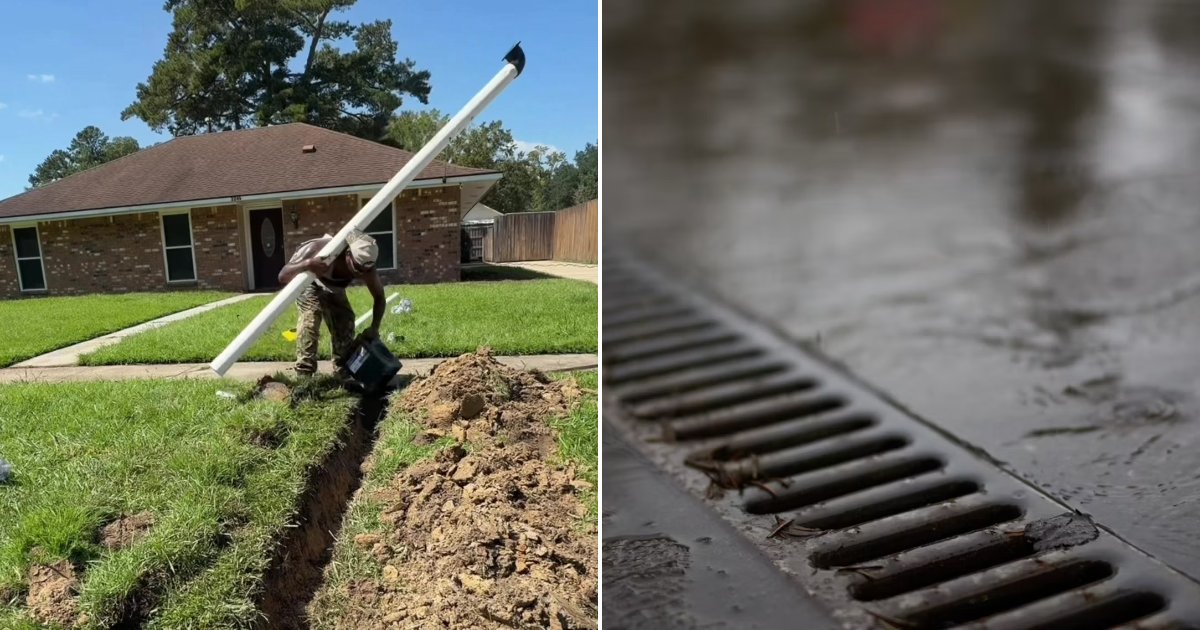
He documents the whole job on @unclejhonn, and says that anybody could do it.
@unclejhonn
The problem
The story opens with him walking down a waterlogged sidewalk after a rainstorm, stepping through shallow puddles beside the grass. Whenever it rains, he explains, this stretch of sidewalk next to the neighbor’s house always floods, and he decided he had seen enough.
Marking and cutting the turf
Dressed in camo overalls and a straw hat, he starts by spraying white marking paint on the lawn so he knows exactly where he will dig. Then he takes a flat shovel and cuts along the outline, setting the grass to the side so it can go back on top later.
Trenching and laying the pipe
Next he digs a long trench through the grass all the way down to the street curb. Into it goes a white PVC pipe with an elbow joint, and a black catch basin grate is set into the ground near the sidewalk, where the water collects. At the curb end sits a green pop up valve, also called an emitter, which lets the water out.
He says everything he used cost under $200. If he were doing the job for a customer, he figures he could charge around $1,000. He took his time and says he spent roughly four hours on it, and he jokes that you could not name another job that pays like that for so little work.
Backfill and the water test
With the pipe in place, he shovels the dirt back over it and packs the soil down around the pop up emitter at the curb. Then comes the real test: he floods the sidewalk with a water hose to see if the system works. The water runs into the catch basin and comes out of the green emitter into the street gutter, exactly as hoped.
He says he did the whole job with spray paint and a shovel, and that it was only his second time doing it. So, he says, if you ask him, anybody could do it.
Tips before you dig a drainage line
A simple drain like this can solve a lot of standing water, but a few precautions make a big difference.
- Call your local utility locating service before you dig, since buried gas, water, power and communication lines are a real hazard.
- Make sure the pipe slopes downhill toward the outlet so water actually flows out rather than sitting in the line.
- Keep the removed sod intact and watered, as he does by setting it aside, so the lawn recovers quickly.
- Check local rules about where you may discharge water, especially at a street curb or onto a neighboring property.
- Always test with a hose before you backfill completely, so you can fix any leaks or low spots.
- Ask the property owner first, even for a free favor, when the work is on or near their land.
Small drainage fixes are often the most satisfying home projects, because the results show up the very next time it rains.
Why water pools on a sidewalk
Standing water usually has a simple cause. The ground may have settled into a low spot, the surface may be too flat to shed rain, or runoff from a roof, downspout or slope may be collecting there. Compacted soil also drains slowly, so water that cannot soak in stays on the surface. Finding the source is the first step toward choosing the right fix.
How a catch basin and emitter work
A catch basin is a grated inlet that lets surface water drop into a pipe instead of spreading across the ground. The pipe carries it by gravity, with a steady downhill slope, to an outlet. A pop up emitter sits at the end of the line and stays closed until water pressure from the pipe pushes the lid open. Solid pipe is used to carry water to an outlet, while perforated pipe is designed to let water seep out into the soil.
Common questions
How do I find buried utilities? In the United States, you can dial 811 before any digging project. The free service arranges for utility lines to be marked, and it is the safest way to start.
Can I send water to the street? Many places allow it and some do not. Local rules differ, so check with your city or county before you build an outlet.
Try this at home: read your yard in the rain
- Walk the property during or just after a rainstorm and note where water collects and which way it flows.
- Check that downspouts carry roof water well away from walkways.
- Mark the low spots with flags or chalk, then take photos.
- Look for the closest legal outlet that sits lower than the problem area.
- Call 811 or your local locating service before any digging begins.
Credit for the original post goes to @unclejhonn on TikTok.
Leave a Reply