A new house is supposed to be the safe, solid choice. But one homeowner climbed into the attic of her newly built home with a flashlight and recorded what she found in the roof framing, then added a pointed note: it all passed multiple inspections.
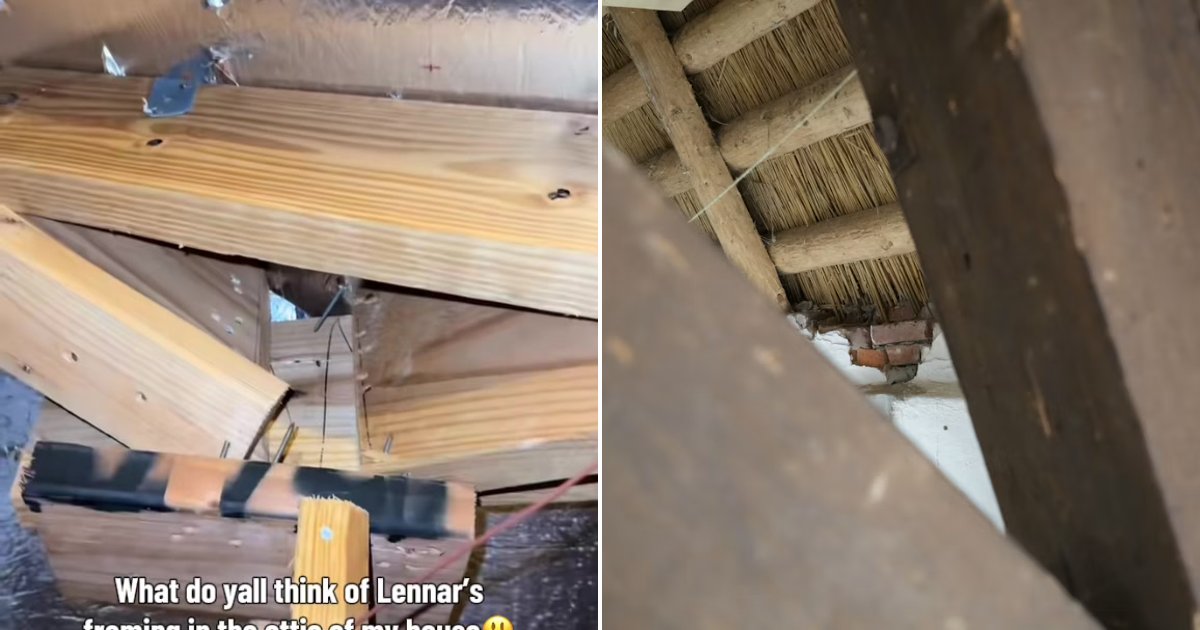
The attic tour comes from @ashthorloki. There is no narration. Instead, the story is told through close up footage and one line of on screen text asking what people think of Lennar’s framing in the attic of her house, with a reminder that it was passed during multiple inspections.
@ashthorloki
What the attic shows
The camera moves slowly through a dim attic lit by a phone light, panning across wooden beams, braces, shims and rafters. Up against the foil backed roof decking and blown in insulation, the close ups show exposed nails, joints that look misaligned, split wood and connections that appear loose.
The footage is cut into quick shots, each one lingering on a different structural point. The homeowner does not explain what each one means, and the shots alone cannot tell us whether any of it affects the strength of the roof. That is a question for a qualified engineer or inspector, not for a short clip.
The line about inspections
The most striking part is the caption. She stresses in capital letters that this framing was passed during multiple inspections. Her point is that the inspection process did not flag what she, as a homeowner, finds worrying when she looks up into her own attic. We do not know what follows, whether she has contacted the builder, or what any further review would find.
Why this matters for new home buyers
A municipal inspection checks that work meets minimum code at a certain moment. It is not a guarantee that every detail was done well, and it does not replace the buyer’s own due diligence. Buyers of new construction can protect themselves in a few ways.
- Hire an independent inspector who works for you, not for the builder, and have them look at the framing before drywall goes up if your contract allows it.
- Schedule a second inspection before your warranty period ends, and be sure to include the attic and crawlspace.
- Take dated photos of anything that looks wrong and send them to the builder in writing so there is a paper trail.
- Read your warranty carefully to learn which defects are covered and how long you have to report them.
- If something looks structural, ask a licensed structural engineer for an opinion before making any repairs yourself.
Looking into an attic is something many homeowners never do. If you have a flashlight and a safe way up, a careful look at your own framing can help you decide whether a professional opinion is worth the money.
What roof framing actually does
Roof framing, whether built from individual rafters or from factory made trusses, carries the weight of the roof covering, and any snow or wind loading, down into the walls. Trusses are engineered as a system, with metal connector plates, bracing and nailing patterns that are part of the design. For that reason, trusses should never be cut, notched or altered without an engineer’s approval.
Common questions
Is every imperfection in framing lumber a problem? Not necessarily. Lumber is a natural material, and small splits or stray nail points are not unusual. What matters is whether the members and connections meet the engineering requirements, which only a qualified professional can judge.
What does passing an inspection mean? Inspections are typically visual checks made at specific stages of construction against the adopted building code. They are one layer of quality control, not a full guarantee of workmanship.
Can I look in my own attic? Yes, with care. Step only on the framing, never on the drywall ceiling between it, and bring a good light. Wear a mask and long sleeves, and avoid disturbing the insulation more than necessary.
Try this at home: a safe attic check
- Let a second person know when you are going up, and bring a bright headlamp or flashlight.
- Photograph the whole space first, then take close ups of anything that concerns you.
- Note the location of each photo, such as which end of the house and which room sits below.
- Send your photos and notes to your builder or an independent inspector in writing.
A calm, documented approach
A new home is a major purchase, and it is reasonable to ask questions about it. Keeping a calm, written, well documented record, and bringing in an independent professional when something is unclear, tends to be more effective than guesswork. Most questions about framing can be settled quickly by someone qualified who can see it in person.
Credit for the original post goes to @ashthorloki on TikTok.
More from Willow and Hearth
- Three hundred fifty thousand dollar brand new home looked flawless until an inspector pressed a simple knife into the wall
- Homeowner’s Personal Dream Home Gym Turned Into a Nightmare the Moment He Discovered Mold Had Been Quietly Growing Behind the Walls
- This Homeowner Reveals the Biggest Homeownership Wake Up Call Nobody Ever Pins on Pinterest
Leave a Reply