A homeowner flew home on an overnight flight, jet lagged and hoping for a normal night in her own house. Instead, she walked in to find that the cracks she had been tracking in her newly built home had grown noticeably worse in just one week.
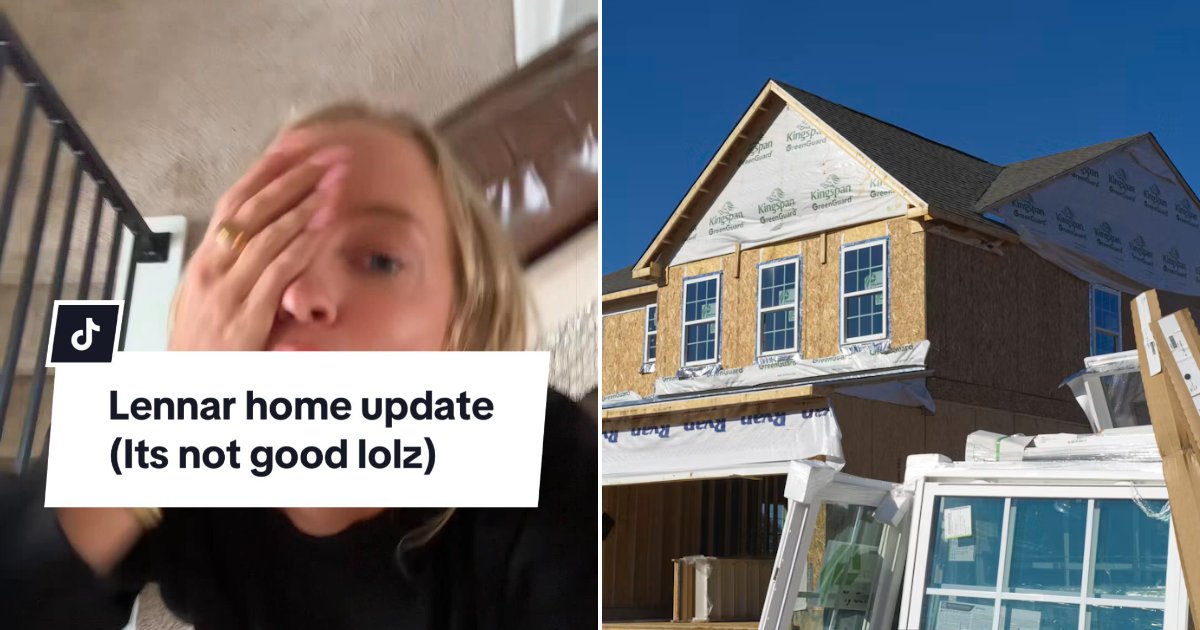
She shared a room by room update on @honeybeeabs, describing herself as one of the owners of a Lennar house that is splitting in half, and opening with the line, “Houston, we have a problem.”
@honeybeeabs
The living area floor
She starts with the wood look tile floor, where a crack runs all the way across and is significantly wider than before. She compares it to a photo she took about four weeks earlier, dated September 8th on screen, and shows how much the gap has opened. One tile on the more worrying side of the house has shifted so much that its edge is now sharp enough that, as she puts it, someone could cut their foot on it.
Walls and ceilings downstairs and up
Panning up a downstairs wall near a display of vinyl records, she points out cracks that she says were not there before. A ceiling crack, she says, looks about a foot and a half longer than it used to be.
Upstairs is where she is most frightened. The newest crack is at the top of the house, with linear cracks crossing the drywall ceiling near vents and recessed lights. On screen she lays out the timeline: a first crack on August 30th, a second parallel crack on September 8th, and a horizontal line on September 9th. She asks why it is happening so fast all of a sudden.
Outside, and what inspectors have done so far
Outdoors, she shows cracks in the concrete foundation slab and at the joints of the exterior siding. She says structural engineers visited her home two weeks earlier and she has not heard anything back. A plumber was also sent to test the pipes to rule out a leak, and she says he told her everything was fine.
Out back she traces a continuous crack along the patio slab beneath the siding, leading into a corner near some rocks and soil. One crack from August 30th, she notes, does not look like much movement.
The ending is unresolved
She heads back inside visibly upset and exhausted. She says she does not know why no one has called her and that she is shocked and nervous at how much worse everything got in a single week. What happens next is not shown, so the outcome of the engineering review is still unknown.
What homeowners can do when cracks keep growing
Not every crack is serious, since settling hairline cracks are common in new construction. But cracks that widen quickly deserve attention, and keeping good records puts a homeowner in a stronger position. This general advice applies to anyone in a similar situation.
- Photograph each crack with a date, and include a ruler or coin for scale so growth is easy to measure.
- Write down the dates of every inspection, call and email with your builder or warranty provider.
- Put your concerns in writing and ask for a timeline for a response, rather than relying only on phone calls.
- Mark the ends of a crack with a pencil and date to track whether it keeps spreading.
- Cover or flag any sharp or lifted floor edges so no one is hurt while repairs are pending.
- Check your warranty terms for deadlines, and consider an independent structural engineer if you are not getting answers.
Why houses crack in the first place
Concrete, lumber and drywall all shrink or shift a little as they dry and settle, which is why small hairline cracks are so common in the first year or two of a new home. Soil also plays a role. Clay soils swell when they absorb water and shrink as they dry, and that movement can push on a foundation. Drainage, nearby trees and long dry or wet spells can all change how much the ground moves.
Common questions
When does a crack need a professional? Cracks that keep widening, run diagonally, or appear alongside sticking doors and windows deserve an expert look. So do cracks where one side of the surface sits higher than the other.
Who should evaluate the foundation? A licensed structural engineer can assess the cause and recommend a fix. Hiring one who is independent of the builder gives you a second opinion that you control.
Should I patch and paint right away? It is usually wise to wait until the cause is understood. Covering a crack too soon can hide evidence of movement, and your warranty provider may want to see the original condition.
Try this at home: start a crack log
- Number each crack with a small pencil mark or removable tape label.
- Photograph it weekly from the same spot, with a ruler in the frame.
- Record the date, the length and the width in a notebook or a phone note.
- Note anything else that changes, such as a door that begins to stick.
- Share the log with your builder and any engineer you hire.
Credit for the original post goes to @honeybeeabs on TikTok.
More from Willow and Hearth
- Homeowner’s Personal Dream Home Gym Turned Into a Nightmare the Moment He Discovered Mold Had Been Quietly Growing Behind the Walls
- Three hundred fifty thousand dollar brand new home looked flawless until an inspector pressed a simple knife into the wall
- This Homeowner Reveals the Biggest Homeownership Wake Up Call Nobody Ever Pins on Pinterest
Leave a Reply