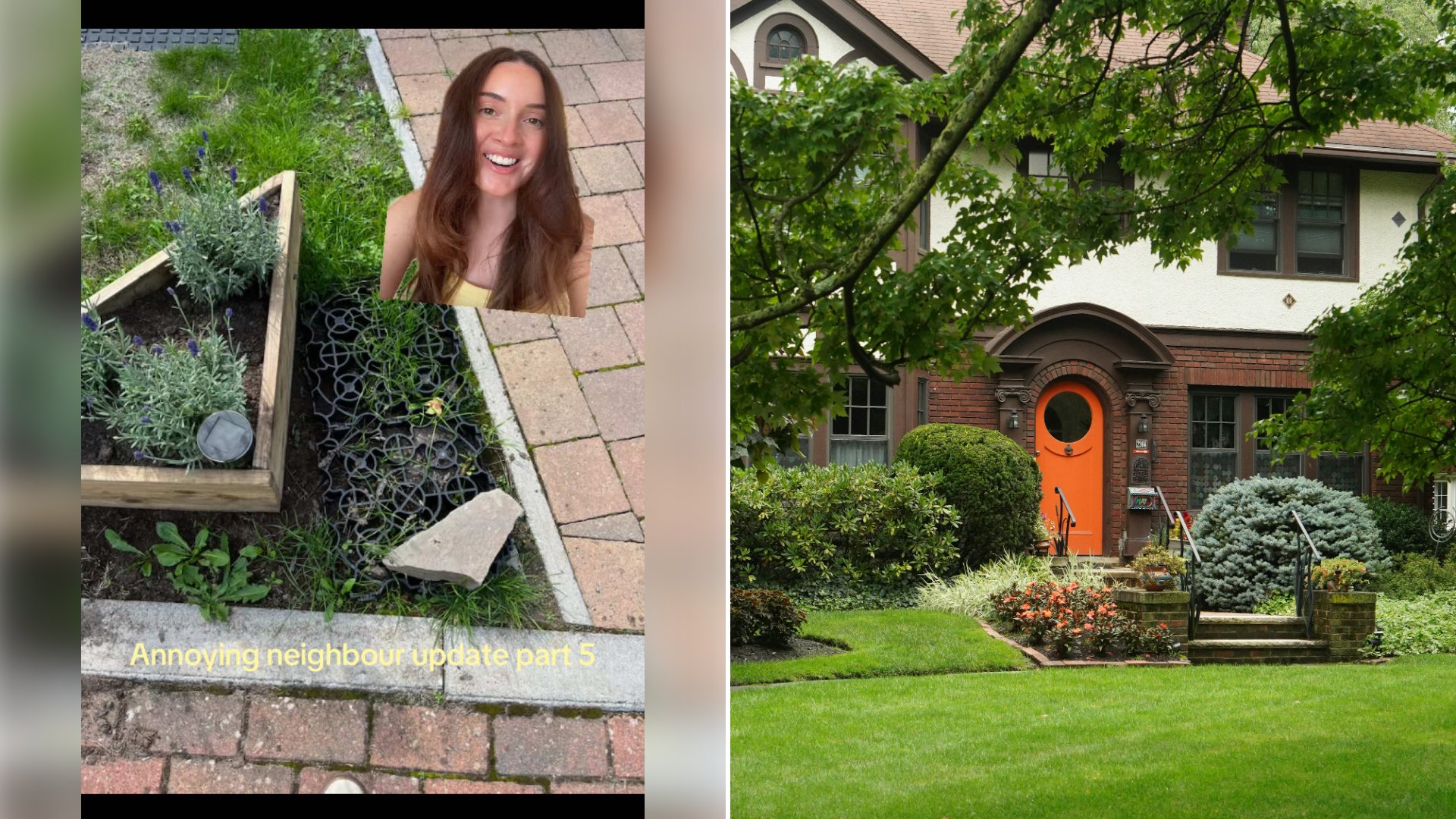
Gabriella came home from holiday to find that someone had been working on her front lawn. “The good news is we’ve ordered a video doorbell,” she says at the start of the fifth video in her “Annoying neighbour” series on her TikTok account @latestobsessions, posted September 25, 2026. “And the bad news is it looks like our neighbour has started their own DIY project. Their own DIY project on our behalf.”
Behind her, the footage shows a wooden planter of silvery green plants set back on the grass, a strip of black rubber mesh laid across the lawn where it meets the block paved drive, and a broken piece of stone sitting on top. “They’ve actually moved the planter and they’ve put down these rubber slabs,” she says. “I’m not sure what the brick’s for. I assume the brick is to hold the rubber slabs down. I have no idea.”
The 30 second clip only makes sense with the videos before it, posted between September 20 and 23, and all her own account of what happened. In the first, filmed in her car, she says her neighbor “keeps driving over the front of my grass,” which she says was starting to look like a mud bath. She says she manages to get out of her own space without driving over the neighbor’s garden. So she and her partner built a flower box, deliberately tall “so that they could see it.” According to Gabriella, the neighbor drove over it anyway, broke it and drove off, then came back a couple of hours later to apologize, saying she had been on the school run. Later, she says, the neighbor’s husband came over, apologized for his wife, and suggested they move the flower box into their back garden “because he said the spacing is tight.”
Part 2 shows what she says they came down to that morning: a wooden planter tipped over on the grass beside the drive. She points to where she says the neighbor drives over, and to “the tire print mark in the mud.” In part 3 she answers people asking whether she had simply talked to them. She says they told the neighbors at the start of the summer that they were driving over the lawn, and that they marked it off with what she calls “really pathetic looking bamboo sticks.” The neighbors apologized and said they would stop, she says, but a couple of weeks later the bamboo was driven over too, which is why they tried the flower box, “thinking there’s no way anyone would drive over a flower bed.” Viewers suggested a rockery, and she joked about heading to B&Q or a garden centre for rocks.
Between parts, she asked viewers whether to buy a video doorbell or a boulder, and in part 4 she answered the question of why they don’t just put up a fence. Besides driving over the lawn, she says, the neighbors pull up on the drive and unload everything from their car onto her grass. She says she had let it go to be “a pleasant neighbour,” but after the flower box she has changed her mind, and she thinks a fence would just get damaged too. Part 5 ends without saying who laid the rubber slabs or why, and Gabriella does not say she has asked; everything here is her side of it.
What the Official Guidance Says About a Dispute Like This
Gabriella does not say where she lives, though she mentions B&Q, holidays and a garden centre. The guidance below is from UK public bodies and applies to England and Wales; elsewhere, check your own local rules.
The first step in the UK government’s guide to resolving neighbour disputes is the one she says she already took: talk to the neighbor and try to solve it informally. If that does not work, the guide lists mediation next and taking legal action through the courts only “as a last resort,” warning that court can be expensive, with fees and possibly a solicitor to pay. If you would rather not talk face to face, the government’s advice on talking to your neighbour suggests writing a letter that sets out the problem clearly and sticks to facts rather than opinion. For a case like this one, that letter can list the dates of each incident Gabriella describes, from the bamboo to the broken planter to the rubber slabs, and say plainly what you are asking for.
Before any of that, find out exactly where your land ends. HM Land Registry sells an online copy of a title register and a title plan for £7 each, according to GOV.UK. Its boundaries guidance warns that title plans usually show general boundaries, not exact legal ones, and that HM Land Registry “cannot decide, mediate or resolve boundary disputes between neighbours.” It points instead to the Royal Institution of Chartered Surveyors boundary disputes mediation service, and to a formal boundary agreement, which can be recorded on the register and can also set out who maintains what.
Then there is the doorbell. The Information Commissioner’s Office guidance on home CCTV covers smart doorbells as well as fixed cameras, and says that if a camera records beyond your property boundary, data protection law applies. In that case, the ICO says, owners should put up a sign that CCTV is in operation, delete footage regularly, provide recordings to a person captured in them who asks, and stop recording someone who objects if there is no legitimate reason to continue. It recommends pointing cameras at your own property where possible, away from neighbors’ property and shared spaces, and using privacy blockers to blur out the rest. A doorbell pointed at a front lawn and the drive beside it is exactly where those settings matter.
Leave a Reply