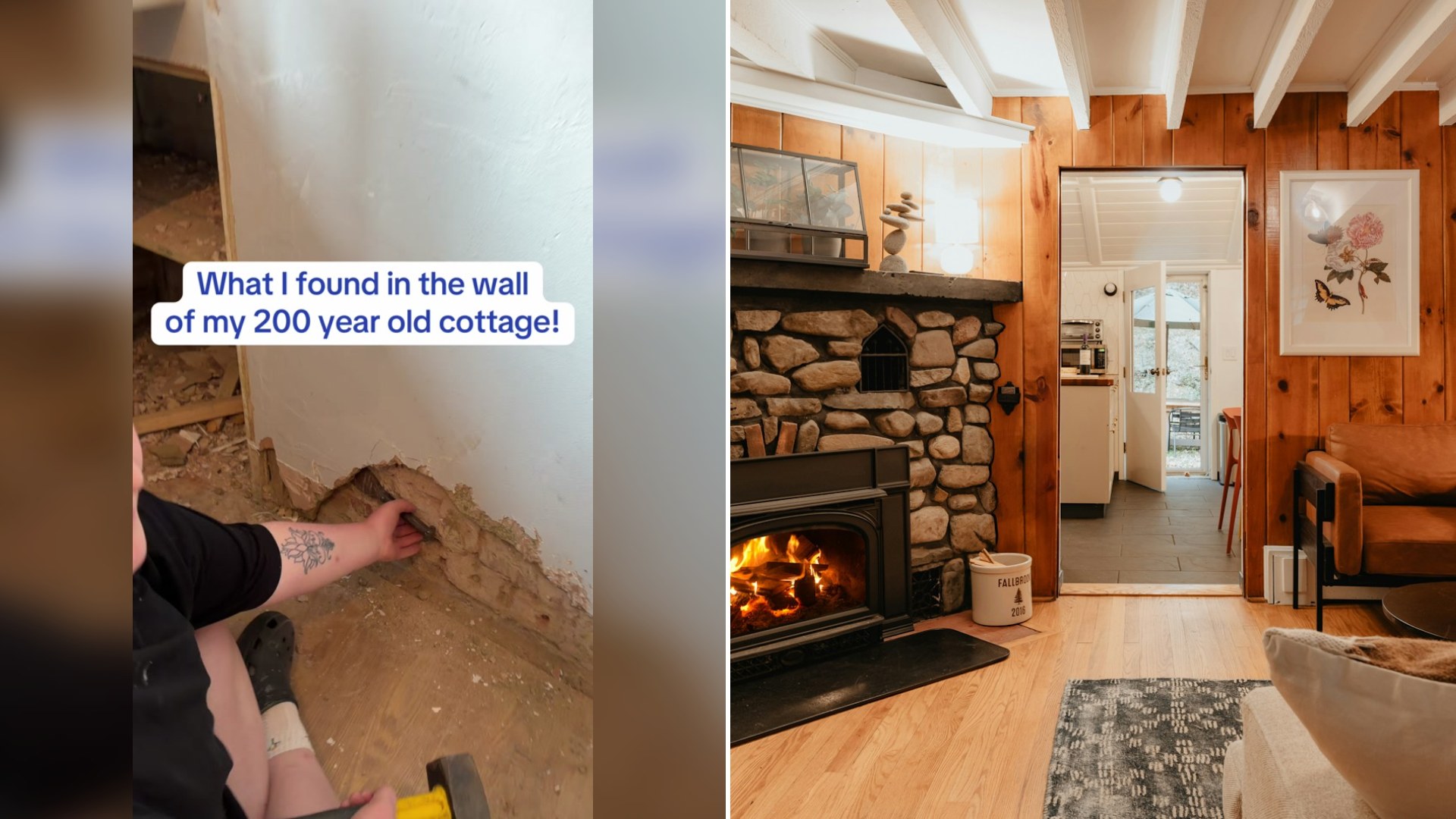
Some people get the keys to a new home and start by unpacking boxes. A new owner who posts as @geoscottagereno got the keys to a 200 year old cottage in Leicestershire, England, and within days had a hammer in hand and a kitchen wall in sight. The post has been played more than 800,000 times, and it ends on a cliffhanger that has people asking what on earth was found.
The new owner goes by Gio, and the instincts about that wall turned out to be right. Here is what Gio found, what it tells us about old houses, and what to do if you ever hear a hollow sound behind plaster of your own.
@geoscottagereno
The Wall That Sounded Hollow
Gio explains that within a few days of getting the keys Gio decided that one wall in the kitchen was hollow. Rather than wait, Gio started hacking the plaster off, much to the family’s dismay. It turned out there was good reason. In Gio’s words, the joke was on them, because there was something behind it. What was uncovered looked like an old fireplace.
That discovery set off a train of thought. Gio wondered whether the room had once been a living room. As the work went on, Gio and the family carried on knocking bricks out. At one point they noticed a steel pole sticking out and were slightly concerned about it. Then they realized it was wobbly and was not actually doing anything, so they pulled it out and hoped for the best.
Gio also went up into the fireplace a few times, and came out looking, in Gio’s words, like a Victorian chimney sweep. After that, something else turned up, and Gio says it made them die with excitement. The post ends there, with a question to the audience about what it could be and a promise to follow along for part two.
Since the post stops before the reveal, we can only say what Gio told us. It looks like a fireplace, there was a steel pole that was said to be doing nothing, and there is something else inside that has not yet been shown.
Why Old Houses Hide Fireplaces
If it seems strange to find a fireplace behind a kitchen wall, it is actually quite common in older homes, especially in the United Kingdom. Over the centuries, houses were remodeled many times. Heating changed from open fires to stoves, then to central heating. Owners often closed fireplaces up, plastered over them, or built walls in front of them to create a flatter, more modern look. The old opening was simply hidden behind a layer of plaster.
Kitchens are a particularly likely place. Before modern ovens, cooking happened at a large hearth, and many old farm cottages had a big fireplace in the kitchen for that reason. When gas or electric cookers arrived, the fireplace was no longer needed and could be blocked up.
That is why a hollow sound or an odd bulge in a wall can be a clue. A thin wall may be hiding a recess, a cupboard, a bricked-up doorway, or a chimney breast that has been boxed in.
How to Check a Wall Before You Open It
- Tap and listen. A solid wall sounds dense, while a hollow area gives a different note. Move along the wall and mark where the sound changes.
- Measure from both sides. If the wall in one room is thicker than the others, or if the adjoining room seems to have a space unaccounted for, there may be a hidden cavity.
- Look at the outside. A chimney stack on the roof that lines up with the wall is a strong hint that a fireplace once sat below.
- Check the plans or ask neighbors. Houses in a row are often built alike, so a neighbor may have an open fireplace in the same place.
Safety First When You Find a Chimney
Opening up a chimney breast can be a rewarding project, but there are some important cautions. This is general advice, not instructions for any particular house.
- Do not remove supports until you know what they do. A metal bar or beam in a chimney breast may be holding up masonry above. Gio says the steel pole was wobbly and did nothing, but it is always smart to have a builder or structural engineer confirm that before removing anything.
- Expect soot and dust. A chimney that has been sealed for decades will hold a lot of fine, dark dust. Wear a proper respirator, eye protection and old clothes, and cover the floors and furniture nearby.
- Be careful with old plaster and materials. In homes built before the late twentieth century, some materials may contain asbestos or lead. If you are unsure, have a sample tested before you disturb them.
- Have the flue checked before use. A fireplace that has been closed for years may be blocked, cracked or unsafe. A qualified chimney sweep or inspector should look at it before any fire is lit.
- Check any local rules. A building like a 200 year old cottage may be protected, and alterations might need permission.
What Might Be Waiting Inside?
Old chimneys have a way of holding surprises. Over the years, people have found bricks stamped with makers’ names, old bottles, shoes, coins, bird nests, tools and bits of newspaper, along with ironwork like hooks, ovens or cranes. In some cottages, a bread oven is tucked into the side of a kitchen hearth. Gio has not said what else was found, and it would be a mistake to guess. For now, all we know is that the family were thrilled.
It is a reminder of what makes older houses so special. Every wall has been changed by someone, and every change leaves a clue. If you are lucky enough to own a home with some age on it, listen closely. Your own walls may have a story to tell.
Leave a Reply