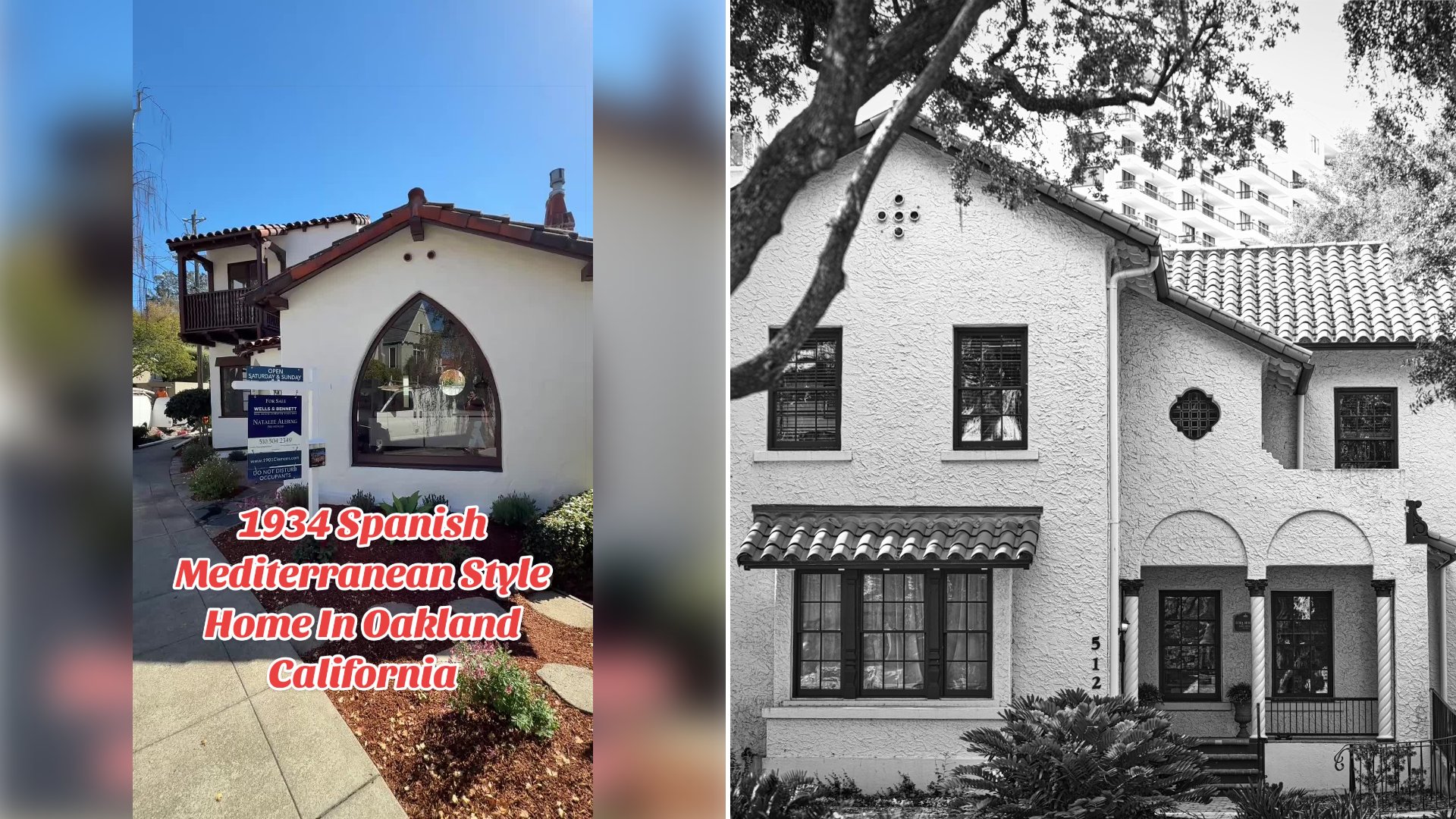
A real estate walkthrough out of Oakland’s Oakmore neighborhood is drawing attention for a home that looks more like a time capsule than a typical listing. In the video, @rolandosage tours a Spanish Mediterranean style house built in 1934, pointing out original details that have survived nearly a century of ownership changes, remodels, and shifting design trends in the surrounding neighborhood.
@rolandosage
The tour highlights the kind of craftsmanship that defined the style when it was built: thick stucco walls, arched doorways and windows, decorative ironwork, and terracotta roof tiles, all details that were built to last rather than applied as a surface finish. Interior touches like built-in shelving, coved ceilings, and original tile work round out the picture of a home that has avoided the kind of gut renovation that strips most houses of their original character within a few decades of being built.
Spanish Mediterranean, sometimes called Spanish Colonial Revival, became one of the dominant architectural styles in California during the 1920s and 1930s, fueled partly by the 1915 Panama-California Exposition in San Diego, which showcased the style on a grand scale and helped popularize it statewide. California’s own Spanish colonial history gave the style a sense of regional authenticity that other imported architectural trends lacked, and it fit the climate well, with thick walls that helped regulate indoor temperature and covered walkways and courtyards designed around outdoor living.
Oakland’s hillside neighborhoods, including Oakmore, saw a wave of development in exactly this period, as the city’s population grew rapidly in the years following the 1906 San Francisco earthquake pushed many residents and businesses across the bay. Developers building in these hill neighborhoods during the 1920s and 1930s frequently turned to Spanish Mediterranean and other revival styles, which is why pockets of Oakland still have such a concentrated and recognizable collection of homes from this exact era.
What makes an unaltered example genuinely uncommon nearly a hundred years later is how much upkeep this type of construction actually requires to preserve correctly. Clay tile roofs need specialized contractors familiar with the material to repair rather than replace sections, decorative ironwork needs periodic treatment to prevent rust from taking hold, and original stucco finishes are notoriously difficult to patch invisibly once cracks form, which is why so many owners over the decades have opted to resurface or replace these features entirely rather than maintain them. A home that has kept its arched doorways, tile work, and ironwork intact for this long reflects a long chain of owners who chose costly, specialized upkeep over simpler modern replacements.
That history also carries real weight for buyers today. Homes recognized for intact historic or period architecture often qualify for local historic designation programs, which in cities like Oakland can come with property tax benefits tied to documented restoration work, alongside the more straightforward benefit of buying a home whose character cannot simply be recreated by a contractor on a tight timeline. Buyers specifically drawn to pre-war architecture tend to understand that a mass-produced new build, however well finished, cannot replicate decades of settling, patina, and craftsmanship-era construction methods that are no longer standard practice.
The tour format itself, letting the architecture carry the video with minimal narration needed, is part of why content like this performs so well with design-focused audiences. Viewers get to experience the arches, tile, and ironwork at a pace closer to walking through the home in person than a typical listing photo gallery allows, and the near-century age of the house gives the whole video a built-in narrative hook that a newer home simply cannot offer. For a style that so heavily defined an era of California homebuilding, seeing one example survive this intact is as much a small piece of local history as it is a real estate listing.
More from Willow and Hearth
- Owners of an Abandoned NYC Townhouse Wait Almost Two Years to Restore Its Carved Staircase With a Lion and a Harp Before a Woodworker Finally Starts
- Homeowner in a 1792 House Shows the Scariest Thing Her Little Brother Found in a Cabinet Before Move In, an Unplayed VHS Tape Labeled 1953 to 1957
- Buyers of Knockderry Castle in Scotland Open Their Restoration Series by Asking What They Have Done, Then Show Scaffolding, Carved Woodwork and a Sealed Envelope
Leave a Reply