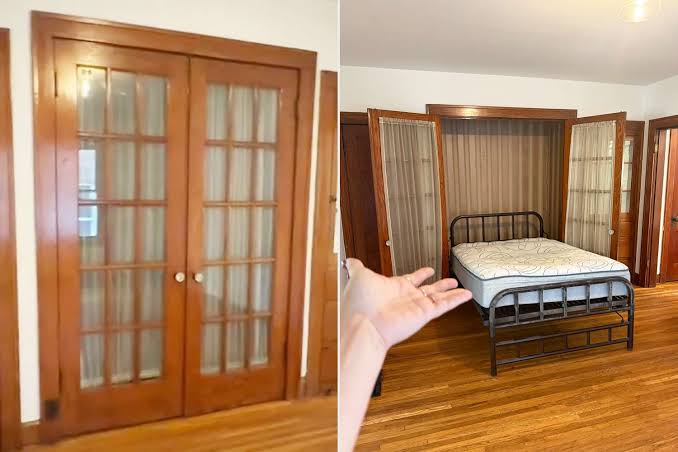
Keely Stagg had been told the extra doors in her 100-year-old apartment simply didn’t work, relics of a much older layout with no real function left. She decided to check for herself, and the result was a hidden Murphy bed she never knew was there. She shared the discovery on TikTok as @keelystagg.
In her video, Stagg walks through the doors that had long been dismissed as decorative or nonfunctional, working through what it took to get them open before revealing the vintage bed mechanism folded away behind them. The moment plays out as a genuine surprise rather than a discovery she’d been anticipating, which is part of what makes the reveal land the way it does.
Beyond the reveal itself, it’s worth being careful not to overstate what’s known about the bed’s exact age or history. A concealed mechanism like this one in a century-old building could plausibly date back to the apartment’s original construction, when Murphy beds were a common space-saving feature in smaller city units, but without documentation from the building itself, that’s a reasonable inference rather than a confirmed fact, and this piece treats it as such.
What makes the story work as more than a simple “look what I found” clip is the structure Stagg builds into it: doors that everyone assumed were useless turn out to hide something both functional and historically interesting. That kind of reversal, where an overlooked or dismissed detail turns out to matter, is a reliable hook in home-mystery content because it invites viewers to wonder what they might be overlooking in their own space.
Older buildings in particular tend to accumulate these kinds of forgotten features as they pass through decades of different owners, renters and renovations, with each new occupant inheriting quirks nobody fully explained to them. Stagg’s video is a reminder that “this doesn’t work” is sometimes simply “no one has checked in a long time.”
The Takeaway
If you live in an older building with a feature you’ve simply been told doesn’t work, an odd door, a strange panel, a mechanism nobody’s explained, it might be worth a closer look rather than taking that assumption at face value. Just proceed carefully with anything mechanical or built into the wall, since older hardware can be fragile or improperly maintained. And when you do find something surprising, resist the urge to fill in the historical gaps with guesses; a little healthy uncertainty about a building’s past is more honest than a confident story you can’t actually back up.
Leave a Reply