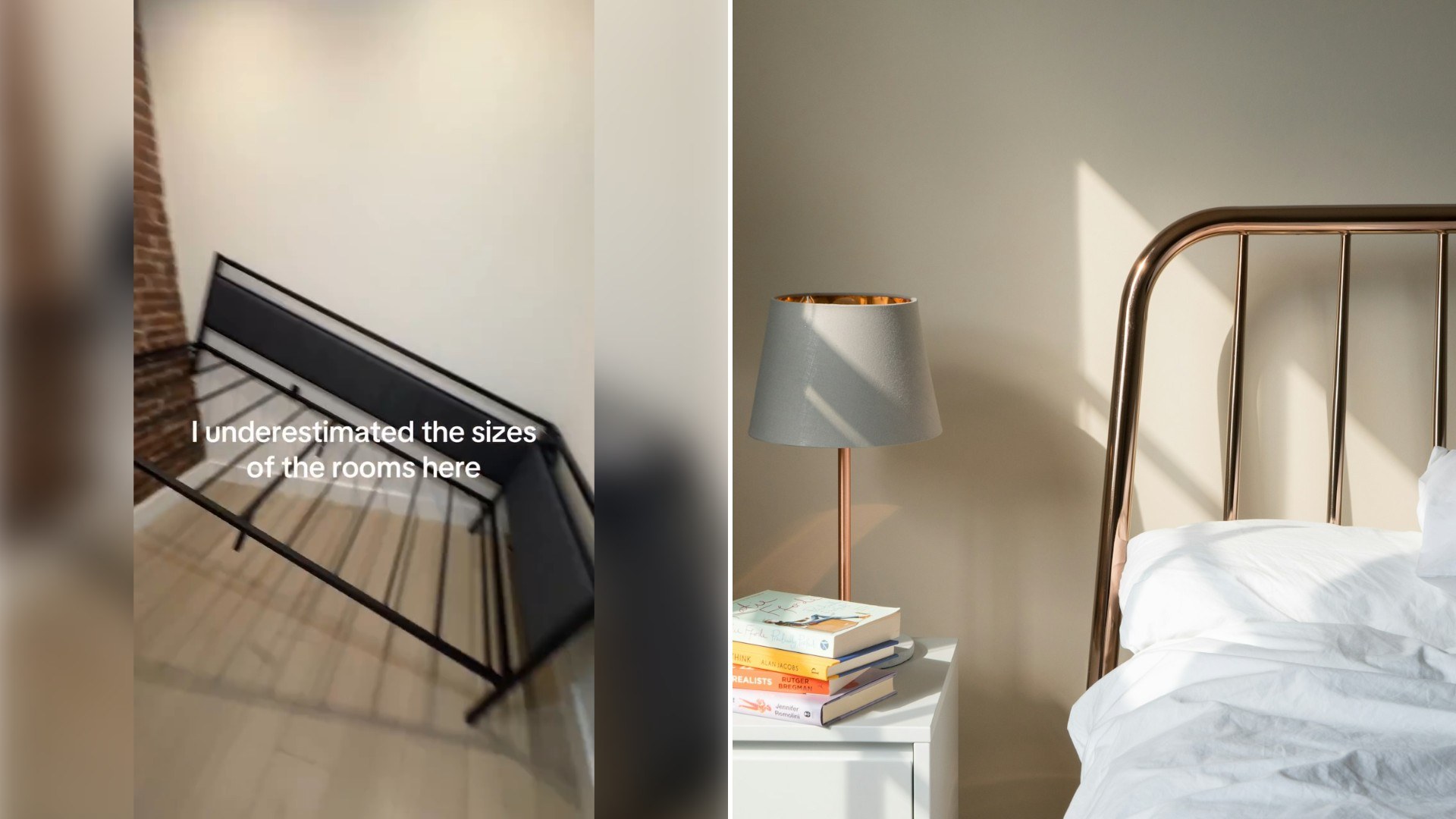
The bed frame sits wedged at an awkward angle against an exposed brick wall, clearly not fitting the way it was supposed to, and the creator doesn’t pretend otherwise. Standing in what is meant to be her new bedroom, she admits on camera, plainly and without much sugarcoating, that she underestimated just how small the room actually was when she signed the lease. What looked reasonable on paper, or in a handful of listing photos, turned out to be a genuinely tight squeeze once actual furniture entered the equation.
Rather than editing around the awkwardness, she leans into it, filming the furniture at the angle it’s currently stuck at and narrating her own surprise in real time. By the end of the clip, she turns the question outward, asking her followers directly what she should do next given how little room she actually has to work with. It’s an unusually collaborative moment for this kind of content, less a polished before-and-after and more an open, in-progress problem she’s genuinely still trying to solve.
Misjudging room dimensions is one of the most common and most universally relatable mistakes people make when moving, and it rarely has anything to do with carelessness. As @bylunadecor shows by literally standing next to the misplaced bed frame, even someone clearly interested and invested in home design and decor can still get caught off guard by how differently a space reads on a listing page versus how it actually feels once real furniture is moved in and measured against the walls.
New York City apartments in particular have a reputation for compact, unconventional layouts, and older buildings with exposed brick, a feature often marketed as charming and desirable, frequently come with irregular wall lines and reduced usable floor space compared to newer construction with flat, predictable walls. A brick wall that looks beautiful in photos can also eat into a room’s effective square footage in ways that aren’t always obvious from a listing description alone, especially if the brick protrudes or the wall itself sits at a slightly different angle than a standard drywall surface would.
For anyone about to sign a lease sight unseen, or even after an in-person viewing, there are a few habits that can prevent exactly this kind of post-move surprise. Bringing a tape measure to any apartment viewing and jotting down the actual dimensions of each room, rather than relying on a floor plan’s stated square footage, gives a much more accurate picture of what will actually fit. It’s also worth measuring existing furniture pieces before the move and sketching out, even roughly, how they might sit inside the new room’s dimensions, accounting for doors that swing open, closet access, and enough clearance to actually walk around a bed rather than climb over it. Listing photos, much like the ones that likely drew her to this apartment in the first place, are almost always shot with wide-angle lenses that make rooms appear more spacious than they are in person, so treating photos as a general impression rather than an accurate scale reference can save a lot of after-the-fact rearranging.
When a room does turn out smaller than expected, as this one clearly has, there are still workable paths forward, many of which her followers likely offered up in the comments. Angling a bed diagonally into a corner sometimes opens up more usable floor space than pushing it flush against an irregular wall. Swapping a standard bed frame for one without a footboard, or opting for a smaller mattress size altogether, can also make a meaningful difference in a genuinely tight room. And sometimes, the most practical answer is simply reconsidering which piece of furniture actually needs to live in that particular room at all, redistributing storage or seating elsewhere in the apartment so the bedroom itself can breathe. What this video captures well, beyond the immediate awkwardness of the moment, is how normal it is to get room dimensions wrong, and how much of apartment living, especially in a city like New York, comes down to solving exactly this kind of puzzle after the fact rather than before.
Crowdsourcing a solution the way she does at the end of the clip is also worth acknowledging as its own small strategy. Design communities online, made up largely of people who have already faced the exact same layout dilemmas in their own small apartments, tend to be a genuinely useful resource for creative furniture arrangements that a single person staring at their own cramped room might not think of on their own. Sometimes the fix isn’t a purchase or a renovation at all, just a different angle, a different piece swapped in, or a layout borrowed from someone else who already solved the same puzzle in a similarly shaped room somewhere else in the city.
There’s also a certain comfort in watching someone admit a mistake this openly rather than pretending everything about a new apartment came together seamlessly. Moving content online skews heavily toward polished reveals and satisfying transformations, which can make ordinary hiccups, like furniture simply not fitting the way it was supposed to, feel like a personal failure rather than the completely normal occurrence it actually is. A video like this one, awkward bed frame and all, quietly gives other renters permission to post their own imperfect moments instead of waiting until everything looks finished to share anything at all.
Leave a Reply