A consumer misting fan and a commercial one can differ in coverage by more than five times and in price by nearly forty times, and the gap isn’t marketing fluff. Ryobi’s cordless bucket-top misting fan lists at $99 and covers a manufacturer-rated 175 square feet. Big Ass Fans’ PowerCool unit lists at $5,850 and covers 2,750 square feet, pushing mist from a 15-gallon reservoir that empties over roughly 12 hours of runtime, call it a bit over a gallon an hour by our own math on those two published numbers. In between sits a $149.99 pedestal fan from NewAir rated for 500 square feet at 1,600 CFM. The physics behind all three is the one the Department of Energy describes for evaporative cooling generally: water evaporating off a surface pulls heat out of the surrounding air. Here’s what the published specs actually tell you before you buy one.
Coverage Area: Ask If It Was Actually Measured
Coverage claims range from precise to suspiciously vague. NewAir’s spec sheet states 500 square feet for its AF-600 pedestal fan, while SPT’s similarly sized 16-inch, 900 CFM misting fan lists its own cooling-area field as “not measured” in its published spec table. A number a manufacturer is willing to commit to, whether it’s 175 square feet or 2,750, tells you more than wattage or blade size ever will.
CFM Measures Airflow, Not Cooling Power
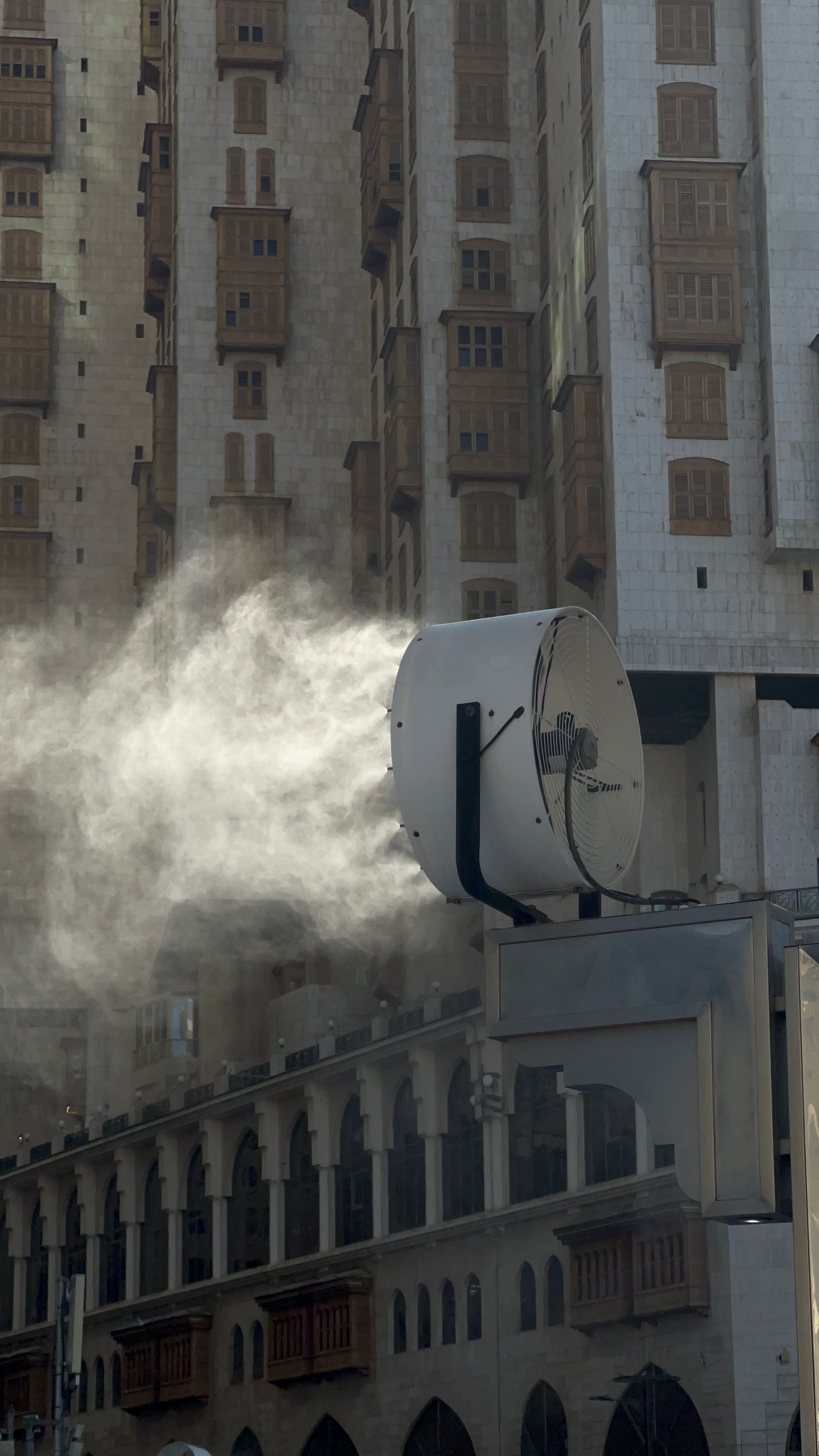
Cubic feet per minute measures how much air a fan moves, not how much cooling actually reaches you, which depends on how much of the mist evaporates before it lands. Ryobi’s cordless model skips a CFM figure entirely and leans on its 175-square-foot rating and battery runtime instead, up to 5.5 hours on low with a 2.0Ah pack, per its Home Depot listing. NewAir’s 1,600 CFM and the Big Ass Fans PowerCool’s larger footprint both lead with airflow numbers, but neither converts directly into a guaranteed temperature drop outdoors, where humidity swings the result more than the fan spec sheet ever will.
Water Source Changes What You’re Actually Buying
How a fan gets its water matters as much as how it sprays it. Ryobi’s unit runs off a garden hose or a 5-gallon bucket with no internal tank, so it never runs dry mid-gathering. Big Ass Fans’ PowerCool carries its own 15-gallon reservoir good for roughly 12 hours before refilling, useful where there’s no hose bib nearby, and also most of what you’re paying for at that price point once you account for the commercial-grade pump and nozzle array behind it.
Evaporative Cooling Has Real Limits
The Department of Energy notes that evaporative cooling can drop air temperature 15 to 40 degrees Fahrenheit in low-humidity climates, and that evaporative systems use about a quarter of the energy and roughly half the install cost of central air conditioning, per its Energy Saver guidance. Those figures describe whole-house evaporative coolers rather than patio misting fans, but the underlying physics scales down the same way: less humidity in the air means more evaporation, and more evaporation means a bigger temperature drop. That range collapses fast in a humid climate, which is the honest asterisk on every misting fan’s coverage claim, regardless of price.
Price Scales With Reservoir and Pump, Not Magic
Once you line the three units up, the price curve makes more sense than it looks at first glance. Ryobi’s $99 fan has no tank, no dedicated pump beyond what a garden hose already provides, and a battery motor built for a handful of hours at a time. NewAir’s $149.99 model steps up to a full 1,600 CFM pedestal motor and oscillation hardware, still hose-fed. Big Ass Fans’ PowerCool carries its own reservoir, a commercial-grade misting pump capable of pushing water through fine nozzles for 12 straight hours, and a build designed for restaurants and event venues rather than one backyard. You’re not paying nearly 40 times more for the same fan with a fancier badge; you’re paying for a completely different duty cycle.
None of these manufacturers publish gallons per hour as a headline spec, which is arguably the number that would tell you the most about how a misting fan actually performs. Until they do, coverage area and water source are the two figures worth comparing side by side before price, because a bigger price tag mostly buys a bigger reservoir and a wider spray pattern, not a fundamentally different cooling trick.
Leave a Reply