
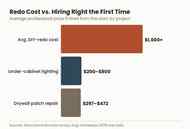
Nearly half of DIY homeowners, 46%, eventually hire a professional to redo work they attempted themselves, and that redo costs more than $1,600 on average, according to a national Sears Home Services survey covered by Apartment Therapy. That number is worth sitting with, because $1,600 isn’t the cost of the original project. It’s the cost of undoing a mistake and then paying to do the job correctly, on top of whatever materials and time already went into round one. For a lot of common weekend projects, that redo fee alone is more than a licensed pro would have charged to do the work right from the start. The gap between “I’ll save money doing this myself” and what actually happens is where a huge amount of home-improvement spending quietly leaks out.
Where the Trouble Starts
The Sears survey identified specific projects with unusually high failure rates: under-cabinet lighting installation, drywall work, and deck waterproofing came up repeatedly as jobs homeowners attempted and then had to call in a professional to fix. These aren’t exotic, high-skill projects. They’re exactly the kind of thing a home-improvement show makes look like an afternoon task, which is part of why people underestimate them. Wiring under-cabinet lights wrong can mean redoing the electrical connection entirely; a botched drywall patch often means cutting out a bigger section than the original hole; failed deck waterproofing can let water into framing before anyone notices.
The Math That Makes DIY Backfire
Here’s where the $1,600 figure becomes genuinely painful. A professional under-cabinet lighting installation costs $200 to $800 nationally, averaging around $400, according to Angi’s 2026 pricing data. A basic drywall repair runs $297 to $472 for professional labor and materials, per Homewyse’s cost calculator. In both cases, the average DIY-correction fee reported by Sears exceeds what hiring a pro from day one would have cost, sometimes by three or four times over. That’s not a rounding error. It means a meaningful share of DIYers are paying full DIY costs, full failure costs, and full professional-correction costs, stacked on top of each other, for projects that would have been cheaper to hand off from the start.
Why Homeowners Keep Trying Anyway
None of this means DIY is a bad idea across the board. Painting, shelf and mirror installation, basic flooring and tile work, and faucet replacement showed strong success rates in the same Sears data, and those remain reasonable places to save real money without much downside risk. The failure cluster tracks closely with jobs that look simple but hide a skill or code requirement most people don’t know exists until they’re mid-project: matching drywall texture, wiring to code, or sealing a deck against actual weather exposure rather than a garden hose test. Nearly 60% of homeowners had taken on some kind of home project since the pandemic began, per the same survey, which means a lot of people are testing their limits on jobs they’ve never attempted before, without always knowing which category theirs falls into.
The Confidence Gap Is the Real Signal
The same research found wide swings in homeowner confidence by task: 55% lacked confidence running a gas line, 47% doubted their ability to handle roof repair, and 44% weren’t sure about installing new windows, all appropriately cautious given the stakes if those jobs go wrong. Under-cabinet lighting and drywall patching don’t inspire the same hesitation, which is exactly the problem. Low perceived difficulty is a worse predictor of DIY success than actual difficulty, because it’s the projects people feel confident about that they attempt without research, backup materials, or a plan B if the first attempt doesn’t hold.
There’s also a financial-stress angle a separate Hippo Insurance survey makes hard to ignore: 54% of respondents said their DIY mistakes led to financial issues significant enough that they needed help covering the cost, and among homeowners who caused property damage through a DIY error, 38% ended up paying $500 or more just in repairs, on top of whatever the original project itself cost. Stack a failed attempt, a $500-plus repair bill, and a $1,600 average correction fee on top of each other, and a project that started as a money-saving weekend job can end up costing more than a full-service remodel on the same room would have.
None of this is an argument for calling a contractor every time. It’s an argument for knowing which category a given project falls into before starting. The fix costs less than the redo, and the redo costs less than the redo-plus-water-damage version of the same story, which is where a surprising number of these projects seem to end up.
The pattern across this data isn’t that homeowners are bad at home improvement. It’s that the projects most likely to end in a $1,600 correction fee are precisely the ones that look easy enough to skip the research step, while the genuinely hard jobs, the gas lines and roof work, get treated with the caution they deserve.
Leave a Reply