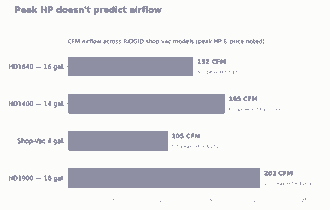
A RIDGID shop vac rated at 7.0 peak horsepower moves 202 cubic feet of air per minute. A RIDGID shop vac rated at 5.0 peak horsepower, sold in the exact same 16-gallon tank size, moves 132 CFM — and costs roughly a third as much. Both numbers come straight from RIDGID’s own product specifications, and together they expose the trap in shop vac shopping: peak horsepower is the number printed biggest on the box, and it’s the number least connected to how well the vacuum actually performs in a garage. If you’ve ever bought a “bigger” shop vac and wondered why it didn’t feel dramatically more powerful than the old one, this is probably why.
Peak horsepower measures the motor’s ceiling, not your daily use
Peak HP is a momentary, unloaded measurement — the maximum output a motor can theoretically hit for an instant, disconnected from the hose, filter, or attachment actually restricting airflow during real use. It’s a standardized figure manufacturers are allowed to advertise, but it’s also the easiest one to make look impressive on a spec sheet, since a shopper standing in a store aisle has no way to verify it against how the machine will actually feel pulling debris through a hose.
CFM airflow is what tells you how fast debris actually moves
Cubic feet per minute measures the real volume of air moving through the hose, which is the number that actually determines how quickly a vacuum clears sawdust, water, or gravel off a garage floor. Across RIDGID’s own lineup the pattern holds up: the 14-gallon HD1400, rated at 6.0 peak HP, moves 165 CFM, while the 16-gallon HD1900 at 7.0 peak HP moves 202 CFM. A comparably-priced Shop-Vac-brand 4-gallon unit rated at 5.5 peak HP manages only 105 CFM, which shows peak HP ratings don’t even compare cleanly across brands, let alone models within the same brand’s lineup.
Tank capacity is a completely separate decision from power
Buyers often assume a bigger tank means a stronger vacuum, but RIDGID’s own 16-gallon lineup proves that assumption wrong on its face: the HD1640 and HD1900 share an identical 16-gallon tank while differing by 70 CFM and roughly $150 in price. Tank size should be chosen around how often you’re willing to stop and empty it — a small garage doing quick cleanups doesn’t need 16 gallons any more than a job site clearing a flooded basement needs a 4-gallon unit — not around any assumption about how much suction it implies. A bigger tank also means a bigger, heavier machine to drag across the garage floor and store on a shelf, which is its own real cost even when the price tag looks like a bargain.
What this means for actually choosing one
For garage-scale work — sawdust, workbench debris, the occasional spill — a mid-range CFM rating somewhere in the 130 to 170 range, like RIDGID’s HD1640 or HD1400, covers nearly everything a homeowner will throw at it, and the roughly $60 HD1640 outperforms its price tag by a wide margin. Save the 200-plus CFM, higher-amperage units for water extraction, construction cleanup, or anyone regularly running long hose extensions, where the extra airflow actually gets used rather than just sitting unused on a spec sheet. Amperage is worth a glance too: RIDGID’s higher-CFM models draw noticeably more current, in the 14-amp range versus under 8 amps on entry models, which matters if you’re running one off a shared garage circuit alongside other tools.
Filters and attachments change the real-world number too
None of these CFM figures account for what happens once a filter, hose, and attachment are actually installed — a fine-dust filter rated for drywall dust restricts airflow more than an open mesh filter built for wet pickup, and a long or narrow hose extension bleeds off suction before it ever reaches the nozzle. Manufacturer CFM numbers are measured at the motor, not at the tip of whatever attachment you’ve got on, so a vacuum’s real-world performance in your garage will always sit somewhat below its spec-sheet number no matter which model you buy.
The number worth shopping on was never the one printed largest. CFM tells you what a shop vac will actually do, price tells you what a marketing department wants noticed first, and matching the tank to the mess you actually make is the one part of this decision that doesn’t cost anything extra to get right.
Leave a Reply