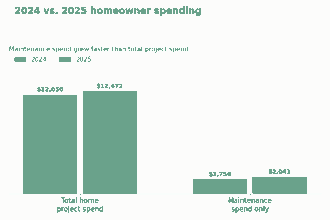
The average U.S. homeowner spent $2,041 on home maintenance in 2025, up from $1,750 the year before — a 16.6% jump in a single year, according to Angi’s State of Home Spending Report, released in January 2026. That’s not a rounding artifact from a thin sample; it’s the headline number from a report tracking what homeowners nationally actually spent, not what they said they planned to spend. Total home project spending — maintenance plus everything else, from remodels to emergency repairs — rose a comparatively modest 3.5% over the same period, from $12,050 to $12,472. The gap between those two growth rates is the real story here: maintenance is eating a bigger share of the average homeowner’s budget than it used to, and it’s worth understanding why the “keep the house running” category is outpacing the “make the house better” category.
Households are doing more projects, not just paying more per project
Part of the increase is volume. The average household completed 10 home projects in 2025, up from nine in 2024, according to the same report, as cited in Angi’s 2026 project rankings. More projects generally means more of the routine, unglamorous kind — gutter cleaning, HVAC servicing, appliance repair — layered on top of whatever bigger renovation a household might also be tackling that year. That alone would nudge maintenance spending upward even before accounting for whether prices for labor and materials moved at all.
Millennials are driving spending harder than any other generation
Millennials posted the highest total home spending of any generation, averaging $14,199, and the highest maintenance spending specifically at $2,601 — well above the $2,041 overall average — per the Angi report. That skews toward a generation that bought older starter homes and first homes during a tight, competitive market over the past several years, which tends to produce more deferred maintenance surfacing all at once rather than a steady trickle of small, manageable fixes spread over decades of ownership.
The increase likely reflects materials and labor catching up, not just bigger jobs
The report doesn’t break out precisely how much of the $291 per-household jump traces to materials costs, labor rates, or homeowners finally addressing repairs they’d been putting off, but the combination lines up with what’s been happening in construction-adjacent labor markets generally: skilled trade wages have continued climbing, and materials used in routine maintenance work — roofing components, HVAC parts, plumbing fixtures — haven’t gotten any cheaper. A homeowner doing the exact same gutter-cleaning-and-furnace-tune-up routine as the year before is very plausibly paying more this time for identical work performed by the same type of contractor.
What it means for the DIY-versus-hire decision
A 16.6% jump in a single year is exactly the kind of shift that pushes more homeowners toward tackling maintenance themselves rather than calling a pro for every task on the list. Jobs like gutter cleaning, caulking around windows and tubs, replacing HVAC filters, and minor drywall patching stay well within reach of a homeowner with basic tools, and doing even two or three of the smaller items on that annual list yourself can offset a meaningful chunk of the $291 increase. The math tends to favor DIY hardest on labor-heavy, low-skill tasks — exactly the ones driving the rising bill in the first place — while anything touching gas lines, electrical panels, or structural repairs still belongs with a licensed pro regardless of what the spending trend suggests.
What counts as “maintenance” is broader than it sounds
The category behind that $2,041 figure isn’t glamorous work. It typically covers HVAC servicing and filter changes, gutter and downspout cleaning, roof and siding upkeep, plumbing fixture repairs, pest control, water heater flushing, and appliance repairs — the recurring, calendar-driven tasks that keep a house from developing bigger problems rather than the one-time projects that change how a house looks or functions. That distinction matters for the spending trend: a remodel is optional and can be delayed a year without consequence, but skipping an HVAC tune-up or gutter cleaning tends to just push the cost into next year’s budget with interest, in the form of a bigger repair once something finally fails.
Put the pieces together and maintenance spending isn’t rising because homeowners are pampering their houses more. It’s rising because the baseline cost of just keeping a house functional went up, and more households are running that baseline more often — a less exciting story than a kitchen remodel, but a far more universal one, and one that rewards whoever’s willing to pick up a caulk gun before hiring it out.
Leave a Reply