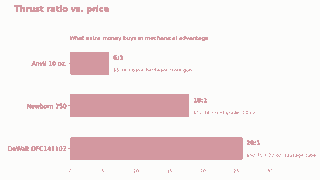
A basic hardware-store caulk gun and a contractor-grade one do the exact same physical job — pushing sealant out of a tube — but one does it with roughly four times the mechanical leverage. An Anvil 10-ounce caulk gun sold at Home Depot for $5.98 carries a 6:1 thrust ratio. A DeWalt DFC141102, at $50.75, carries a 26:1 ratio — more than four times the leverage for roughly eight times the price. Whether that trade is worth it depends entirely on what’s being squeezed out of the tube, and how many tubes are getting squeezed in one afternoon.
Thrust ratio is a real mechanical measurement, not marketing fluff
The number describes the gear or lever ratio between how far the trigger travels and how far the plunger rod advances into the cartridge — a higher ratio delivers more force to the sealant per trigger pull, according to Newborn’s own explainer on caulk gun thrust ratios. That translates into two practical things: how much hand fatigue builds up dispensing a full tube, and how well the gun handles thick, cold, or high-viscosity material that a low-ratio gun struggles to push through at all.
The middle tier exists for a reason
Between the $6 hardware-store gun and the $50 contractor tool sits something like the Newborn Model 250, priced at $32.34 with an 18:1 ratio, built specifically for heavy-bodied sealants and structural adhesives rather than ordinary latex caulk. It’s a genuine middle ground: enough leverage to handle serious construction adhesive without needing the rotating barrel, sausage-tube compatibility, and heavier metal frame that pushes the DeWalt into full job-site territory.
Where the $50 gun actually earns its price
The DeWalt’s 26:1 ratio and 20-ounce sausage-tube compatibility matter most for high-volume or heavy-material work — sealing an entire building envelope, running large beads of construction adhesive all day, or working outdoors in cold weather when sealants stiffen and resist an easy trigger pull. For that kind of repeated, physically demanding use, the extra leverage isn’t a luxury; it’s what keeps a contractor’s hand functional by three in the afternoon on a job that started at seven in the morning.
Where the $6 gun is genuinely the right call
For one bathroom re-caulk a year, a 6:1 ratio isn’t a compromise — it’s simply proportionate to the job. A homeowner running a single 10-ounce tube of silicone around a tub isn’t fighting cold weather, isn’t running twenty tubes back to back, and won’t notice any difference in leverage because there isn’t enough total work happening for it to register. Buying the $50 gun for that one job is spending contractor money on a homeowner’s afternoon, and the money would do more good going toward better-quality caulk instead of a better gun.
Drip control matters as much as raw thrust
Thrust ratio gets the attention, but the smooth-rod, drip-free design built into even the cheapest guns — including that $5.98 Anvil model — matters just as much for a clean bead as raw force does. A gun with poor pressure release keeps pushing sealant out for a second or two after the trigger is released, which is what causes the blobbing and overshoot that ruins an otherwise careful caulk line, regardless of how many pounds of force the mechanism can generate.
Cartridge compatibility narrows the choice fast
Before thrust ratio even enters the decision, cartridge size rules out options: standard 10-ounce tubes fit the Anvil and the Newborn 250, while the DeWalt’s sausage-tube design handles 20-ounce cartridges that hold roughly twice the material per reload. That matters for anyone doing enough caulking in one sitting that reload frequency itself becomes a time cost — fewer reloads per project is a real efficiency gain independent of trigger-pull force, and it’s a big part of why sausage-tube guns show up on job sites even when a crew doesn’t strictly need the extra thrust ratio that typically comes bundled with that format.
Thrust ratio, like most tool specs, only becomes a real decision once it gets multiplied by volume — the same 20-point gap between a $6 gun and a $50 one that’s irrelevant for a single tube becomes the entire point of the purchase once someone’s on their tenth tube of the day.
Leave a Reply