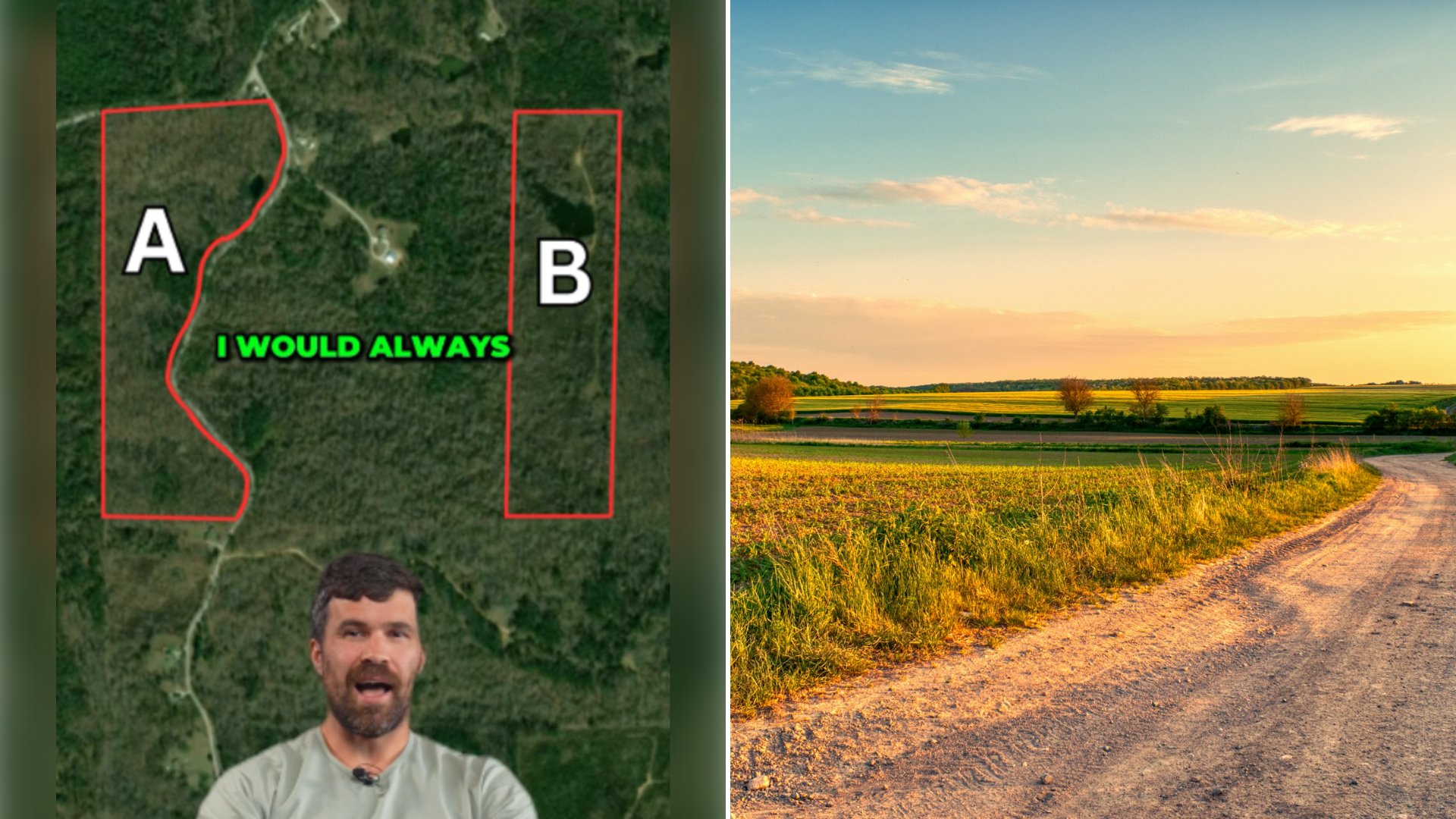
“I would always buy this property and never buy this property,” Ron Apke says, pointing at a satellite map with two red outlines on it, one marked A and one marked B. In the 48 second video, posted September 5, 2026 to his TikTok account @ron_apke with the caption “I would never buy this piece of land,” he admits the two look “super similar.” They’re both about 40 acres, he says, and “right next to each other.” His point is about one thing you cannot see from above.
“What if you spent tens of thousands of dollars on a piece of land just to find out that you can’t do anything on the property?” he asks, over clips of a wooded lot and a green clearing. Then he walks through both parcels on the map.
Property A, he says, is “nice wooded land with almost 2,000 feet of road frontage.” On the map, a county road curves along one whole side of the red outline. Property B is a long, narrow rectangle with a small pond inside it, and he says it “looks like really good land based on satellite images.” A pale dirt track runs from a paved road at the top of the frame, past a building, and down into the parcel; he traces it in yellow. “You might think this dirt road here is how you would get to the land,” he says. “But just because a property looks like it has access does not make it true.”
“I did some digging,” he says, “and found out that this dirt road is not legal access, nor is it a legal easement. It’s just a homemade dirt path.” The video circles the track in red, then switches to a map with parcel lines drawn over it, showing property B boxed in by neighboring lots on every side. That, he says, means “property B is landlocked and you can’t even access it.” He does not say what county or state the land is in, or what records he checked; the finding is his. “This is why I would always buy property A and not property B.”
How a Texas A&M Guide Describes Easements
Apke draws his line between a road you can see on a satellite image and what he calls “legal access” or “a legal easement.” Property A, with its road frontage, has the access he wants; property B, on his account, has only a homemade track. The video does not say where the land is, so the easement rules below come from a Texas source and are shown only as one state’s example.
Texas A&M AgriLife Extension’s Easements 101 guide, written for Texas landowners, describes an easement as a means by which a landowner grants another person the right to use the owner’s land. The guide calls an express easement one the landowner affirmatively grants and says it should be put in writing and recorded in the county deed records, adding that the cost of drafting and recording one will likely be minuscule next to the cost of trying to prove an implied easement in court. For an easement by necessity, according to the guide, three things must be proven: the landlocked tract and the tract crossed were once owned by the same person, the access claimed is a necessity and not a mere convenience, and that necessity existed when the parcels were split. The guide puts the bar for a prescriptive easement in Texas at no less than 10 years of use that was open and notorious, continuous, exclusive and adverse, and it advises working with an attorney familiar with these issues. Apke’s finding on property B is that its dirt path is “not legal access, nor is it a legal easement.”
What a Texas Land Purchasing Checklist Says About Access
Apke’s warning starts with a satellite image and ends on a map with parcel lines drawn over it, the view that shows property B boxed in by other lots. Texas A&M AgriLife Extension’s Texas Rural Land Purchasing Checklist, published in May 2026, says “access to public roads, emergency services, and utilities should also be considered” when a buyer weighs a tract’s location. In its list of red flags for first time buyers, the checklist says buyers should “proceed with caution if they encounter unclear or disputed legal access,” and it names “undisclosed easements” among the other warning signs.
On title, the same checklist says buyers should “examine ownership history, deed restrictions, easements, liens, leases and property tax status,” and that “Title insurance can help reduce ownership risk.” The American Land Title Association’s 2021 Owner’s Policy, as filed with the Florida Office of Insurance Regulation, lists “No right of access to and from the Land” among its covered risks, while matters listed as exceptions in its Schedule B are not covered.
The checklist says “A current survey is strongly recommended,” naming legal access and the presence of any encroachments or rights of way among the things a survey should confirm, and it adds that “Pressure to waive inspections, surveys, or title review should also prompt careful reconsideration.” It also calls working with an attorney licensed in Texas to review and draft land documents “highly recommended.”
Leave a Reply