A Seattle-area real estate agent is pulling back the curtain on one of the city’s most distinctive listings: a mid-century modern home built in 1957. In a recent video, @paul_rosales_realestate walks through the property’s low-slung rooflines, walls of glass, and a landscaped yard filled with mature Japanese maples, stacked stone walls, and winding garden paths that look like they were lifted straight out of a mid-century design magazine.
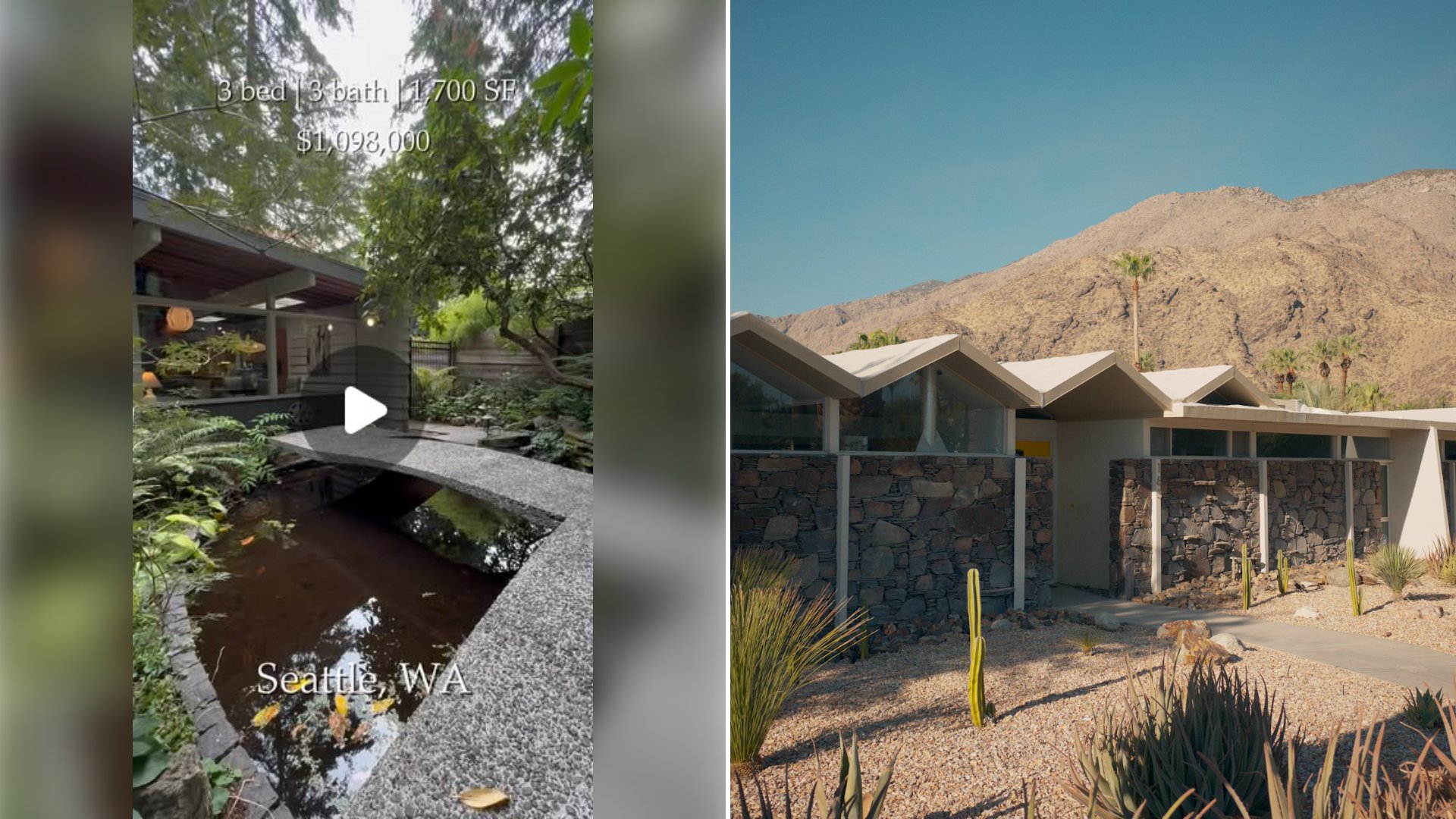
The agent lingers on the details that made homes like this one special in their era: floor-to-ceiling windows that blur the line between indoors and out, clean horizontal lines instead of ornate trim, and an open floor plan built around how a family actually lives rather than how a house is supposed to look from the street. The landscaping gets equal billing in the video, with the stone retaining walls and layered plantings treated less like an afterthought and more like a second architectural statement wrapped around the house.
Homes from this era are having a real moment again, and not just because they photograph well for social media. Mid-century modern design emerged in the decades after World War II, driven by architects who wanted to move away from the heavier, more formal styles that had dominated American homebuilding for generations. The Pacific Northwest became one of the style’s strongholds because its climate and geography were almost perfectly suited to the philosophy: abundant natural light to chase during gray winters, dramatic topography to build into rather than flatten, and a regional building culture that already prized natural materials like wood, stone, and glass.
Seattle in particular has a well-documented mid-century modern architectural legacy, with homes from this period concentrated in neighborhoods that were being actively developed through the 1950s and 1960s as the city’s population and economy grew around aerospace and shipping industries. Many of these homes were designed by regional architects working in a loosely shared style sometimes called Northwest Regional or Northwest Modern, which blended the clean geometry of broader mid-century modernism with material choices and siting decisions suited to rain, evergreens, and hillside lots.
What makes a listing like this one stand out in today’s market is scarcity. A huge share of mid-century homes have been altered over the decades, with original windows swapped for standard replacement units, open floor plans chopped up for resale appeal in different eras, and landscaping replaced entirely as properties changed hands. A home that still has its original architectural bones, intact glazing, and a garden that reads as a deliberate design rather than a patchwork of decades of different owners is genuinely rare, and buyers who specifically seek out this style know it.
That rarity has translated into real market demand. Real estate agents and preservation-minded buyers in cities with strong mid-century modern inventory, including Seattle, Palm Springs, and parts of Southern California, have reported that well-preserved examples routinely draw premium interest compared to homes of similar square footage built in other eras, simply because so few remain unaltered. Architectural and historic preservation groups in several cities have gone as far as creating specific survey programs to document surviving mid-century modern homes before more of them are renovated beyond recognition.
The landscaping shown in the video is its own piece of that preservation story. Japanese maples and stone hardscaping were common choices in mid-century Pacific Northwest design because they fit the era’s broader fascination with Japanese and Scandinavian design principles, both of which emphasized natural materials, asymmetry, and a sense of calm restraint rather than showy ornamentation. A mature Japanese maple canopy and a stacked stone wall take decades to establish properly, which is part of why landscaping like this reads as such a selling point rather than a simple yard upgrade; it genuinely cannot be recreated quickly no matter how large a renovation budget a new owner has.
For buyers scrolling past dozens of generic flips and new-construction listings, a home like this one offers something different: proof that a specific design philosophy, built around light, materials, and a relationship to the landscape, can still feel completely livable nearly seventy years later. Whether this particular listing finds a buyer who wants to preserve it exactly as is or one who sees it as a foundation to build on, the attention the video is getting is a reminder that good design ages very differently than trend-driven renovations do.
More from Willow and Hearth
- Homeowner Who Calls Her 90s House Boring Whitens the Brick Front, Adds a Timber Covered Porch and Lays a Herringbone Brick Floor in a Three Minute Time Lapse
- Buyers of Knockderry Castle in Scotland Open Their Restoration Series by Asking What They Have Done, Then Show Scaffolding, Carved Woodwork and a Sealed Envelope
- Idaho Builders Show a Grain Bin in a Dry Open Field Becoming a Finished Home With Tall Windows, a Loft Staircase and a Bedroom in 11 Seconds
Leave a Reply