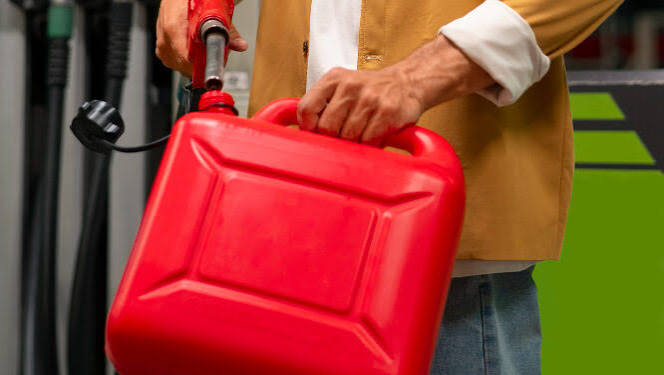
Sunnyside Corporation is recalling about 960 gallon-size 1-K kerosene heater and appliance fuel containers from batch 26082 because they were built without a required flame-mitigation device, according to a recall notice the Consumer Product Safety Commission posted August 13, 2026. The containers sold for roughly $13 at Amazon and Do It Best stores between May and July 2026, and the missing part isn’t cosmetic. Without it, a stray spark near the spout can flash back into the container and ignite the vapor inside, turning a one-gallon jug into something closer to a pipe bomb. No injuries have been reported yet, but the recall is a good excuse to explain what’s actually supposed to be inside every fuel can you own, and why so many cheap containers skip it.
What to Check Before You Buy
- Look inside the spout opening for a fine metal mesh screen. You should be able to see or feel it just past the pour point.
- Confirm the container is labeled for the specific fuel — kerosene, gasoline, or diesel — and never repurpose one type for another.
- Check for a child-resistant closure that requires a squeeze-and-turn or push-and-turn motion, not a simple twist cap.
- Look for compliance markings referencing ASTM F3326, ASTM F3429, or UL 30 on the packaging or molded into the container itself.
- Buy from a retailer that still carries the manufacturer’s original box, since loose or bulk-bin containers are more likely to be recalled stock or gray-market imports.
What a Flame-Mitigation Device Actually Does
A flame-mitigation device, most commonly a flame arrestor, is a fine wire mesh screen installed inside the spout or fill opening. It works on a simple principle of heat dispersion: flame can’t sustain itself through gaps small enough that the surrounding metal absorbs and scatters heat before combustion carries through to the other side. So if a container sits near a grill, a lit cigarette, or a spark from a lawnmower, the screen keeps that ignition from traveling backward into the bulk fuel and vapor pooled just inside the opening. Without it, vapor near the spout can ignite and flash back in a fraction of a second, and the resulting pressure release is what causes the “blowtorch” burn injuries the CPSC has documented for years.
This isn’t a new idea the agency invented for this recall. The Commission made flame-mitigation devices a mandatory requirement for essentially all portable fuel containers sold in the U.S. starting in 2023, following years of emergency-room data showing thousands of burn injuries annually tied to gas cans and similar containers, largely from backyard fires and refueling accidents near heat sources. The rule, detailed in the CPSC’s 2023 rulemaking announcement, adopted existing voluntary industry standards and made them legally enforceable. The underlying regulation now lives in the Portable Fuel Container Safety Act regulation at 16 CFR Part 1461, and any container sold without meeting it is noncompliant by definition and subject to recall, which is exactly what happened with the Sunnyside batch.
Reading the Container Before You Buy It
Don’t take a manufacturer’s word for it. Tip the container toward a light source and look down the spout; the mesh should be visible a short distance in, not buried so deep you can’t confirm it exists. If you’re buying online rather than off a shelf, check listing photos for an actual view into the spout opening, and skip listings that only show the exterior. A legitimate fuel-type label matters just as much as the screen. Kerosene containers are typically blue, gasoline cans red, and diesel cans yellow, though color alone isn’t a substitute for reading the printed label, since off-brand containers don’t always follow the convention. Never store kerosene in a container labeled or previously used for gasoline, and never do the reverse. The two fuels have different vapor pressures and volatility, and cross-contamination changes how the fuel behaves around heat.
Storing Fuel Ahead of Heater Season
With kerosene heater season approaching, store filled containers outside the living space entirely, ideally in a detached shed or garage rather than a basement or an attached garage that shares airflow with the house. Keep containers away from water heaters, furnaces, and anything with a standing pilot light, since fuel vapor can travel along the floor toward an ignition source well before you’d smell a leak. If you run a kerosene heater indoors, the CPSC’s kerosene heater safety guidance recommends cracking a window about an inch or leaving an interior door open to the rest of the house any time the unit is running, since these heaters vent combustion byproducts into the room instead of outside. Refuel only after the heater has been off long enough to cool completely, and always refuel it outdoors.
A Safety Note Before You Head Out
If you already own a fuel container and the pour seems slow, don’t remove or puncture the mesh screen to speed it up. That screen is the flame-mitigation device this entire recall is about, and disabling it turns a compliant container into exactly the hazard the CPSC pulled these Sunnyside units for. If your container matches batch 26082, stop using it, mark it “RECALLED” in permanent marker, photograph it for the manufacturer, and dispose of it through your local hazardous-waste program rather than pouring the fuel into a different can.
Leave a Reply